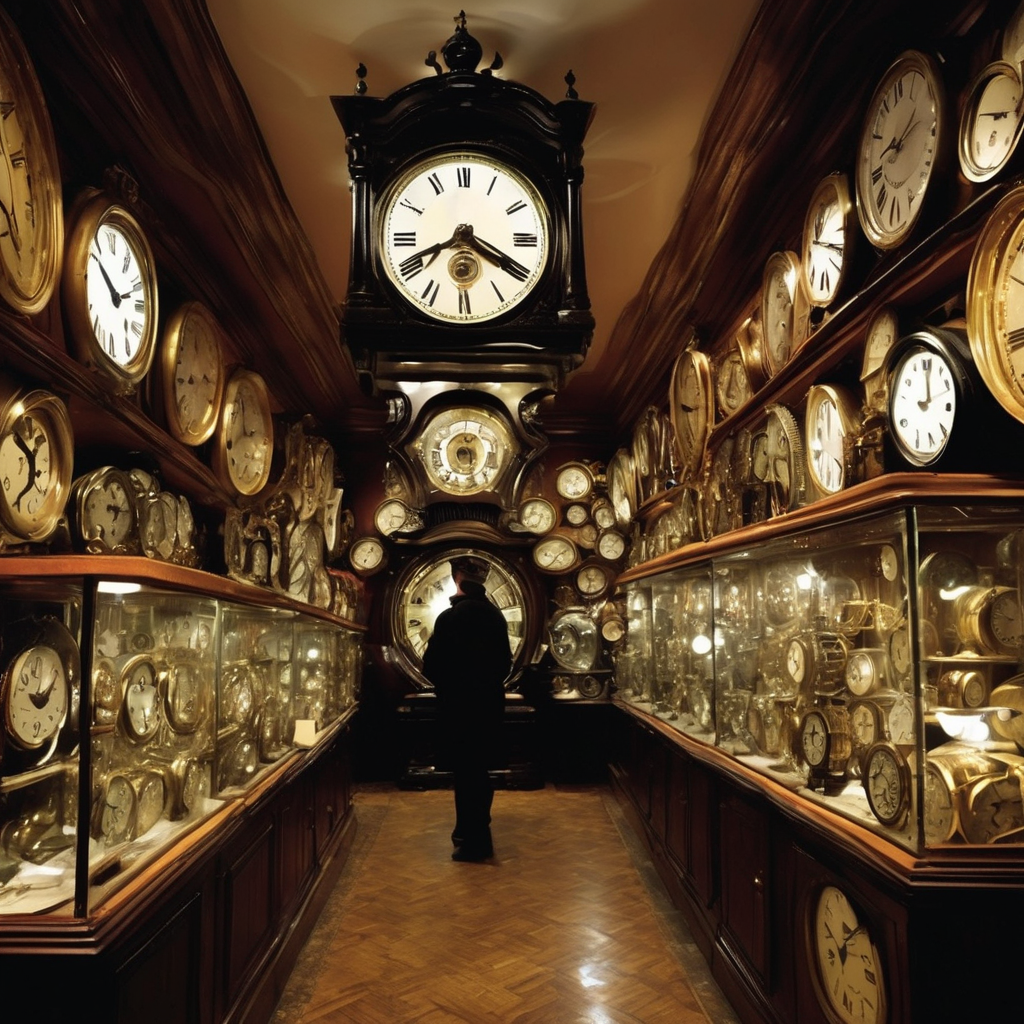
The old clockmaker had been dead for three years when his shop began chiming at impossible hours. Thirteen strikes at midnight, when all his clocks had only twelve numerals. The sound drew crowds to the narrow street in Prague’s lesser quarter, where frost collected on windows like crystallized whispers.
Mila arrived on the winter solstice, her sustainable wool coat threadbare at the elbows, carrying only a leather satchel and her grandmother’s diary. The shop had been left to her—a peculiar inheritance from a great-uncle she’d never met. The neighbors watched from behind curtains as she turned the tarnished key.
Inside, hundreds of clocks lined the walls, their faces reflecting the dim afternoon light like so many moons. But they were all stopped at different times, creating a cemetery of frozen moments. At the workshop bench, she found his final creation: a clock with thirteen hours marked in symbols she couldn’t read, its hands moving backward.
The diary fell open to a page her grandmother had marked with a pressed violet. “Your uncle learned the old ways,” the spidery handwriting revealed. “Before algorithms and metrics, before influencers sold time in thirty-second intervals. He knew that time could be folded, stretched, even flavored like honey.”
That night, Mila wound the thirteen-hour clock. The shop filled with the scent of cardamom and old snow. At the thirteenth chime, the walls became transparent, revealing not the Prague street outside but a vast ballroom where dancers moved in reverse, their gowns unraveling into threads of light.
Her great-uncle stood at the ballroom’s edge, young again, holding a clock that pulsed like a heart.
“You came,” he said, though his lips moved before the words reached her. “Time is collapsing. The world speeds forward so fast now—everyone consuming moments like a competitive sport, posting their lives before living them. But here, in the thirteenth hour, we can slow it all down.”
He handed her the heart-clock. Inside its crystal case, she saw her grandmother as a girl, dancing with a man whose face was kind. She saw herself at seven, reading under an apple tree. She saw futures that might have been—a daughter she’d never had teaching her to paint, a love she’d let go returning with winter roses.
“The thirteenth hour exists between heartbeats,” her uncle explained. “It’s where lost time goes. But someone must tend it, or it will overflow into the world, and all of time will run backward.”
Mila understood. In a world obsessed with productivity and speed, someone had to be the keeper of the slow moments, the guardian of pause. She accepted the heart-clock, feeling its warm weight.
When she returned to the shop, dawn was breaking. The neighbors found her arranging the clocks, setting each one to a different time zone—not of places, but of feelings. Three-fifteen for first love. Seven-forty-two for forgiveness. Eleven-eleven for wishes.
And at midnight, when the thirteenth chime rang out across the lesser quarter, people stopped scrolling, stopped rushing, stopped consuming time like a scarce resource. For one impossible hour, they remembered that time wasn’t a currency or a challenge, but a gift that could be savored like wine, shared like bread, held like a lover’s hand.
The clockmaker’s shop became a pilgrimage site, though city officials could never quite locate it on their digital maps. It existed in the spaces between GPS coordinates, in the pause between breaths, in the thirteenth hour that no algorithm could predict or monetize.
Mila grew old there, teaching apprentices the art of temporal resistance. And when she finally passed the heart-clock to her successor, she whispered the secret her uncle had shared: “Time isn’t running out. It’s running in—into this moment, this breath, this single, perfect chime that contains all the others.”
The shop still stands, if you know when to look for it. Not where, but when. Listen for the thirteenth chime. It sounds like everything you thought you’d lost, waiting patiently for you to find your way back.


Leave a Reply