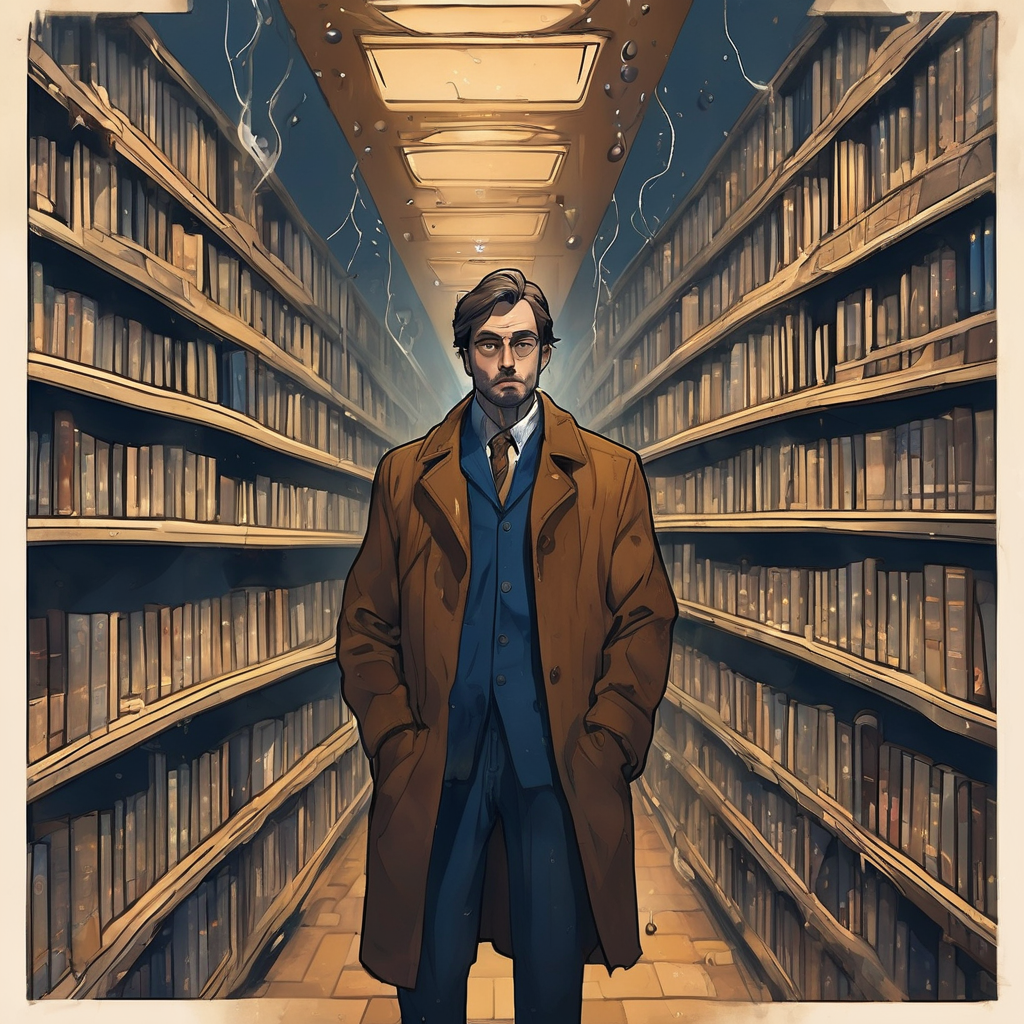
The job was Elias’s strange little side hustle, a position he’d fallen into during a period of deep personal recession. He was a Cataloger, Grade III, for the Bureau of Temporal Reclamation. His work was simple: receive, categorize, and archive.
The Acquisitions team, a rough bunch of ethereal types who moved through the world like drafts under a door, were the ones who did the actual stealing. They harvested seconds. Not just any seconds, but the potent ones, the ones saturated with uncut human emotion. A gasp of pure shock. The three-and-a-half seconds of freefall after a lover says “I love you” for the first time. The infinite, stomach-plummeting second before a car crash.
These moments arrived on Elias’s desk in small, shimmering vitrines, like teardrops of solid light. His job was to grade their purity, their emotional heft, and file them away in the endless, silent stacks of the Great Library. The vitrines were organized by aesthetic. There was the sprawling “nostalgiacore” wing, filled with the amber light of first bicycle rides and the smell of a grandmother’s kitchen. There was a smaller, more intense section for “melancholycore,” all blues and greys, holding moments of watching rain slide down a windowpane while feeling exquisitely, beautifully alone.
Lately, there was a problem. A kind of spiritual inflation. Common joy was cheap, its value diluted by overuse. The Bureau demanded rarer, more complex moments. The supply chain was strained. This new pressure had trickled down from management, who spoke of synergistic outputs and maximizing emotional yield. It felt like the worst kind of hustle culture, bleeding the vibrancy from the world to fill a quota.
Elias had entered his archivist era with a certain professional detachment. It was a job. He clocked in, he sorted the seconds, he clocked out. A quiet quitting of the soul. He didn’t think about the people from whom these moments were plucked, leaving them ever so slightly more faded, more muted, like a photograph left in the sun.
Then he received batch 74-J.
The first vitrine in the batch was different. It wasn’t a grand moment. It held only the feeling of a woman, alone in her apartment, catching a sunbeam on her palm and smiling a small, secret smile. It was a moment of uncomplicated contentment, so pure and genuine it hummed in Elias’s hands. It had no grand narrative, no dramatic weight. It was just… real. He labeled it, following protocol, but he couldn’t shake it.
He began searching for her. He cross-referenced the batch number, a flagrant breach of Bureau policy. He found others. The second she realized she had forgotten her keys and laughed at her own foolishness. The second of relief when a cake she was baking rose perfectly. The quiet satisfaction of watering her plants. Her life, told in stolen, insignificant beats, was more compelling than any epic drama in the stacks. He didn’t know her name, but he started calling her The Sun Catcher.
This obsession, he knew, was probably a bit delulu. His supervisor, a being of dust and regret named Anya, saw the change in him. “Don’t get attached to the inventory, kid,” she rasped, her voice like sandpaper. “It’s a fast track to burnout.”
But attachment was already there, a tiny root in the dry soil of his job. He started noticing the gaps in her timeline. An influx of seconds categorized under “Anxiety, Low-Grade, Persistent.” Then a new acquisition arrived, a high-priority vitrine that pulsed with a cold, dark light. He picked it up, and the feeling that washed over him was not someone else’s. It was his own. A sudden, hollowed-out emptiness. A dread so profound it felt like a physical weight.
This was the second The Sun Catcher learned her mother was gone.
The Bureau had stolen her grief. Not for its sadness, but for its *potency*. They had mined the purest moment of her heartbreak. The thought made Elias physically sick. He looked at his own hands, the hands that would catalog this agony, and felt complicit.
This was no longer a job. This was a violation.
He made a decision. It wasn’t born of courage or a grand plan, but of a simple, gut-level refusal. He would not file this second. He would return it.
He slipped the vitrine of grief into his pocket, his heart thudding a loud, clumsy rhythm against his ribs. He then began to move through the stacks, his movements frantic. He pulled her other seconds: the sunbeam, the forgotten keys, the perfect cake. He was stealing the stolen. Anya watched him from the end of an aisle, her dusty form unreadable. He expected her to raise an alarm, but she simply gave a slow, deliberate nod, then turned and walked away, disappearing into the endless shelves.
Escaping the Bureau was surprisingly easy. They had security against grand assaults, not a single employee walking out the front door with a pocketful of contraband moments.
He found her in the real world. She was greyer than he’d imagined, her movements lacking the quiet vitality he’d witnessed in her stolen seconds. She was a living embodiment of quiet quitting, going through the motions of a life she no longer fully inhabited.
He followed her to a park. He didn’t know how to give the moments back. He couldn’t just hand her a glowing marble of trauma. He watched as she sat on a bench, her gaze distant. A single, perfect autumn leaf detached from a branch above and spiraled down.
This was it. This was the kind of moment that started it all.
Without thinking, Elias stepped forward. He didn’t have the manufactured charm the Acquisitions team used, no spiritual rizz to disarm her. He just had an idea. He reached out and caught the leaf, its edges crisp and crimson.
He walked over to her bench and stood there, silent, until she looked up. Her eyes were tired.
He held out the leaf to her. He didn’t say a word. He just offered it.
She blinked, confused. Then a flicker of something shifted in her expression. She took the leaf. As her fingers brushed his, a tiny, almost imperceptible warmth passed between them. A small, secret smile touched her lips, a ghost of the one he’d seen in the very first vitrine. It was a new second, born of the ashes of an old one.
Elias backed away, a profound understanding settling over him. You couldn’t catalog a life. You couldn’t steal a second, not really. You could only make a new one. He turned and walked away, leaving the Bureau and its endless library behind, feeling the unfamiliar, exhilarating weight of his own unwritten moments, waiting to be lived.


Leave a Reply