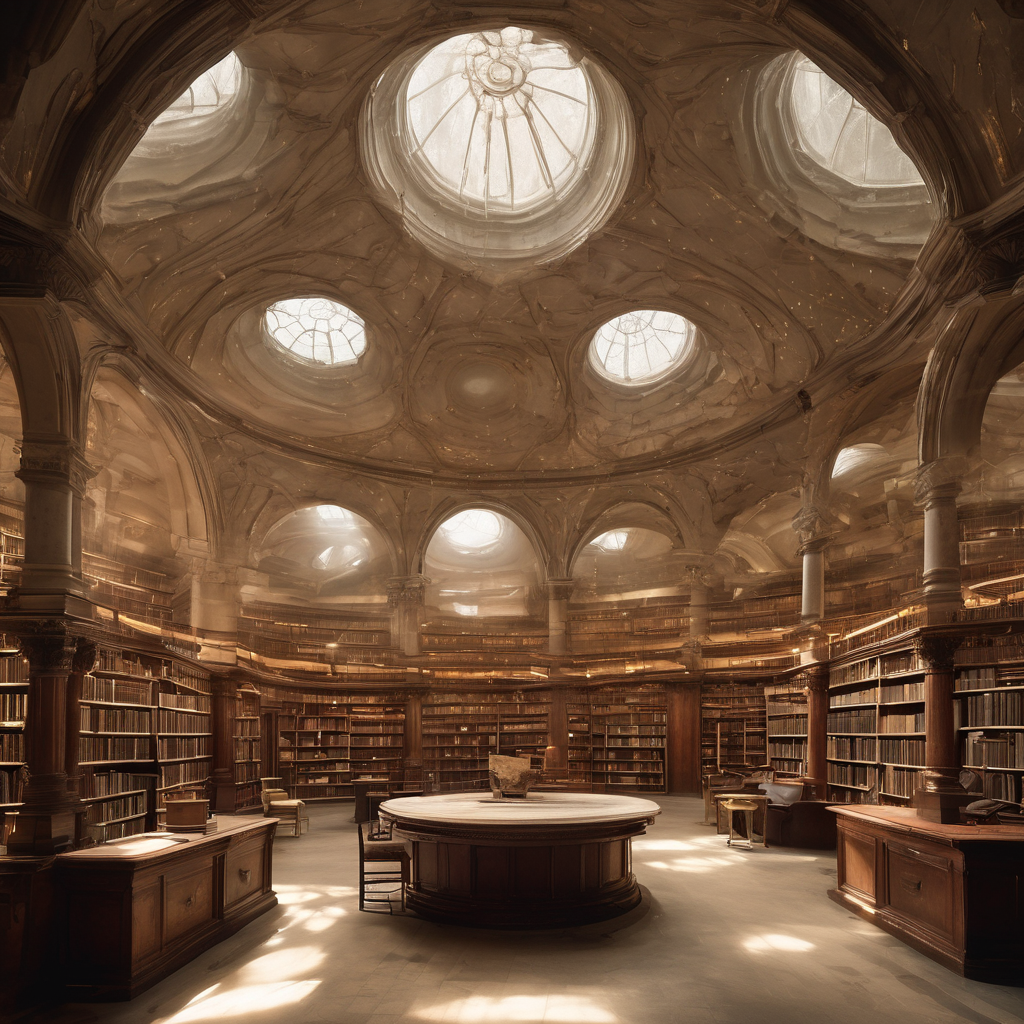
The Athenaeum of Unfulfilled Things was a library of ghosts. Not of people, but of passions. Elara was its sole librarian. Her job was to catalogue the arrivals: the half-written symphonies that arrived as silent, weightless musical scores; the un-carved sculptures that were mere shimmering outlines of marble dust; the unrequited loves that materialized as single, perfect, ice-cold rose petals.
They were the results of what the world above had termed ‘quiet quitting,’ though here it was a far more literal phenomenon. When a person abandoned a deep-seated calling not with a bang but a whimper, a piece of that ambition detached and drifted down to her archives.
For years, the work had been predictable. Elara would find a new echo—a cobbler’s last that smelled of unworn leather, a single sentence from a novel hanging in the air like smoke—and she would record its provenance in her ledger before placing it in its designated alcove. She considered this her ‘curator era,’ a period of peaceful, dusty solitude.
Then came the Great Vibe Shift. The echoes arriving now were different. Sharper. More bitter. They felt less like gentle sighs and more like choked-back screams. And with them, one day, came the Anomaly.
It wasn’t an object or a scent or a sound. It was a sphere of pulsing, pearlescent light, no bigger than a fist, hovering in the center of the main rotunda. It hummed with a low thrum that vibrated in Elara’s bones. It had, for lack of a better term, main character energy. It refused to be shelved.
Her superior, Silas, communicating through a pneumatic tube from a wing of the Athenaeum she’d never seen, was furious. His scrawled notes were dismissive. “A fluke. Nullify it,” one read.
But Elara couldn’t. She was drawn to it. The light felt… aspirational. When she got close, it projected fleeting images onto the cavern walls: a pair of hands stained with paint, a canvas showing a star-drenched sea, the face of a young woman, her eyes wide with a desperate, brilliant hope. This wasn’t the remnant of something given up on. This felt like a pause, a breath held for too long.
“It’s from a painter,” she whispered to the empty hall. “She didn’t quit. She was just… afraid.”
“You’re being delulu,” came Silas’s next message, a direct response to a thought she hadn’t even vocalized. He had his ways. “It’s an echo. It is, by definition, stillborn. Its potential is a phantom limb. Acknowledge the loss and file it.”
But the Anomaly was changing. Its light was warming, its hum developing a complex melody. The other echoes in the rotunda were reacting to it. The silent scores seemed to rustle, the dust-outlines of statues to subtly shift their poses. The sphere had a charisma, a celestial rizz that was waking the dead dreams around it. Elara feared it would either coax them all into a chaotic cacophony or shatter itself from the sheer force of its own contained will.
She knew what Silas would do. He would bring out the Nullifier, a lead-lined box that snuffed out echoes completely. He saw the Anomaly as a threat to their quiet order. Elara saw it as the first thing in a century that wasn’t a failure.
Ignoring the tube that was now spitting out increasingly frantic notes, Elara walked toward the sphere of light. It pulsed wildly, its projected images flashing faster: the woman staring at her blank canvas, a tear tracing a path down her cheek, a vision of the finished painting so beautiful it made Elara’s own heart ache with a forgotten longing.
This was not a stillborn echo. It was a hope in hibernation.
Silas’s heavy footsteps echoed from a distant corridor. He was coming.
Elara made a decision. She wouldn’t try to contain the light. She wouldn’t try to catalogue it. She reached out, not with her hands, but with her own dormant, dusty will. She focused on the painter, on the half-formed starlight on the imagined canvas. For so long, her job had been to accept endings. For the first time, she refused.
She pushed. Not at the sphere, but with it. She gathered all its yearning, its terror and its beauty, and instead of filing it away on a shelf, she flung it back. Not to the woman—that was impossible, the connection was severed—but just… up. Out. A raw, untethered spark of creation cast back into the living world.
The sphere of light dissolved with a final, melodic sigh. The Athenaeum fell silent, the other echoes settling back into their benign slumber. The air was still, but it no longer felt stagnant. It felt clean.
When Silas arrived, breathless and angry, he found only Elara, standing alone in the center of the rotunda. He looked around, his eyes narrowed. “Where is it?”
“It was an echo of a choice not yet made,” Elara said, her voice clear and steady. “I sent it back to be someone else’s.”
He stared at her, utterly baffled, shaking his head at her foolish, romantic notion. But as he looked at the empty space where the light had been, he could still feel a faint warmth, a ghostly trace of its impossible, defiant glow. High above, in a cramped and cold apartment, a young painter who had been packing away her supplies suddenly stopped, picked up a brush, and, for a reason she could not name, began to paint the sea.


Leave a Reply