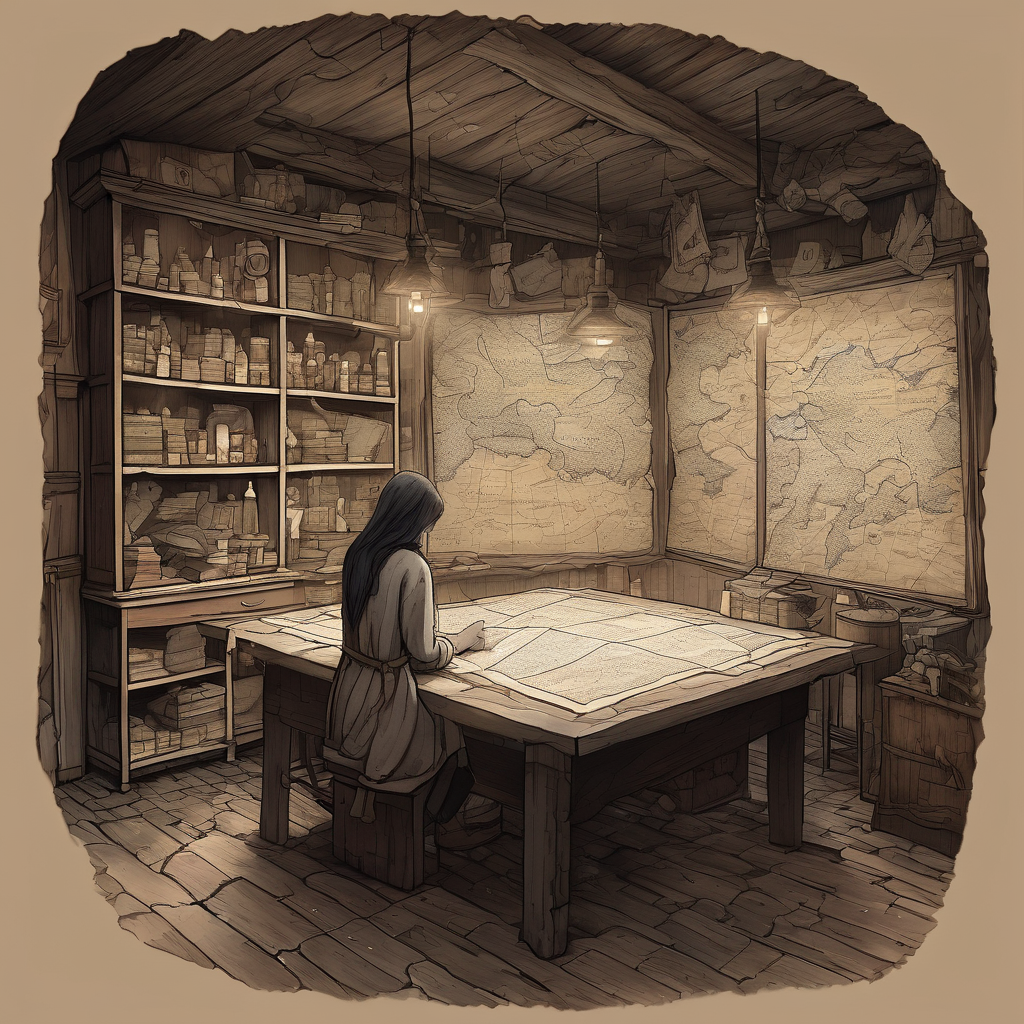
The map appeared on Eliza’s doorstep at exactly midnight, rolled in oiled leather and tied with string that smelled of bergamot and secrets. She hadn’t ordered anything, hadn’t been expecting deliveries, yet there it was—waiting like a patient cat in the November drizzle.
Inside her cramped London flat, she unrolled the parchment across her kitchen table, pushing aside empty takeaway containers and unpaid bills. The map showed her neighborhood, but not as it was. Instead of the gentrified coffee shops and boutique wellness centers that had sprouted like mushrooms after rain, the streets bore different names entirely. Mercy Lane where Thornfield Street should be. The Sanctuary of Lost Things where the artisanal candle shop stood. A great forest labeled “The Grief Woods” sprawling where the shopping complex dominated her daily commute.
Eliza traced her finger along the careful ink lines, noting how her own building was marked simply as “The Seeker’s Rest.” A small notation in flowing script read: “For those who have lost their way in the in-between.”
She’d been feeling precisely that since the divorce papers arrived—suspended somewhere between her old life and whatever came next, like a breath held too long. The sustainable lifestyle she’d cultivated felt hollow now, all those carefully curated choices seeming performative without Marcus there to witness her virtue signaling about farmer’s markets and zero-waste living.
The next morning, she decided to follow the map.
Where it indicated Mercy Lane, she found an actual cobblestone path threading between two buildings she’d passed a thousand times before. The narrow alley led to a door painted midnight blue, above which hung a sign: “Cartographer of Hidden Territories. By Appointment Only.”
The woman who answered Eliza’s knock had silver hair braided with tiny bells and fingers stained purple with ink. “You received my map,” she said, as if this explained everything. “I’m Cordelia. Please, come in.”
The shop defied physics, stretching back farther than the building’s exterior could possibly contain. Maps covered every surface—some showing underwater cities, others depicting the migration patterns of dreams, a few tracking the emotional weather systems of forgotten neighborhoods.
“I don’t understand,” Eliza began.
“The maps find people who need them,” Cordelia said, settling behind a desk covered in compass roses and measuring tools that hummed with their own inner light. “You’re experiencing liminality—that threshold space between who you were and who you’re becoming. Exhausting, isn’t it?”
Eliza nodded, surprised by the sudden tightness in her throat.
“The world tells us to optimize ourselves, to manifest our best lives, to find our authentic selves as if they’re items we’ve misplaced,” Cordelia continued, her bells chiming softly as she moved. “But transformation isn’t a destination. It’s a landscape you have to walk through.”
She handed Eliza another map, this one showing winding paths through what looked like emotional topography—valleys of grief, mountains of possibility, rivers that ran with liquid starlight.
“This is your territory now. Not the life you planned, not the future you think you should want, but the actual ground beneath your feet.”
Eliza studied the map, recognizing something true in its strange cartography. “How do I navigate it?”
“One step at a time. And perhaps with less concern about whether each step is the optimal choice.” Cordelia smiled. “The path reveals itself to those who walk it, not to those who stand at the edge analyzing the best route.”
That evening, Eliza packed a small bag and left her flat, following the impossible map through streets that existed only for those willing to see them. She didn’t know where she was going, but for the first time in months, she wasn’t afraid of not knowing.
Behind her, the midnight cartographer rolled another map and tied it with bergamot-scented string, preparing for the next seeker who would find it waiting on their doorstep like a patient cat in the rain.


Leave a Reply