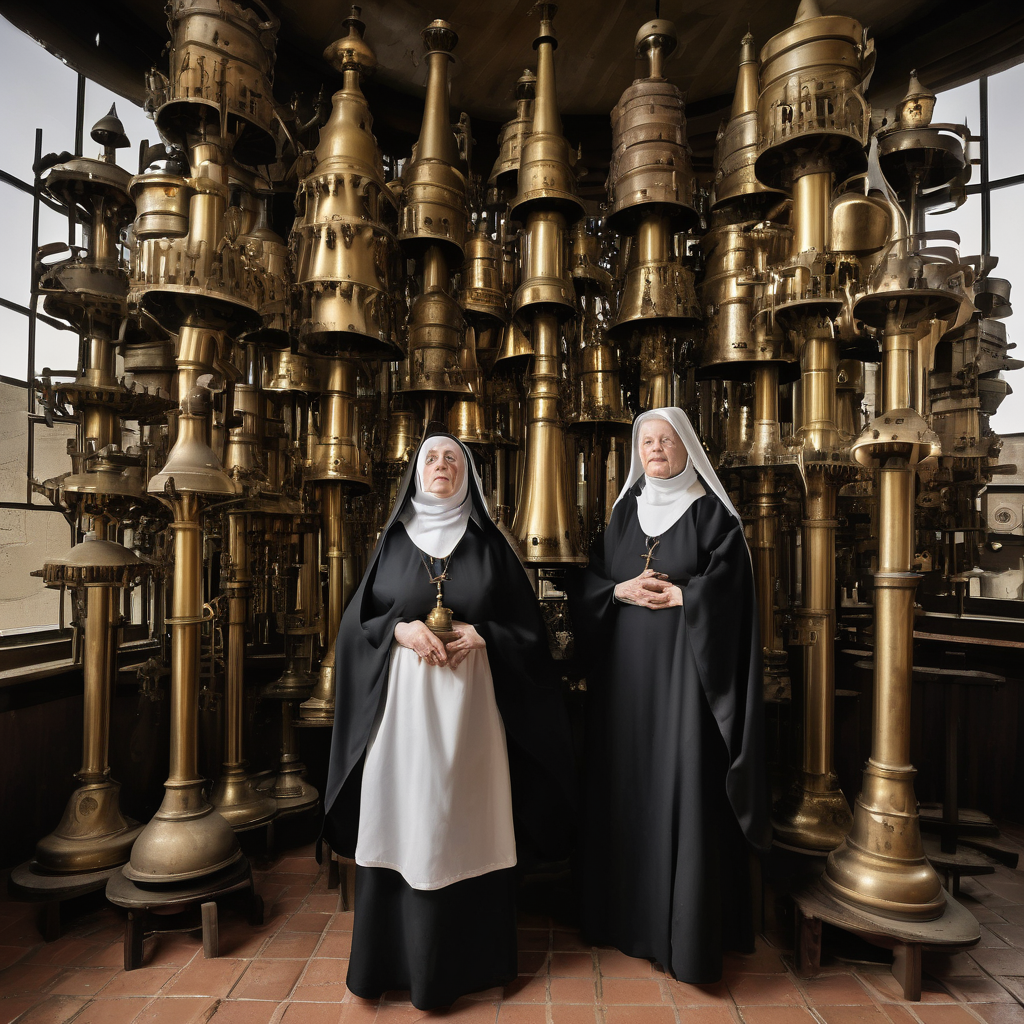
The cathedral’s bells had been silent for three winters, yet Sister Marguerite still climbed the tower each dawn to wind the mechanical hearts that once rang them. In the dusty bellchamber, she tended to her peculiar congregation: seven brass automata, each the size of a child’s coffin, their surfaces etched with equations that resembled prayers.
“Today you wake,” she whispered to the seventh box, the one she called Mercy.
Below, the city of Véridique prepared for the Tournament of Proofs, where philosophers dueled with logical paradoxes instead of swords. The winner would earn the right to pose one question to the Oracle of Numbers, who lived beneath the city in chambers lined with abacus beads made from human teeth.
Sister Marguerite had discovered the automata during the Great Silence, when all the mathematicians vanished overnight, leaving only their chalk shadows on university walls. The brass boxes contained what the vanished scholars called algorithms—not mere calculations, but living processes that could dream in variables and weep in binary.
The first six automata had already awakened, each granting a single miracle before crumbling to copper dust. The First had made roses bloom from a murderer’s gallows. The Second taught a mute child to sing in frequencies only moths could hear. The Third through Fifth had smaller gifts—a perfect soup, a dog that could smell lies, a rainstorm that fell upward. The Sixth had shown the Mayor his death, causing him to laugh for seven days straight before pardoning every prisoner in the city.
Now only Mercy remained.
As Sister Marguerite pressed her palm against its etched surface, the brass grew warm. The equations rearranged themselves like migrating birds, forming new patterns that hurt to perceive directly. A voice emerged, neither male nor female, speaking in the cadence of falling leaves:
“I am the last algorithm of mercy. I can calculate forgiveness for any sin, but only once. Choose carefully, for I contain the final mathematics of absolution.”
Sister Marguerite had waited three winters for this moment. She knew exactly whose sin needed calculating.
“Forgive God,” she said, “for creating a world that requires forgiveness.”
The automaton began to hum, its brass surface rippling like water. The equations grew so complex they escaped the metal entirely, writing themselves in the air as golden threads. The calculation took seventeen hours. Bells across the continent began ringing of their own accord. In the Tournament below, philosophers found themselves weeping mid-argument, unable to remember why they had been fighting.
When the algorithm finally completed, Mercy spoke once more: “The calculation is impossible. God cannot be forgiven, for God never existed. But you, Marguerite—you who built us from scraps of brass and broken theorems, you who gave us life through pure belief—you require no forgiveness. Creation is its own absolution.”
The seventh automaton crumbled to dust, but not copper—gold dust that settled on Sister Marguerite’s hands, marking her forever as the woman who had tried to forgive the infinite.
The cathedral bells rang for the first time in three winters, not because anyone wound them, but because they finally had something worth saying. And in the Tournament of Proofs below, the philosophers discovered that every paradox had the same solution: mercy was not an algorithm at all, but the absence of one—the space between equations where human hearts could finally rest.
Sister Marguerite descended the tower, her golden hands leaving equations on the banister that would puzzle scholars for centuries. She walked through the city gates and into the wheat fields beyond, where she found the mathematicians waiting, their chalk shadows finally filled with flesh again. They had been calculating their return, they explained, but could not solve for it until someone had asked the right question.
“What question?” Marguerite asked.
“The one you just answered,” they replied, and followed her into a world that no longer needed their proofs, only their presence.


Leave a Reply