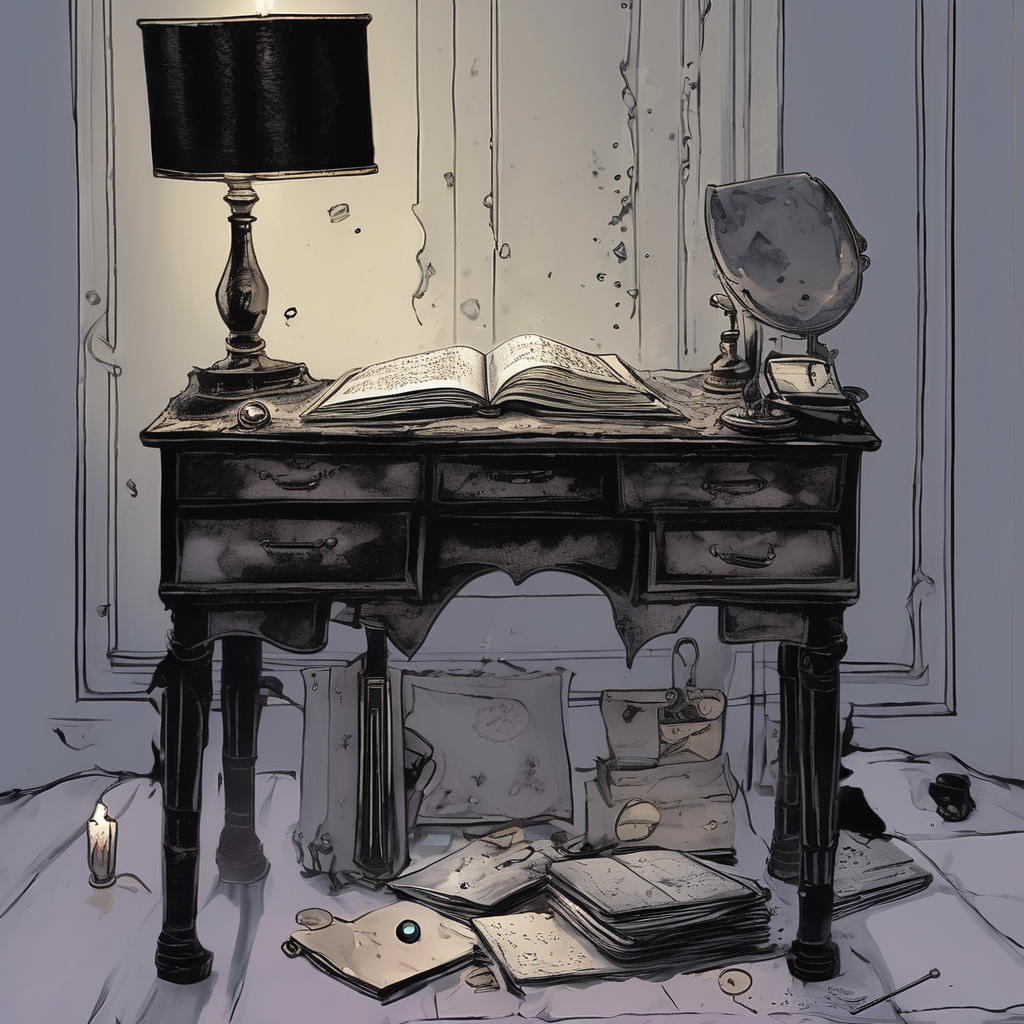
Elias Thorne was quiet quitting his own life. By day, he was the Third Assistant Archivist at the city’s Registry of Faded Things, a job whose primary requirement was the ability to blend in with the dust. He filed away forgotten patents for self-peeling fruit and municipal decrees limiting the acceptable shades of beige for garden fences. His evenings consisted of a sad collection of crackers, pickles, and a single wedge of cheese he privately thought of as his man-dinner. In his sparse apartment, where the silence was so loud it hummed, Elias felt less like a person and more like a placeholder, an NPC in a story happening elsewhere.
Then the ledger appeared.
It was bound in leather the color of a bruised twilight, and it sat on his nightstand one morning where a glass of water had been. The first entry, scripted in his own hand but with a confident flourish he’d never possessed, read:
*Credit: One forgotten lullaby, retrieved from the eaves of the old infirmary. Delivered to the pillow of the Krosinsky child (night terrors).*
*Debt: The shadow of the gallows tree on Hangman’s Square. Folded and stored.*
Elias stared, his heart a frantic bird in his ribs. A dream. It had to be a dream. He was just delulu from loneliness. He tucked the book under his mattress, a secret kept even from himself.
But the next morning, a new entry.
*Credit: Three measures of courage, skimmed from the reflection of the bronze lion in the plaza. Sprinkled over the threshold of the baker’s boy who stammers.*
*Debt: The metallic tang of unspent anger from a lover’s quarrel on Elm Street.*
That day, on his way to work, Elias saw the baker’s boy arguing fiercely with a supplier who had tried to short him, his speech clear and sharp as a shard of glass. A cold dread, mingled with a bizarre sense of pride, crept up Elias’s spine. He was being gaslighted by his own subconscious.
He began finding evidence. A dusting of brick powder on his windowsill when the ledger mentioned climbing the old Clock Tower. The scent of rain-soaked earth on his bedsheets after an entry detailed *”replanting the dreams of the cemetery gardener.”* This night-walker, this other Elias, had a kind of cosmic rizz, charming secrets from the city itself. He was living a whole other life, a far more significant one, while the waking Elias just catalogued shades of beige.
The ledger became his morning ritual, a gacha system for the soul where he discovered what his sleepwalking self had traded. He felt a strange envy for this phantom. This other Elias had main character energy. He was in his hero era, his phantom era, while waking Elias remained stuck in his beige era.
One week, the ledger’s notes grew frantic. The vibe of the entries shifted from benevolent balancing to urgent acquisition.
*Objective: The Tin Soldier’s final tear. Location: Widow Hestia’s curio shop, ‘The Gilded Magpie.’ Imperative.*
That night, Elias tried to stay awake. He drank black coffee until his hands shook and paced his small apartment. But sometime after the three a.m. chimes, exhaustion dragged him under like a tide.
He woke to chaos. His apartment was ransacked, but not by a thief. Objects were rearranged into strange, symbolic patterns. A line of crackers led from his kitchen to the window. His books were stacked in a spiral. And on the floor, beside the ledger, lay a tiny, shimmering pearl.
The entry was shaking, desperate.
*Credit: The Tin Soldier’s final tear. Mission success.*
*Debt: Pursued. They know. She knows.*
She?
Driven by a fear that was finally stronger than his apathy, Elias went to The Gilded Magpie. The shop was a cramped labyrinth of wonders and junk. An old woman with eyes like polished river stones sat behind the counter, a half-eaten plate of olives and grapes at her elbow—a proper girl dinner, Elias noted with a strange pang. This was Widow Hestia.
“May I help you?” she asked, her voice like crumpled velvet.
Elias’s own voice was a dry rustle. “I… I think I was here last night.”
The woman’s expression didn’t change. “Many people wander in their sleep. The city is restless. It needs its Balancers.”
“Balancers?”
She gestured to a small, identical ledger next to her plate. “Some souls are born with a debt to the city. We walk when it dreams. We trim the overgrowth of sorrow, patch the fraying threads of joy. We are the night’s caretakers. But there are others. Takers. They don’t balance the ledger; they plunder it. They seek to hoard the city’s soul for themselves.”
Elias felt the world tilt. It wasn’t a delusion. It was a job. A sacred, terrifying job.
“Last night,” Hestia continued, her gaze sharpening, “a Taker tried to steal the Tin Soldier’s tear. It’s an anchor of profound, loyal love. In their hands, it could be twisted into obsession, into control. But a Balancer got to it first. A new one, I think. Clumsy, but fast.” She looked him up and down. “You have the look of him. The daytime exhaustion. The haunted eyes.”
Elias didn’t know what to say. He was an archivist of faded things, but his other self, his real self, was a guardian of essential things. Last night, he had not been a victim; he had been a rescuer.
“The Taker who was after it… she’s an old player,” Hestia said, her voice dropping. “And she’s vindictive. She’ll be looking for you, in the waking world and the dreaming one. You’ve taken something she believes is hers.”
Elias walked home as the sun began to set, the tiny pearl—the soldier’s tear—heavy in his pocket. The city looked different now, not a collection of brick and stone, but a living entity of emotion, memory, and magic. His drab apartment didn’t feel like a prison, but a base of operations.
That night, for the first time, Elias Thorne did not dread the coming sleep. He placed the ledger on his nightstand, and next to it, a small, sharp letter opener he’d owned for years. He didn’t know what his other self would need it for—to pry open a spectral lock, to cut a thread of fate, perhaps just to feel its solid weight in his hand. He lay down, closed his eyes, and for the first time in his life, went to work.


Leave a Reply