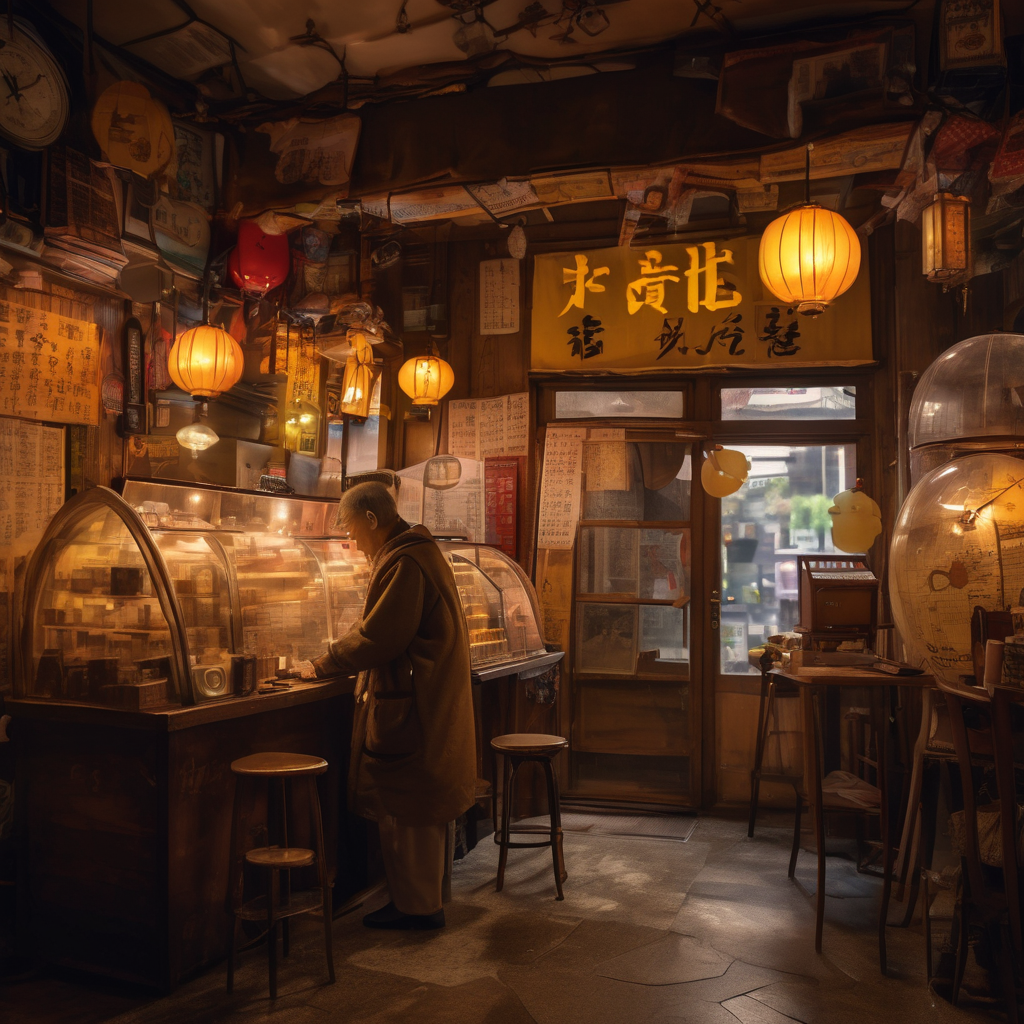
The map shop stood wedged between a bubble tea café and a vintage clothing boutique, its weathered sign barely visible through the morning drizzle. Inside, Margot Chen traced her fingers across yellowed parchments while her grandfather dozed in his chair, CNN murmuring from an ancient radio about elections and climate summits.
“These borders,” she whispered to herself, studying a map dated 1847, “they keep changing.”
The bell chimed. A woman entered, her coat dripping, carrying a leather portfolio case. She had the anxious energy of someone who’d been searching for something vital.
“I need to commission a map,” she said.
Margot’s grandfather stirred. “We sell maps, we don’t make them anymore.”
“You’re Chen Wei-Lin,” the woman insisted. “The last cartographer who remembers the old ways. Before GPS. Before satellites. When maps could still find places that wanted to be found.”
The old man’s eyes sharpened. “What place?”
The woman opened her portfolio, revealing a child’s drawing—crayon mountains, a silver lake shaped like a crescent moon, and words in wobbly letters: “Where Mama Lives Now.”
“My daughter drew this before she died,” the woman’s voice cracked. “She said she visited her grandmother there in dreams. I know how it sounds, but I’ve tried everything else. Therapy, meditation retreats, even consulted influencers who claim they can contact the other side. Nothing helps with the grief.”
Margot expected her grandfather to politely decline, but he stood, joints creaking like old floorboards. “Margot, bring the ink made from forget-me-nots. The vellum from the highest shelf.”
“Grandfather?”
“Some maps,” he said, pulling out instruments she’d never seen him use—a compass that pointed to longing instead of north, rulers that measured distance in heartbeats, “chart territories beyond the physical. Your grandmother taught me, before the world decided such things were nonsense.”
As he worked, the map began to emerge—not drawn but revealed, as if it had always existed beneath the vellum’s surface. Mountains that shifted like breathing, paths that appeared only when you weren’t looking directly at them, a lake that reflected not sky but memory.
“This realm,” he explained, adding labels in scripts from multiple alphabets, “exists in the spaces between. Like how dark matter holds galaxies together, invisible but essential. Scientists study sustainability of ecosystems, but forget to map the sustainable connections between souls.”
The woman watched, transfixed. “Is it real?”
“Real as grief. Real as love. Real as the democracy of death—it comes for everyone, regardless of who they vote for or what they believe.” He added a final mark, a small house by the silver lake. “Follow this at dawn or dusk, when boundaries thin. Don’t expect to photograph it for social media. Don’t expect to bring back proof. But you might find what you’re looking for.”
After the woman left, clutching the map like a life preserver, Margot found her grandfather teaching her the old techniques—how to grind pigments from flowers that bloomed only in memory, how to stretch vellum so thin it could hold dreams.
“Why haven’t you taught me this before?”
“Because I thought the world had moved past needing such maps. Everything tracked, tagged, reviewed, monetized. But loss creates territories that Google will never index. Grief opens borders that no election can close.” He smiled sadly. “Besides, someone must chart the forgotten realms. The places that exist because we need them to exist.”
That night, Margot dreamed of her grandmother, young again, standing in a garden that smelled of jasmine and star anise. She woke with ink-stained fingers she couldn’t explain and the strange certainty that she’d been drawing maps in her sleep—maps to places that waited patiently to be found by those who needed them most.
The next morning, she found her grandfather’s chair empty, but his tools remained, along with a note: “The last cartographer is always the next one. The forgotten realms are never truly forgotten, just waiting for someone brave enough to remember them into being.”
Margot picked up the compass that pointed to longing. Outside, the city hummed with its usual chaos—delivery trucks, school buses, people rushing to catch trains. But now she could see it: the invisible geography overlaying everything, the hidden territories of hope and loss, the unmapped countries of the heart that existed parallel to the world everyone else navigated.
She turned the shop’s sign to “Open” and waited for the next person who needed to find what satellites couldn’t see, what algorithms couldn’t predict, what only the ancient art of impossible cartography could reveal.


Leave a Reply