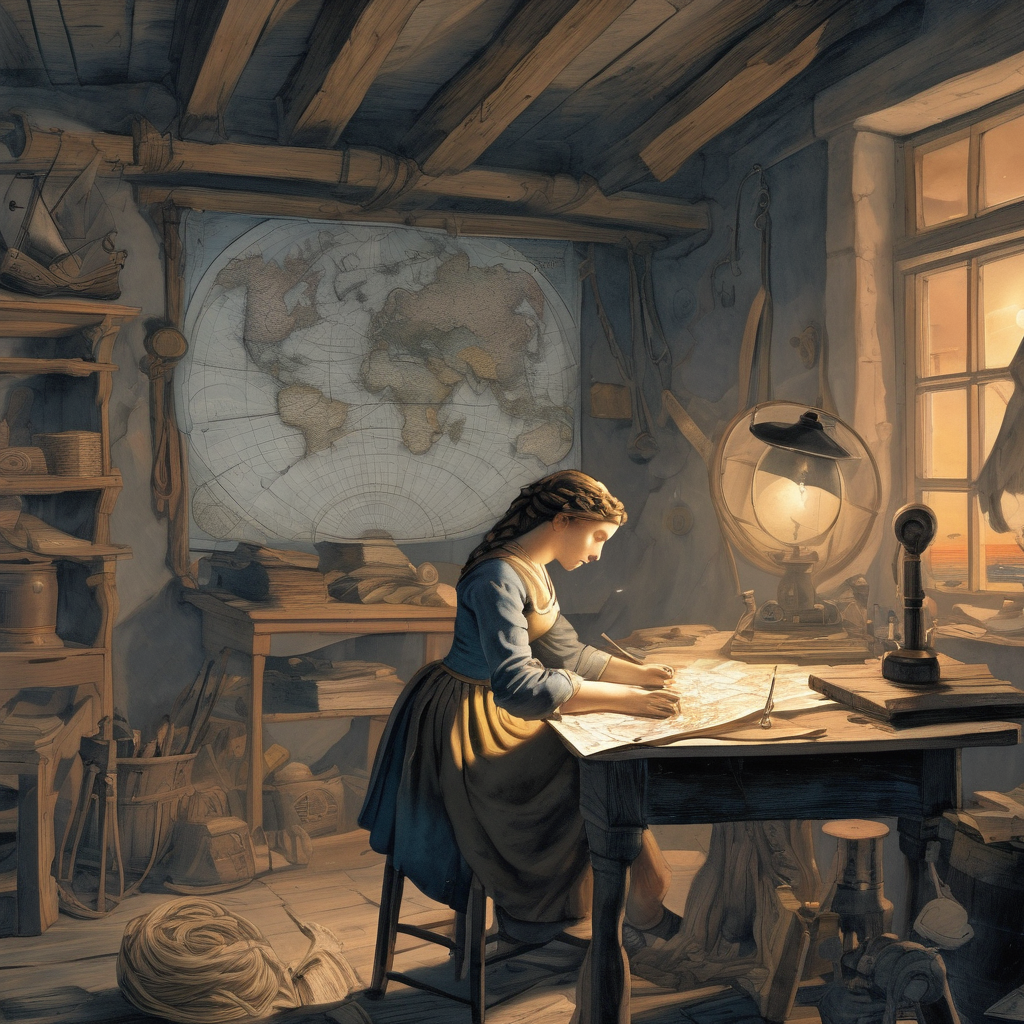
The salt wind carried whispers of revolution across the harbor as Katarina pressed her ear to the cellar door. Above, her father’s boots paced the workshop floor in their familiar rhythm—three steps east, pause at the compass rose, four steps west to the window overlooking the siege lines.
She had been forbidden from the mapmaking chamber since the British ships appeared on the horizon, their hulls dark as storm clouds against the October sky. But tonight, as cannon fire thundered in the distance, curiosity proved stronger than obedience.
The brass key turned easily in her palm. Her father’s workshop sprawled before her in moonlit chaos—charts scattered across oak tables, ink wells abandoned mid-stroke, and there, pinned to the far wall like a captured butterfly, the map that would change everything.
It was not Sevastopol that stared back at her, but somewhere else entirely. The coastline curved in impossible spirals, and cities bore names written in her father’s careful script: New Geneva, Port Resilience, Haven’s Rest. At the map’s heart, a vast inland sea bore the annotation “The Sanctuary Waters—where the displaced shall find home.”
Footsteps creaked overhead. Katarina traced her finger along the mysterious shores, and the parchment grew warm beneath her touch. The ink began to shimmer, then move, flowing like liquid mercury across the page. New mountains rose from the paper’s surface, forests bloomed in miniature, and tiny ships appeared in the harbor, their sails full of impossible wind.
“You’ve found it at last,” her father said from the doorway, his voice heavy with resignation. “I wondered when the map would call to you.”
“Papa, what is this place?”
He stepped into the moonlight, and she saw how the siege had aged him—silver threading his beard, new lines carved deep around his eyes. “It is tomorrow, little star. It is the place we will build when this war ends, when the rubble stops smoking and the survivors emerge to count their losses.”
The map pulsed beneath her fingers like a living heart. In its glowing depths, she could see people moving along the drawn streets—refugees from a hundred different conflicts, their faces etched with hope and exhaustion in equal measure. Gardens grew where defensive walls might have stood. Children played in squares that bore the names of fallen cities.
“But how can you map a place that doesn’t exist?”
Her father lifted a second chart from his desk, this one showing Sevastopol as it truly was—their beloved port city ringed with enemy guns, her neighborhoods marked in red ink where the bombardments had taken their toll. “Every map begins with a dream, Katarina. The question is whether we have the courage to make our dreams real.”
Outside, the cannons fell silent for a moment, as if the very war had paused to listen. In that stillness, Katarina felt the weight of choice settling on her shoulders like her grandmother’s winter cloak. The future map called to her with whispers of sanctuary and peace, while the present demanded witness to suffering and loss.
She pressed both palms flat against the impossible chart. “Then we’ll need more ink, won’t we? And larger tables. If we’re going to map hope for everyone, we’ll need much more space.”
Her father smiled for the first time in weeks, and together they began to plan the roads that would lead from the ruins of today to the harbors of tomorrow.


Leave a Reply