The antique shop smelled of bergamot and forgotten dreams when Elara pushed through its heavy door, the brass bell announcing her arrival with a melancholy chime. She hadn’t intended to stop here—she’d been walking aimlessly through the cobblestone streets of the old quarter, trying to process the news her doctor had delivered that morning. Early onset dementia. At thirty-four.
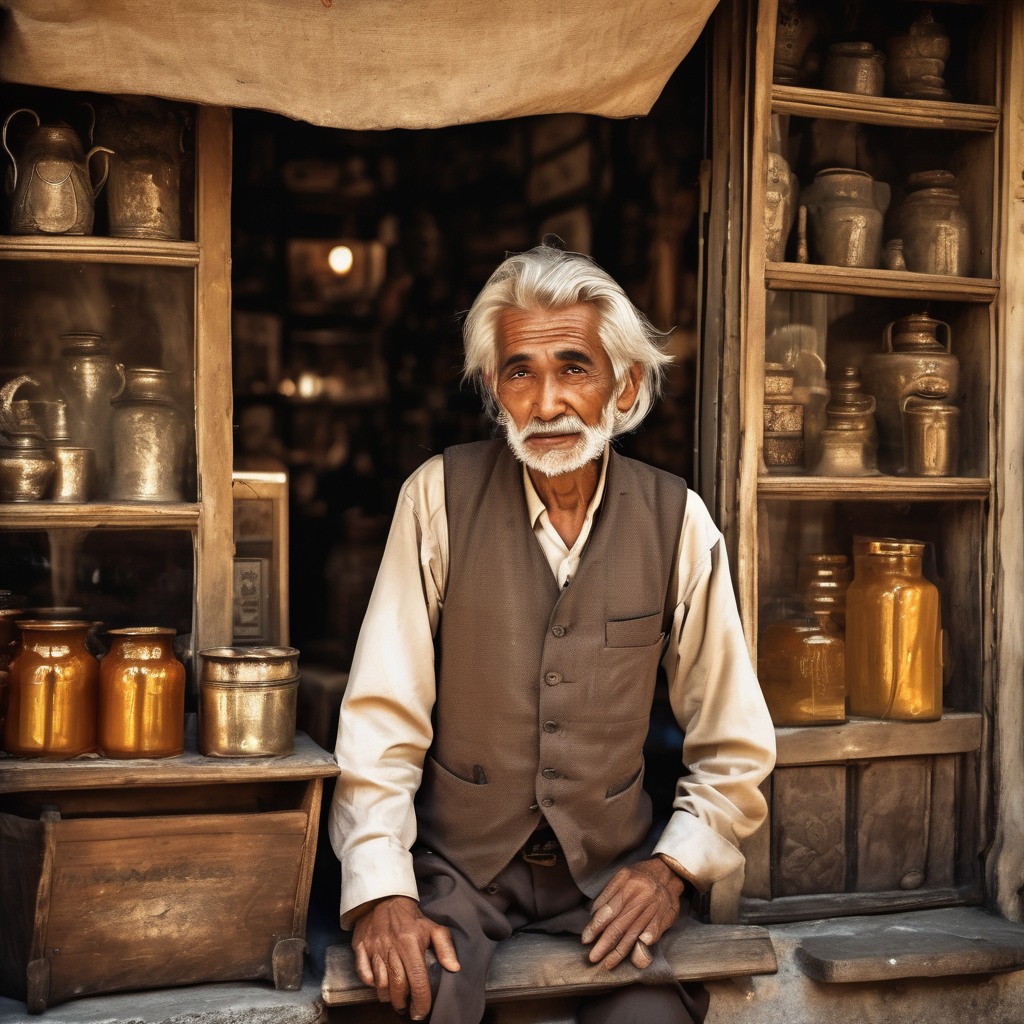
“Looking for anything in particular?” The shopkeeper emerged from behind a towering cabinet filled with porcelain dolls. He was ancient, with silver hair that caught the amber light filtering through dusty windows, and eyes that seemed to hold more years than his face suggested.
“Just browsing,” Elara murmured, though something had drawn her here with surprising urgency. Her fingers traced the edge of an ornate music box, its ballerina frozen mid-pirouette.
“Ah, but we’re never just browsing, are we?” The old man smiled knowingly. “We’re searching. Sometimes for what we’ve lost, sometimes for what we fear we’ll lose.” His gaze lingered on her face with uncomfortable perception. “I’m Cassius. This collection has been my life’s work.”
Elara felt heat rise in her cheeks. Could he somehow sense her diagnosis? She moved deeper into the shop, past shelves lined with snow globes containing miniature worlds, vintage cameras with brass fittings, and books whose titles seemed to shift when she wasn’t looking directly at them.
“These items,” Cassius continued, following her through the narrow aisles, “they’re more than mere objects. Each one holds memories—not just of their owners, but within their very essence.” He picked up a tarnished silver locket. “This belonged to a woman who waited sixty years for her lover to return from war. Every day, she opened it and remembered his face.”
“That’s a beautiful story,” Elara said politely, though something about his tone suggested it wasn’t merely a story.
Cassius set the locket down carefully. “What would you give to preserve your most precious memories forever? To ensure they could never fade or disappear?”
The question hit like a physical blow. Elara’s hand instinctively went to her temple, where a dull ache had been building all week. “I should go.”
“Wait.” Cassius moved with surprising speed for someone his age, positioning himself between her and the door. “I know why you’re here, Elara. The fog is already beginning, isn’t it? Little gaps in your recall, words that slip away just as you reach for them?”
She froze. She hadn’t told him her name.
“How do you—”
“Know?” Cassius chuckled softly. “My dear, I’ve been collecting memories for over two centuries. I can sense a mind in distress as easily as you might smell smoke from a burning building.” His expression grew gentle. “But I can help. That’s what I do—I preserve what matters most before it’s lost forever.”
Elara’s rational mind screamed warnings, but desperation made her stay. “What are you talking about?”
Cassius gestured around the shop with obvious pride. “Every item here contains extracted memories—love, joy, triumph, the moments that define us. I remove them before disease or age can steal them away.” He lifted a small glass bottle filled with swirling, opalescent mist. “This contains a grandmother’s recollection of her granddaughter’s first steps. Here”—he touched a brass compass—”a sea captain’s memory of navigating by stars on the clearest night of his life.”
“You’re insane.” But even as she said it, Elara felt drawn to a corner where dozens of objects glowed with soft, warm light. A child’s wooden toy horse. A wedding ring worn smooth by decades of touch. A fountain pen that somehow emanated the satisfaction of writing important words.
“Perhaps I am,” Cassius agreed. “Mad with the beauty of human experience, drunk on the preservation of what makes us who we are.” His voice took on an urgent quality. “But consider the alternative, my dear. In a few years, maybe less, you won’t remember your mother’s lullabies or your first kiss or the way morning light looks through your bedroom window. I can save all of that.”
Elara found herself nodding despite her fear. The diagnosis had felt like a death sentence—not of her body, but of herself. Everything that made her Elara would slowly disappear until only an empty shell remained.
“How does it work?”
Cassius smiled, and for the first time, she noticed his teeth were too sharp. “Simple transference. You focus on the memory while I bind it to an appropriate vessel. The recollection remains perfectly preserved while simultaneously disappearing from your mind—creating space, you might say, slowing the progression of your condition.”
“And you keep the memories?”
“I’m a collector, not a thief,” he said with mild offense. “Though I admit, after two hundred years, the distinction has blurred somewhat.” He moved to an empty display case near the back of the shop. “This section is reserved for my final acquisition before retirement. I’ve been waiting for someone whose memories possess sufficient… resonance.”
The way he said it made her skin crawl, but the alternative loomed larger. Living with awareness of her own dissolution. Forgetting her sister’s face, her father’s voice, the taste of her grandmother’s apple pie.
“Which memories would you take?”
“Oh, I wouldn’t presume to choose,” Cassius said quickly. “That decision is entirely yours. Though I might suggest starting with something particularly vivid—first love, perhaps, or a moment of profound beauty. The more emotionally rich the memory, the more effective the preservation.”
Elara closed her eyes, sifting through the catalog of her life. Her mind settled on a summer evening three years ago when she’d climbed a mountain with her sister to watch the sunrise. They’d talked all night about their dreams, their fears, their hopes for the future. It was perfect and complete and absolutely hers.
“I know which one.”
Cassius clapped his hands together in delight. “Wonderful! Please, sit here and focus on every detail—sights, sounds, emotions, even the way the air felt on your skin.”
She settled into an antique chair while Cassius arranged various crystals and mirrors around her. He selected a small wooden box carved with intricate mountain patterns and placed it on a table between them.
“Now then, simply remember.”
Elara let herself sink into the recollection. The thin air at elevation. Her sister’s laugh echoing off the rocks. The way the stars had seemed close enough to touch. The profound sense of connection—to the world, to her family, to her own place in the universe.
As she remembered, the wooden box began to emit a soft golden glow. She felt something shifting in her mind, like a thread being gently pulled. The memory grew distant, fading even as she tried to hold onto it.
“Stop,” she said suddenly, but her voice sounded weak.
“Nearly finished,” Cassius murmured, his hands weaving complex patterns in the air above the box. “Just a little more…”
The thread snapped. Elara gasped as the mountain memory disappeared entirely, leaving only the vague sense that something important had been lost. The wooden box now pulsed with warm light, beautiful and terrible.
“Magnificent,” Cassius breathed, lifting the box reverently. “Absolutely exquisite. The purity of sisterly love, the majesty of natural beauty, the poignancy of a perfect moment—this may be the finest piece in my collection.”
“I can’t remember what I just gave you,” Elara said numbly.
“Of course not. That’s rather the point.” Cassius placed the box in his special display case with obvious satisfaction. “But think of the space you’ve created, the progression you’ve slowed. Shall we continue?”
Over the next hour, Elara surrendered memory after memory. Her first day of school (preserved in a vintage lunch box). The taste of her mother’s birthday cakes (captured in a ceramic mixing bowl). The feeling of accomplishment when she’d finished writing her novel (bound within an antique typewriter). With each extraction, she felt herself becoming lighter, vaguer, as if she were dissolving from the inside out.
“One more,” Cassius said eventually, studying her with clinical interest. “Something recent and powerful. The process works best with a strong emotional foundation.”
Elara struggled to think. So many memories had already been taken that her mind felt like a library after a fire—mostly empty shelves with scattered books remaining. Then she remembered the morning’s doctor visit, the devastating diagnosis that had brought her here.
“No,” she said firmly. “I need to keep that one.”
Cassius raised an eyebrow. “The memory of learning about your condition? My dear, that’s hardly a pleasant recollection to preserve.”
“It’s mine,” Elara insisted. “It’s the reason I found you, the reason I made this choice. I won’t let you have it.”
For a moment, something predatory flickered across Cassius’s features. Then he smiled indulgently. “Of course. I wouldn’t dream of taking anything you wish to keep.” He began packing away his extraction tools. “Though I should mention—the memories I’ve preserved will remain here with me permanently. There’s no return policy, as it were.”
The full weight of what she’d done crashed over Elara. She’d traded away pieces of herself for the promise of slowing an inevitable decline, but she could no longer remember what those pieces contained. The cure had become indistinguishable from the disease.
“I need to leave,” she said, standing unsteadily.
“Certainly. You know where to find me when you’re ready for your next session.”
But as Elara reached the door, something made her turn back. “How many others have you helped?”
Cassius gestured around his shop with obvious pride. “Thousands, over the years. Each item here represents a life saved, a precious memory preserved for eternity.”
“What happens to them? The people you help?”
His smile faltered slightly. “They live on, of course. Lighter. Unburdened.”
“But do they remember living?”
The question hung in the air between them. Cassius didn’t answer, but his expression grew cold.
Elara left the shop and walked home through streets that seemed somehow unfamiliar, though she was certain she’d traveled these roads countless times before. By the time she reached her apartment, she could barely recall why she’d gone out in the first place.
She found a business card in her pocket: “Cassius – Antiquities & Memory Preservation.” Below it, someone had written in her own handwriting: “Don’t go back.”
But she couldn’t remember writing those words, just as she couldn’t remember who Cassius was or why she shouldn’t return to his shop. The card seemed important, though she couldn’t say why.
Three blocks away, Cassius locked his shop door and turned the sign to “Closed.” In a few days, Elara would return, driven by the growing gaps in her recollection and unable to remember their previous transaction. He would help her again, and again, until she was empty enough that the dementia no longer mattered because there would be nothing left to destroy.
He moved through his collection, touching each preserved memory with satisfaction. Thousands of lives distilled into objects, thousands of souls made lighter through his generous service. In the back corner, his newest acquisitions glowed with fresh warmth—a mountain sunrise, a mother’s love, the pride of creative accomplishment.
Soon, his retirement would be complete. Two centuries of collecting had taught him that the most beautiful memories came from those who had the most to lose. And Elara’s memories were indeed beautiful—so vivid, so pure, so perfectly crafted that he almost regretted the necessity of taking them all.
He opened the wooden box and allowed Elara’s mountain memory to wash over him. For a moment, he was young again, climbing toward the dawn with someone who loved him enough to share the journey. The experience was exquisite, as borrowed beauty always was.
Tomorrow, he would add another piece to his collection. And the day after that, another. Until the last of Elara’s memories belonged to him, and she became just another empty vessel wandering the world, unable to recall what she had lost or why she felt so inexplicably hollow.
After all, someone should preserve the beautiful things. Someone should remember what it felt like to be human.
Even if that someone was no longer human himself.


Leave a Reply