Mila discovered the first letter wedged between the floorboards of her grandmother’s attic on a Tuesday that tasted like cinnamon and regret. The envelope bore no postmark, no return address—only her name written in handwriting that seemed to shimmer and shift when she wasn’t looking directly at it.
Inside, the paper crackled like autumn leaves as she unfolded it. The words were written in a language she’d never seen before, yet somehow understood perfectly:
*The ravens have forgotten how to speak your name. Come to the crossroads where the old oak bleeds amber. Bring salt for the threshold.*
Mila had been cleaning out the house since her grandmother’s funeral three weeks ago, finding the usual detritus of a long life—recipe cards stained with decades of use, photographs of people whose names had been lost to time, mason jars filled with buttons and possibilities. But this letter felt different, alive somehow, pulsing with an energy that made her fingertips tingle.
She found the second letter that evening, slipped under her apartment door despite the fact that she lived on the fourth floor and the building’s main entrance had been locked all day. This one spoke of underground rivers that ran backwards through the city, carrying messages from the living to the dead. It instructed her to leave bread crumbs at the subway entrance on Meridian Street and listen for her grandmother’s laughter echoing through the tunnels.
The third letter arrived in her mailbox at work, though she’d never given her office address to anyone but her employer. Her coworkers noticed her distraction during the morning meeting, the way she kept glancing at the envelope protruding from her purse. Sarah from accounting asked if she was feeling alright—she looked pale, almost translucent in the fluorescent lighting.
This letter was different. The words writhed across the page like living things, rearranging themselves as she read:
*You are remembering how to see. The veil grows thin where sorrow accumulates. Your grandmother’s garden holds what was planted in silence.*
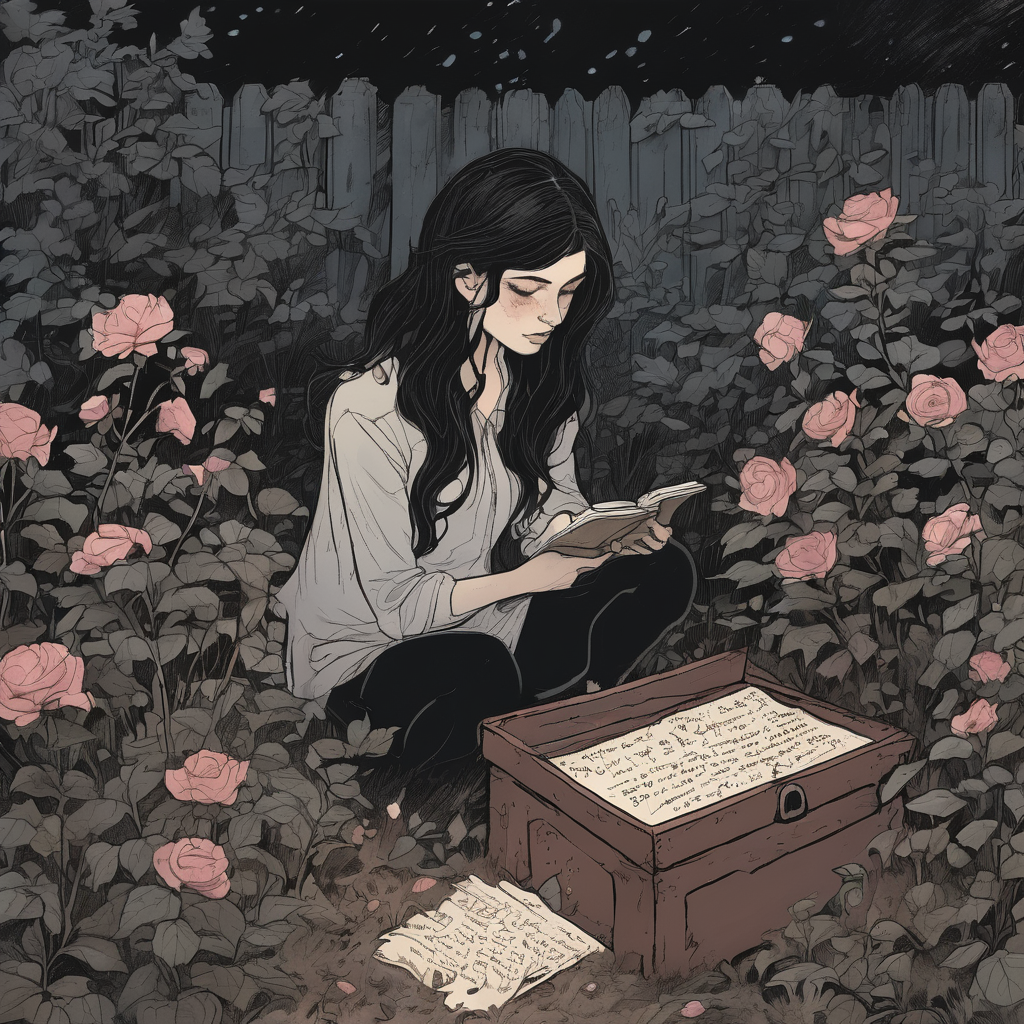
That night, Mila drove to her grandmother’s house, now empty and listed for sale. The garden was overgrown, choked with weeds and wild growth that seemed too lush for November. She knelt beside the rose bushes, digging with her bare hands until her nails broke and her fingers bled.
Buried beneath the thorns, she found a metal box containing dozens of letters, all addressed to her in that same shifting handwriting. Some were dated years in the future, others decades in the past. All were written in the strange language that spoke directly to her understanding rather than her eyes.
As she read, the truth unfurled like a night-blooming flower. The letters were from her grandmother—not the woman who had raised her, but the young woman who had loved unwisely and lost everything. The woman who had learned to write in the language of longing, whose words could slip through cracks in time and space to reach the granddaughter she would never live to see grow old.
Each letter was a bridge across the impossible distance between what was and what could have been. They spoke of parallel lives where different choices had been made, where love had conquered fear, where words had been spoken instead of swallowed.
The final letter was still warm to the touch, the ink still wet:
*The language of lost letters is the only tongue that death cannot silence. Keep writing, child. Keep remembering. The ravens are learning to speak again.*
Mila looked up to find seven black birds perched on the garden fence, their eyes reflecting the streetlight like stars. When she whispered her grandmother’s name, they answered in perfect unison, their voices carrying the sound of laughter from underground rivers, of seeds planted in silence finally breaking through the earth.
She understood then that some conversations are too important for the living world to contain. Some words must travel through stranger channels, must learn to speak in languages that exist only in the space between heartbeats, in the pause between one breath and the next.
That night, she sat at her kitchen table and began to write her first letter in the language she was still learning, addressing it to someone she had not yet met, someone who would find it when the time was right, when the veil grew thin enough for love to slip through the cracks in ordinary time.


Leave a Reply