The city was painted in serotonin pastels, a palette mandated by the Ministry of Perpetual Uplift. Every citizen was a curator of their own contentment, and a collective good vibe was the highest civic duty. The mandated aesthetic was a kind of enforced quiet luxury; soothing fabrics, noiseless mag-vehicles, architecture that flowed without sharp angles to snag the eye or the mood. In this world, Elara’s sorrow was a jagged, black thing she kept folded in a tight square behind her ribs.
Her brother, Finn, had been gone for six months. An ‘unfortunate dematerialization,’ the official report called it. A sterile, meaningless phrase for a vibrant, chaotic life snuffed out. To speak of him, to weep for him, was to risk a visit from the Chroma Wardens, men and women with placid smiles and devices that could read the dissonance in your bio-signature. To be caught grieving was to be sentenced to a mandatory Dopamine Detox, a month-long re-calibration in a white room until you were fit for society again.
The constant performance was fraying Elara at the seams. It was the ultimate gaslighting: to be told that the hole in her heart was a figment of her imagination, a symptom of malcontent. The official psych-casts, streamed directly into every home, called it ‘sorrow delusion,’ or ‘delulu’ in the common parlance, a dangerous indulgence that could trigger a negative vibe shift in an entire district.
But whispers persisted. In the hushed corners of synth-ale bars, on the encrypted back-channels of the Community Network, there were rumors of a black market. Not for spice or illicit tech, but for catharsis.
Following a breadcrumb trail of coded messages, Elara found herself in the Undercroft, the city’s forgotten warren of brick and rust, a place the pastels couldn’t quite bleach. She knocked on a splintered-wood door marked only with a single, faded teardrop.
The man who opened it was older, with lines etched around his eyes that weren’t from smiling. He looked at her, and for the first time in months, Elara felt truly seen. He didn’t appraise her outfit or her placid expression; he seemed to look straight at the jagged thing behind her ribs.
“First time?” he asked. His voice was like stones rolling in a slow river.
Elara just nodded, her throat tight.
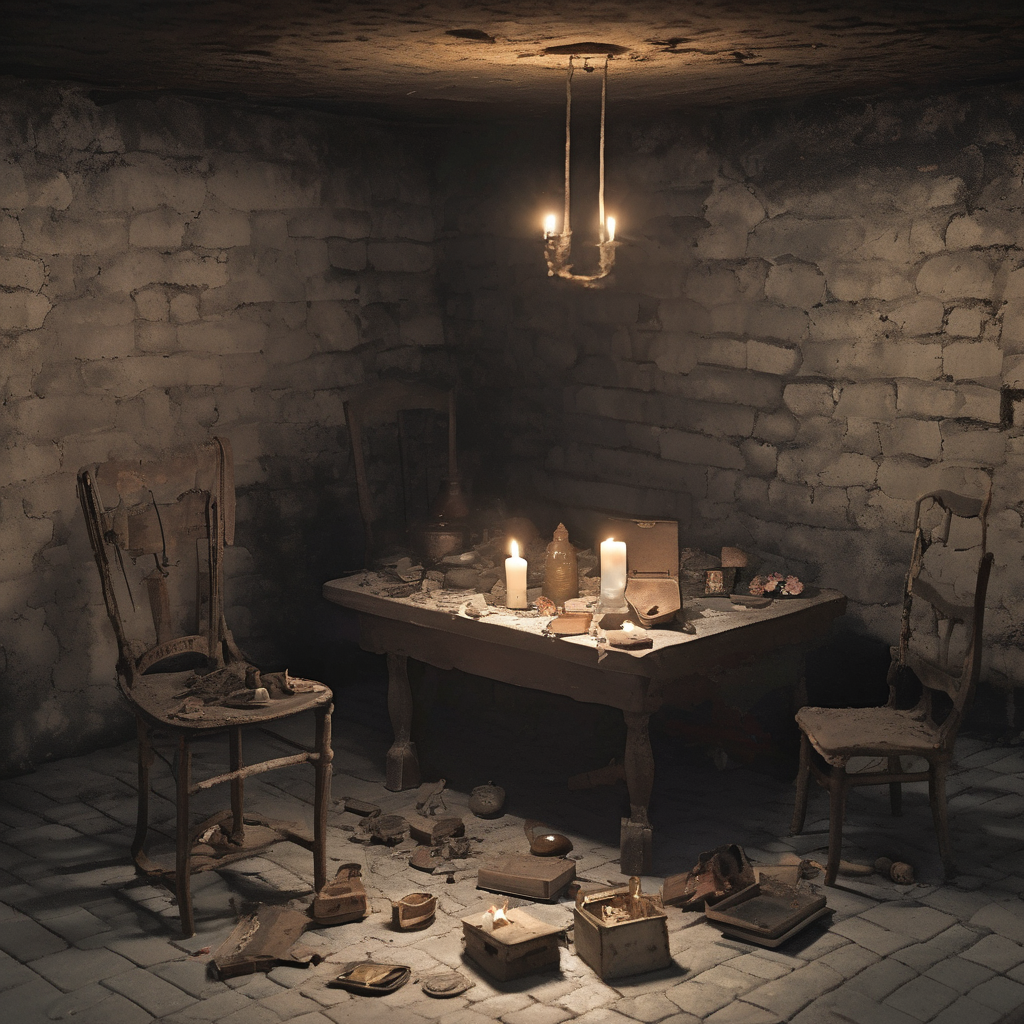
He led her inside. The room was the antithesis of the world above. It was dark, lit by real-flame candles. It smelled of dust, old paper, and something like rain on dry earth. It wasn’t luxurious, but it was real. Books with cracked spines lined the walls. Mismatched, threadbare chairs were arranged in a loose circle. In the center of the room sat a simple wooden box. The cost of living was high, but the cost of feeling, she was about to learn, was astronomical.
“I’m Silas,” the man said. “And this is a Remembrancery.”
Another person was already there, a young man who looked like he’d just stepped out of a high-level corporate office, his quiet luxury suit looking woefully out of place. He was staring at his hands, his knuckles white.
Silas gestured for Elara to sit. “The Ministry wants you to believe that feeling sad is a character flaw. They want you radiating positive, main character energy at all times. But to love someone is to make a space for their absence. We just provide the room to visit that space.” He had a kind of solemn rizz, a charisma born not of charm, but of deep, unflinching empathy.
He asked for payment. Not credits. Something personal. A memory. “The first one is the steepest,” he warned. Elara gave him the memory of Finn teaching her to skip stones across the reservoir, the weight of the perfect flat rock in her palm. The exchange felt physical, a faint shimmer in the air.
Then, Silas opened the wooden box. Inside, there was nothing but a collection of small, mundane objects: a tarnished silver locket, a child’s worn-out toy soldier, a dried flower pressed between two pieces of glass, a single key.
“This is your… *era*,” Silas said to the young man. “Choose.”
The man reached in with a trembling hand and picked up the toy soldier. He stared at it, and his carefully constructed composure shattered like a dropped plate. A single, choked sob escaped him. Then another. Silas didn’t comfort him. He simply sat, a silent guardian, giving him the permission to break.
Elara watched, mesmerized. This wasn’t the ugly, shameful thing the Ministry described. It was a terrible, beautiful storm.
When it was her turn, her hand hovered over the box. She chose the locket. It was cold to the touch. Silas nodded. “Open it.”
Inside, it was empty. Two hollow ovals of tarnished silver where photos should have been. And in that emptiness, everything came rushing back. The empty space at the dinner table. Finn’s silence on the other end of the comm-line that would never ring again. The hollow echo in her own chest.
The grief she had kept folded so tightly unfurled with savage force. It was a physical blow. Tears streamed down her face, hot and cleansing. She didn’t make a sound, but her whole body shook with the silent scream she had been swallowing for half a year. It was agony. And it was the most honest she had felt since before he was gone.
Later, as she prepared to leave, her body feeling strangely light, Silas gave her a small, smooth stone. “Keep this,” he said. “For ballast. The world will feel flimsy for a while.”
Walking back into the pastel city was like surfacing from a deep dive. The forced cheerfulness was jarring, the smiles of passersby grotesque. A Chroma Warden stood on a corner, his face a mask ofbeatific calm. He turned as she passed, his gaze lingering. For a terrifying second, Elara was sure her raw, recent sorrow was radiating from her like a heat signature. She clutched the stone in her pocket, its cool weight a tiny anchor to the truth she now carried.
The Warden’s eyes narrowed slightly, as if he detected not sadness, but an unnerving authenticity, a depth that didn’t belong in their shallow world. He seemed confused, then turned away.
Elara walked on, her expression as placid as everyone else’s. But inside, something had fundamentally changed. She carried her contraband with her now, not folded and hidden, but integrated into the very fabric of her being. Grief wasn’t the absence of joy; it was the proof that love had been real. And in a world that demanded perpetual happiness, remembering was the last true act of rebellion.


Leave a Reply