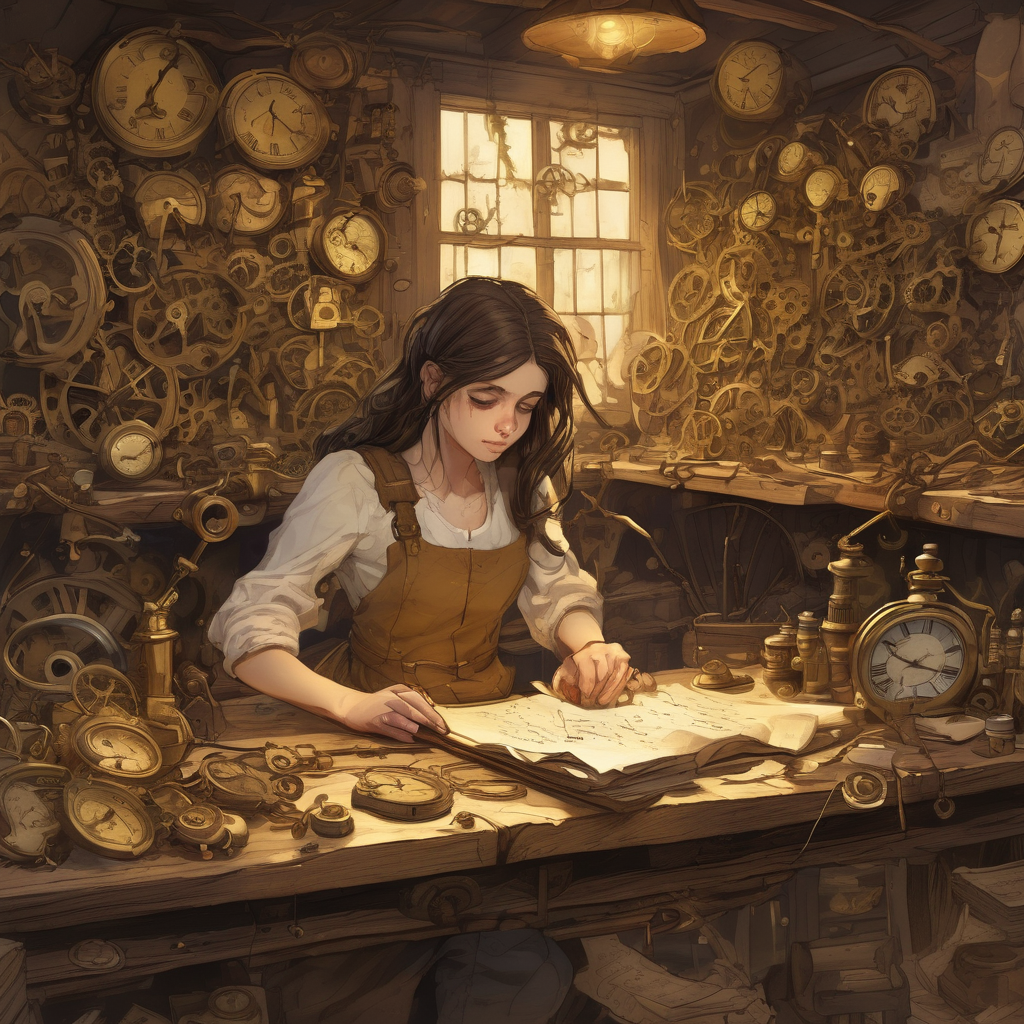
The brass gears clicked their final rotation as Elias Thornwick collapsed over his workbench, his weathered hands still clutching the peculiar timepiece that had consumed his last three months. The workshop fell silent except for the gentle ticking of a hundred clocks, each marking time in their own stubborn rhythm.
His granddaughter Maya discovered him there the next morning, surrounded by sketches of impossible mechanisms and notes written in his spidery handwriting. The strange clock lay beside him—no larger than a pocket watch, yet its face bore thirteen hours instead of twelve, and its hands moved backward.
“Another one of grandfather’s puzzles,” she murmured, though something about this particular creation made her skin prickle with unease.
The funeral drew half the town. Elias had repaired timepieces for three generations of families, and his workshop had become something of a landmark. People spoke of his kindness, his precision, his uncanny ability to breathe life back into the most hopeless mechanisms. But Maya noticed how their voices dropped to whispers when they mentioned his final months—how he’d grown secretive, working late into the night on something he claimed would “set everything right again.”
That evening, as Maya sorted through his belongings, she found herself drawn repeatedly to the backward clock. Its reverse hands had moved significantly since morning, though she was certain she hadn’t wound it. Tucked beneath it lay a letter addressed to her in Elias’s careful script.
“My dearest Maya,” it began, “if you are reading this, then time has finally caught up with an old man’s ambitions. The clock beside this letter is my masterpiece and my curse. I built it to undo my greatest regret, but I fear I lack the courage to use it. Perhaps that wisdom comes only with age, or perhaps I am simply a coward.”
Maya’s hands trembled as she continued reading. The letter spoke of choices made decades ago, of a love abandoned for duty, of roads not taken that haunted Elias through all his years. The clock, he claimed, could wind back more than its hands—it could unravel the threads of decision and circumstance, allowing the bearer to return to a crucial moment and choose differently.
“But beware,” the letter warned. “Time is not thread to be rewoven lightly. Every choice creates ripples. I have wound the mechanism and set it to the day I chose duty over love. If you activate it, you will witness what I was too afraid to face—the life I might have lived, and the price of changing it.”
Maya stared at the clock’s backward-moving hands. They had reached the thirteenth hour, a position that shouldn’t exist on any normal timepiece. As she watched, the workshop around her began to shimmer like heat waves rising from summer pavement.
The familiar walls faded, replaced by a train station from sixty years past. She saw a young man who looked remarkably like her grandfather, clutching a suitcase and staring at a departing train. On the platform, a woman in a blue dress watched from a window, her face a mask of heartbreak. Maya understood—this was the moment Elias had chosen family obligation over following his heart to another city, another life.
In the vision, young Elias suddenly turned and ran toward the train. The scene shifted and blurred, showing flashes of a different timeline—a life lived with the woman in blue, children who were not Maya’s father, a small clock shop in a distant town filled with laughter instead of the quiet precision she had always known.
But as the alternate life unfolded, Maya felt herself growing translucent. Her own timeline was unraveling, her existence becoming uncertain. She realized with crystal clarity why her grandfather had lacked the courage to activate the clock—choosing differently would erase not just his life, but everyone who came after.
With shaking fingers, she grabbed the strange timepiece. Its surface burned cold against her palm as she forced its backward-moving hands to stop. The vision shattered like glass, and she was back in the familiar workshop, surrounded by the comforting tick of ordinary clocks.
Maya carefully wound the mysterious timepiece forward until its hands matched the others, then placed it in her pocket. Some riddles, she understood now, were meant to teach rather than be solved. Her grandfather’s final creation wasn’t really about changing the past—it was about accepting it, and finding peace in the choices that led to love in unexpected forms.
Outside, dawn was breaking over the small town where three generations of her family had built their lives, one careful tick at a time.


Leave a Reply