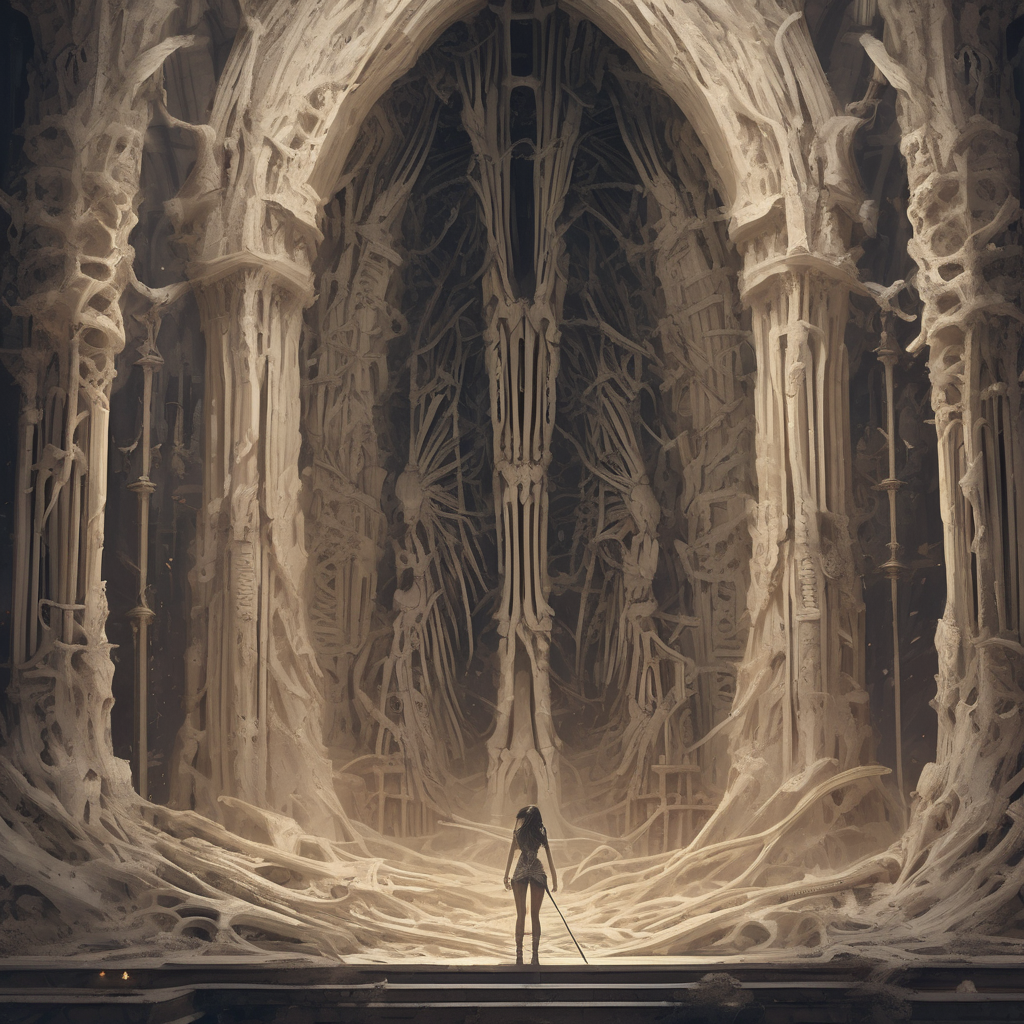
The city of Alabastrine was built on the back of a dead god, its avenues and spires carved from the divine, fossilized bone. From the city’s heart, the Great Sternum, the High Weaver drew forth shimmering filaments of magic, the raw material of their prosperity. These were the Threads, and the law that governed them was sacrosanct.
Elara was in what her friends called her ‘Era of Seeing.’ Colors felt louder, sounds had texture, and the city’s constant, humming harmony felt dissonant to her, a single, sour note buried deep within the chord. Everyone said she had the talent, the grace, the focus. She would slay the trials and become a Weaver herself. Her own mother, a patron of the arts, had already commissioned a victory tapestry. To doubt Elara’s destiny was to be willfully blind.
The first trial was simple: to feel the resonance of a relic, a chip of divine rib, and describe the visions it offered. The other aspirants spoke of golden light, of civic pride, of the glorious founding. When Elara’s turn came, she pressed her fingers to the bone’s cool surface.
The hum became a scream.
Not a vision of glory, but a suffocating memory of pressure, of being buried alive, of a consciousness trapped and endlessly milked for its power. The gilded prosperity of Alabastrine was a scab on a wound that never healed. The vibes were not just off; they were rot. She stumbled back, gasping, and lied. “I saw… the founders’ triumph,” she whispered, the falsehood tasting like ash in her mouth.
That night, the sour note was all she could hear. She sought out Rhys, the only one she trusted. He wasn’t a Weaver but a Lore-Keeper, his hands always smudged with archival dust. Theirs was a strange, undefined bond, not quite love, not quite alliance. It was a situationship, held together by late-night debates and shared disillusionment.
“The Marrow isn’t dead,” Elara said, the words tumbling out in the quiet of his scriptorium. “It’s aware. It’s in agony.”
Rhys didn’t look up from a brittle scroll. “Careful, Elara. That sounds dangerously close to what the Old Heretics preached.” He gestured to a sealed alcove. “That’s where their words are buried.”
“You think I’m being delulu? That this is just nerves?”
“I think the High Weaver maintains an Order that has kept us safe for five hundred years,” Rhys said carefully. “He has a certain… rizz. A gravity. People believe in him because he gives them a world that works. He doesn’t tolerate stories that complicate the narrative.”
Elara knew what he meant. The High Weaver, with his serene smile and voice like smoothed river stones, was a master of control. His unofficial decree, understood by all, was simple: quiet on set. The grand performance of Alabastrine must proceed without interruption, without ad-libbed notes of dissent.
Ignoring a warning tremor in her own gut, Elara used Rhys’s access to unseal the alcove. The scrolls within told a different story. They didn’t speak of a dead god, but a living earth-titan, lulled into a stone slumber and then chained by the first Weavers. The Threads were not a gift, but a plunder. Her Era of Seeing was no personal quirk; she was simply attuned to the titan’s long-suppressed consciousness.
The final trial was to be held in the Chamber of the Great Sternum. Elara would be tasked with weaving a Thread of Fealty, a complex strand binding her own life-force to the High Weaver’s doctrine. It was the ultimate act of complicity.
As she walked toward the dais, she could feel the titan’s slumbering mind stir, sensing her terror and her resolve. The chamber was silent, expectant. The High Weaver smiled his placid smile. Quiet on set.
Elara placed her hands on the loom. Golden light flared. She was supposed to focus on the intricate pattern, the symbol of the Weaver’s guild. Instead, she closed her eyes and reached past the golden hum, past the lies, and into the screaming dark. She pulled not on the shimmering, stolen Threads, but on the raw, red threads of the titan’s own memory.
They flooded the chamber not as light, but as feeling.
The audience felt the cool peace of the world before Alabastrine. They felt the sweet, narcotic song that lulled the great consciousness to sleep. They felt the sudden, sharp bite of the first magical chains. They felt five hundred years of silent, captive loneliness. The High Weaver’s face, for the first time, showed something other than serenity. It was stark, naked fear. The threads of causality he had so masterfully controlled were snapping, one by one.
He lunged for the loom, but Rhys was there, blocking his path with nothing more than his own body and a defiant stare. The gilded illusion shattered. The hum of the city ceased. For the first time in centuries, Alabastrine was silent, save for the collective gasp of a people waking from a long and beautiful dream.
On the dais, Elara let go. The raw, red light faded, replaced by the pale, honest light of the morning sun filtering through the high windows. The deep, sour note in her soul resolved into a chord of melancholic peace. The pain wasn’t gone, but it was finally heard.
This was the end of the Era of Weaving. Elara stood amidst the wreckage of a perfect lie, and knew, with bone-deep certainty, that her true era, the Era of Listening, had just begun.


Leave a Reply