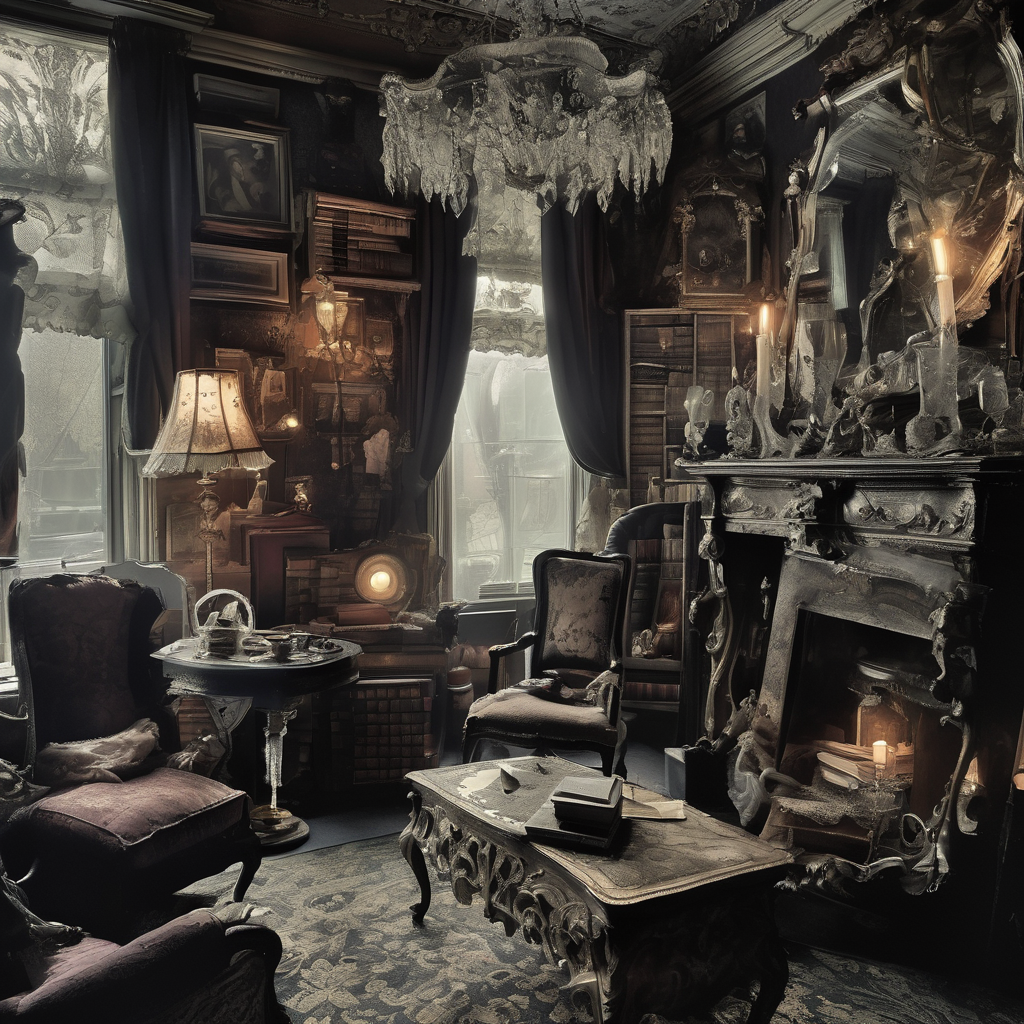
In the fog-shrouded alleys of Victorian London, where gas lamps flickered like hesitant confessions, Amelia Thorne inherited a peculiar heirloom from her eccentric aunt: an ornate mirror said to have been forged in the fires of a long-lost alchemist’s forge. It hung in her cluttered parlor, its silvered glass etched with faint runes that whispered secrets to those who dared listen. Amelia, a budding novelist with a taste for the macabre, dismissed the tales as mere folklore—until the night the mirror grinned.
It began subtly, as the clock struck midnight during a rare lunar eclipse, the kind astronomers buzzed about in the penny papers, calling it a “blood moon trending across the heavens.” Amelia stood before the mirror, brushing her raven hair, when the reflection twisted. Her own face remained, but behind it, shadows stirred like ink in water, coalescing into forms that mocked the light. The mirror’s frame seemed to curl at the edges, forming a sly, toothy smile that widened with every heartbeat.
From the depths emerged the first shadow: a lithe figure, swift as a Taylor’s needle through silk, darting across the glass with the grace of a forgotten ballerina. It wore a gown of swirling eras, fabrics from Renaissance velvets to Regency muslins, each layer peeling away like pages from a forbidden tome. “Join the dance,” it sang in a voice like wind through crumbling ruins, “for the world spins on trends that fade like morning mist.”
Amelia reached out, her fingers brushing the cold surface, and the mirror pulled her in—not bodily, but in spirit. She found herself adrift in a surreal ballroom within the glass, where shadows waltzed under chandeliers of fractured starlight. There, amid the throng, loomed a doll-like specter named Barbie, her porcelain skin aglow with an unnatural pink hue, eyes wide with manufactured innocence. She twirled in a gown of candy floss and dreams, whispering of plastic paradises where perfection reigned eternal. “Look at me,” Barbie cooed, her voice a viral echo that infected the air, “I’m the queen of fleeting fame, trending in every heart until the next idol rises.”
But the dance darkened as another shadow materialized, a gaunt man with haunted eyes and a coat singed by invisible flames. He called himself Oppenheimer, his presence heavy with the weight of cataclysmic knowledge. “I built the fire that devours worlds,” he intoned, his hands weaving shadows into blooming mushrooms of smoke and ruin. “In the name of progress, I birthed the end—an atomic waltz of creation and obliteration.” The ballroom trembled as his shadow-self conjured illusions of blazing horizons, where cities melted like wax under a merciless sun.
Amelia, caught in the whirl, felt the grin’s pull tighten. The swift shadow linked arms with her, spinning tales of lost loves and bygone ages, while Barbie’s laughter rang hollow, promising joys as ephemeral as social whispers. Oppenheimer’s warnings thundered like distant artillery, urging restraint amid the chaos. Yet the mirror’s grin only grew, feeding on their interplay, drawing Amelia deeper into its maw.
As dawn crept in, painting the real world in hesitant gold, Amelia wrenched free, stumbling back into her parlor. The mirror’s surface smoothed, the grin fading to a mere crack in the glass. But in her reflection, she now saw faint shadows lingering—echoes of the dance, reminders that every trend, every era, every burst of creation carried the seed of its own destruction. And sometimes, in the quiet hours, she swore she heard the mirror chuckle, waiting for the next eclipse to begin anew.


Leave a Reply