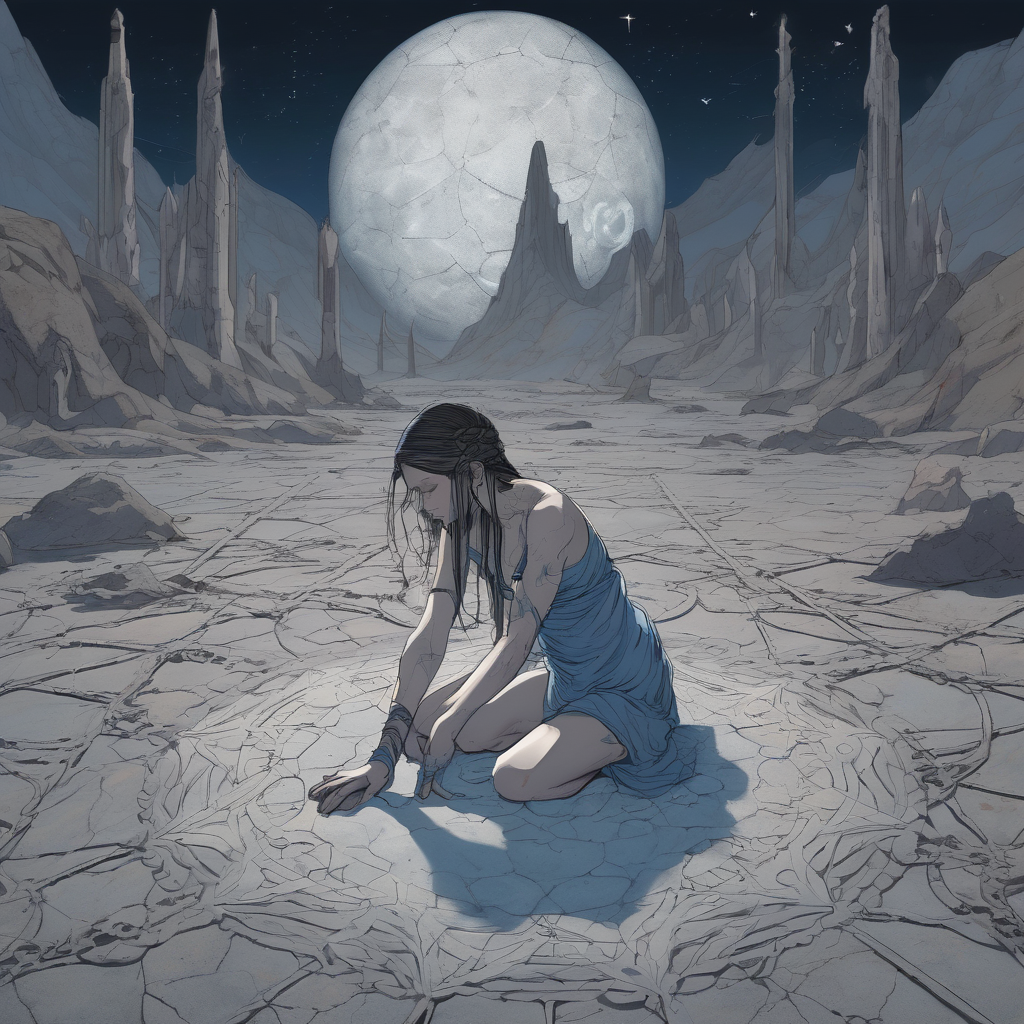
The dust tasted of ancestors and regret. Elara knelt, tracing the final sigil in the desiccated riverbed. The grooves in the grey earth were a familiar prayer, a geometric lexicon she had known since childhood. Around her, the other chanters of Oakhaven stood silently, their faces etched with the same brittle hope they wore every season. This was the Rite of Resonance, the Grand Canticle. And it was failing.
Elder Kael, his voice as dry as the river itself, began the invocation. “Hark, the old sleep of the soil, the deep slumber of the wyrms…”
The words, once vibrant with power, were now just sound—an echo in an empty chamber. The wyrms, the great serpentine arteries of life that writhed and dreamed in the planet’s heart, were silent. For generations, the canticle had been a conversation. The chanters would sing the patterns of rain and root, and deep below, the wyrms would answer, their slow, tectonic shifting nudging water towards the surface, coaxing nutrients from stone. Now, there was only silence.
The existential dread was a physical weight on the village. The crops were thin whispers of their former selves. The Great Blight had left the northern forests a skeletal grey, and the cost of living was measured not in coin, but in how many days one could stretch a ration of dried fungus. The younger generation had all but given up. It was a form of quiet quitting; they attended the rites out of respect for their elders, but their hands fumbled the sigils and their voices were hollow. They had retreated into themselves, a kind of communal goblin mode where caring was too exhausting a luxury.
“Their faith is weak,” Kael would rasp at Elara in the evenings, his eyes burning with a zeal she found terrifying. “This new strain of blight, the stillness in the soil… it is unprecedented. They must sing louder.”
But Elara knew it wasn’t about volume. She’d spent her nights in the archives, poring over the old scrolls, the logarithmic chants and harmonic maps. The canticle wasn’t a command; it was a prompt. The chanters provided a model of the world they wanted, and the wyrms, the vast, subterranean intelligence of the world, would generate a response. The problem, she was beginning to suspect, was that their prompt was outdated. They were singing about a world that no longer existed.
Her own sister, Lyra, had mocked her for it. “You keep feeding the Great Below the same old lies, the same misinformation about green fields and clear water,” she’d said, carving a toy boat from a piece of pallid bark. “It’s a strange arithmetic you practice, sister. A kind of ritual-math where you add hope to dust and expect a forest.”
The words stung because they were true.
That night, before the final phase of the canticle, Elara did not study the old scrolls. Instead, she walked out to the edge of the petrified woods, knelt, and pressed her ear to the cracked earth. She didn’t sing. She listened. For hours, she listened past the whine of the wind, past the frantic scurrying of dust-beetles. She listened to the deep silence. And in it, she finally heard something. A hum. Not the sonorous, healthy thrum of the old wyrms, but a faint, discordant static. A sound of pain.
A thought, heretical and terrifying, sparked in her mind. What if the wyrms weren’t sleeping? What if they were trying to say something new, and the old canticle was just drowning them out?
As the twin moons rose, casting the valley in a spectral, silver light, the chanters gathered for the final verse. Kael raised his arms, his voice cracking with effort as he began the Chorus of Abundance, a paean to a memory.
Elara stood, but she did not join him. The other chanters faltered, turning to look at her. Kael’s face contorted in a mask of fury. “Sing, girl! Do not break the chain!”
“The chain is already broken,” Elara said, her own voice trembling but clear. “We are singing a lullaby to a world that is having a nightmare.”
She closed her eyes, not to remember the old patterns, but to feel the dissonant hum beneath her feet. She let the raw, unfiltered eco-anxiety of her generation flood into her—the fear, the grief, the tiny, stubborn spark of defiance. And she began to sing.
It was not the Grand Canticle. Her song was jagged, atonal. She sang of the grey sky, of the bitter taste of the water, of the skeletal trees. She sang not of verdant leaves but of the beauty in the hard-shelled lichen that clung to the dead bark. She sang about her sister’s cynical hands and the exhaustion in the faces around her. She abandoned the perfect, sacred geometry of the sigils and began to draw new ones in the dust with her bare toes—erratic, broken, honest. She was generating a new prompt, one built not of idealized memories but of the broken, immediate truth. It was a dirge. It was a confession. It was a plea.
Among the chanters, it was an IYKYK moment. The younger ones, the ones lost to their quiet resignation, felt it first. A flicker of recognition. A few of them, hesitantly, began to hum along with her discordant melody, their voices adding layers of their own unspoken grief.
Kael roared, “Heresy! You will poison the wyrms!”
But a new sound was rising from the ground. It wasn’t the old, familiar rumble. It was a low, guttural chittering, a complex sound that shifted and evolved, as if a vast mind was processing a novel idea. The ground beneath Elara’s feet vibrated, not with the gentle pulse of the past, but with a sharp, inquisitive tremor.
Then, a crack.
Not the brittle splintering of dry earth. This was a wet, tearing sound. From the center of Elara’s new, chaotic sigil, a single, pale green shoot pushed its way into the moonlight. It was not a species anyone recognized. Its leaves were shaped like listening ears, and it unfurled with an impossible speed, glistening with a dew that had not been seen in a generation.
The old canticle was dead. The silence was broken. A new conversation had just begun.


Leave a Reply