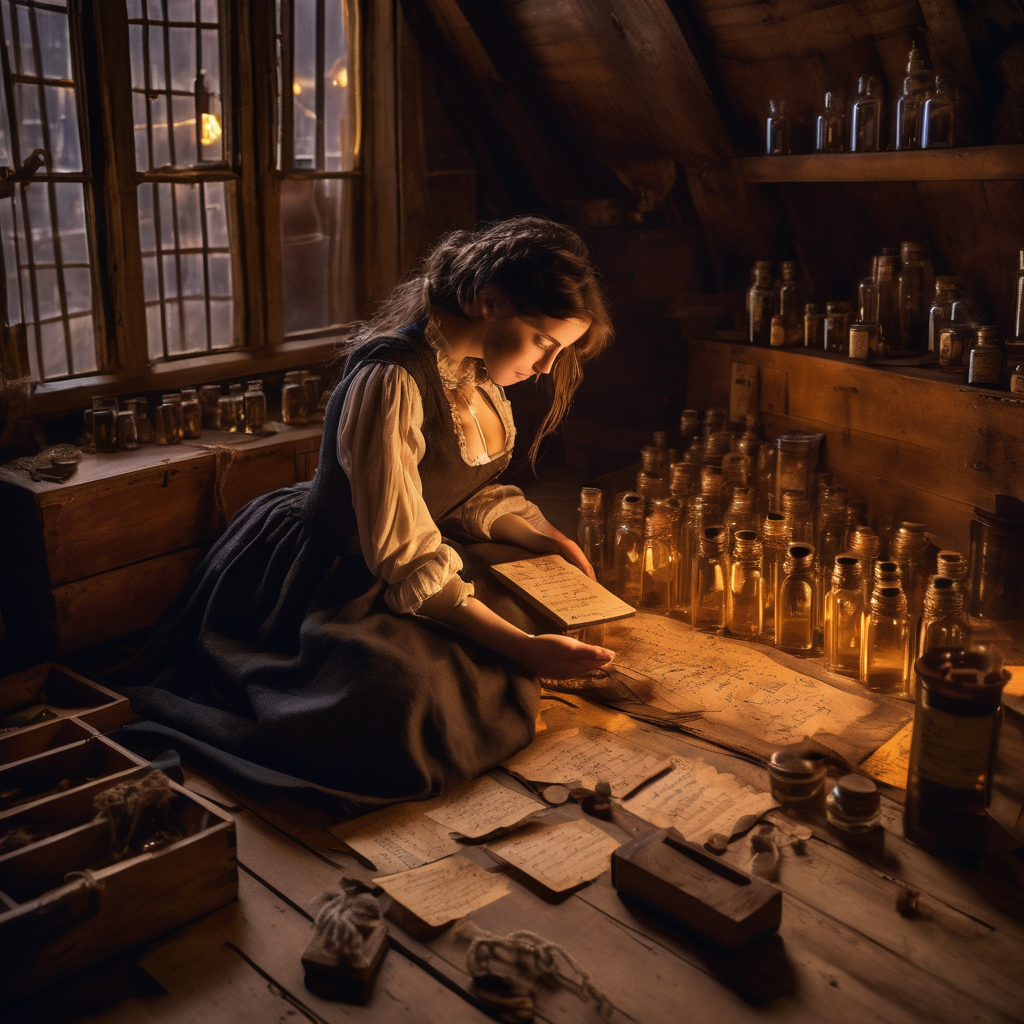
Maya discovered the glass vials by accident, tucked beneath loose floorboards in her grandmother’s attic. Each delicate vessel bore a tiny label written in spidery handwriting: “Helena, seamstress, died of tuberculosis, 1918.” “Thomas, baker, heart failure, 1923.” “Rose, age seven, influenza, 1919.”
Her grandmother had been dead three months when Maya finally worked up the courage to sort through her belongings. The old Victorian house felt impossibly quiet, as if it were holding its own breath. Maya had inherited everything—the creaking floors, the dusty furniture, and apparently, a collection of bottled air from the dead.
She held one vial up to the afternoon light streaming through the diamond-paned window. The glass contained nothing visible, yet something about its weight suggested it wasn’t empty. The label read: “Samuel Chen, railroad worker, typhoid fever, 1921.”
A leather-bound journal lay beside the wooden box that housed the collection. Maya opened it with trembling fingers. The first entry was dated September 15th, 1918:
*The Spanish flu has taken Mrs. Morrison from the boarding house. I arrived too late to ease her passing, but not too late to preserve what remained. There is power in the final exhale, power that dissipates if not captured. The old midwife taught me this before she died. Said her grandmother learned it from the Cherokee women who once lived on this land.*
Maya’s grandmother had been many things—herbalist, unofficial town doctor, keeper of secrets—but she had never mentioned this. Page after page detailed careful rituals: arriving at deathbeds, positioning the vials, speaking words in a language Maya didn’t recognize.
*November 2nd, 1918: Young Timothy Walsh, age sixteen, died of his war wounds. His mother begged me to save something of him. I told her I would try. The breath of soldiers burns brighter in the glass, as if their sacrifice adds luminescence.*
Maya found herself counting the vials. Hundreds of them, spanning decades. Her grandmother had collected last breaths for over fifty years, stopping only in the weeks before her own death. The final journal entry was barely legible:
*My hands shake too badly now. Maya will come soon to settle things. I should tell her, but how do you explain that a town’s worth of souls have been kept safe in glass bottles? That I’ve been their guardian all these years, protecting them from whatever comes after? The weight grows heavier each day. Someone else must carry it forward.*
As Maya read, the house settled around her with unfamiliar creaks. Or perhaps they had always been there, and she had simply never listened carefully enough. She thought of her grandmother’s reputation, the way people had whispered about her gift for easing suffering, her uncanny ability to appear at deathbeds moments before the end.
A soft tapping drew her attention to the window. A crow perched on the sill, watching her with intelligent black eyes. It tapped again, more insistently.
Maya set down the journal and approached the window. The moment she drew near, the crow cawed three times and flew away. In the distance, church bells began to toll—not the regular hourly chimes, but the slow, solemn rhythm reserved for death.
She knew, without understanding how, that someone in town was dying.
The vials seemed to pulse with their own subtle light as evening approached. Maya packed several empty ones into her grandmother’s worn leather satchel, along with the journal. The words of the ritual swam in her memory as if she had always known them, passed down through blood and bone rather than books.
Mrs. Patterson’s house stood at the end of Elm Street, windows glowing amber against the gathering dusk. Maya had never been inside, but she found the front door unlocked. The scent of lavender and impending rain filled the hallway.
She climbed the stairs toward a soft murmuring of voices. Mrs. Patterson’s daughter sat beside the bed, holding her mother’s hand. The old woman’s breathing came in shallow, irregular gasps.
“Maya,” the daughter whispered, looking up with red-rimmed eyes. “I don’t know why I called you. Something just told me you’d know what to do.”
Maya hadn’t received a call, but she nodded anyway. She understood now that the work chose its own practitioners. Her grandmother’s legacy lived not in the house or the furniture, but in this strange calling that passed from one guardian to the next.
As Mrs. Patterson’s breathing slowed, Maya positioned the vial near her lips and spoke the words that seemed to rise from some ancestral memory. The room filled with the sound of wind through leaves, though all the windows were closed.
When Mrs. Patterson’s final breath misted into the glass, Maya felt the weight of it—not heavy, but significant, like holding a snowflake that would never melt. She sealed the vial carefully and wrote the label in handwriting that looked remarkably like her grandmother’s.
Walking home through the quiet streets, Maya understood that she had inherited more than a house. She was now the keeper of her town’s most sacred trust, the collector of what remained when everything else fell away. In her satchel, hundreds of souls waited in their glass homes, and she was their guardian until someone else could carry the burden forward.
The wind picked up, carrying the scent of rain and roses, and Maya could swear she heard her grandmother’s voice whispering approval through the rustling leaves.


Leave a Reply