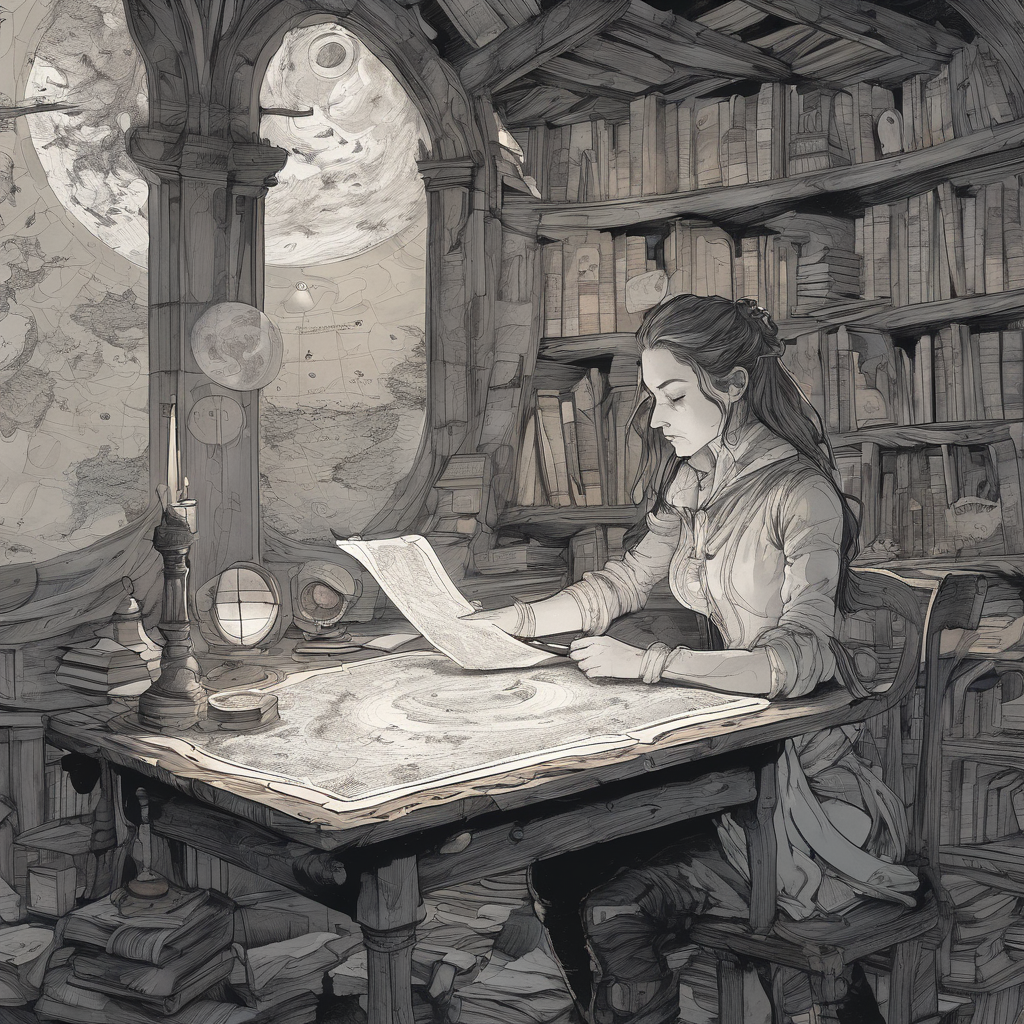
The cartographer’s tower stood at the edge of the known world, where maps dissolved into warnings: Here Be Dragons, Terra Incognita, The Swallowing Sands. Mira inherited it all when her father vanished into the blank spaces he’d spent his life trying to fill—his compasses, his astrolabes, and most peculiarly, a chest of ink that changed color with the phases of the moon.
She discovered the truth about their family trade on a Tuesday, when the delegation from the Obsidian Court arrived. Three figures in moth-eaten velvet climbed her spiral stairs, their faces hidden beneath hoods that seemed to absorb light rather than cast shadow.
“Your father owed us a map,” the tallest one said, producing a contract written in what looked like pressed butterfly wings. “The Treaty of Diminishing Borders requires it.”
Mira had never heard of such a treaty, but the document bore her father’s seal—a compass rose with a missing point. The visitors explained: every decade, the world literally shrank. Not in size, but in possibility. Places that once existed—the Singing Canyons, the City of Brass Tears, the Forever Orchards—simply ceased to be unless a true mapmaker committed them to paper with moon-ink.
“But I’m not a true mapmaker,” Mira protested. “I just copy existing charts for merchants.”
The shortest visitor laughed, a sound like wind chimes made of bone. “Child, there are no existing charts. Every map your father drew, he dreamed first. Every coastline he penned, he pulled from the space between waking and sleeping. The gift runs in bloodlines.”
That night, Mira mixed the moon-ink according to her father’s notes—three drops of memory, a whisper of longing, ground pearls from oysters that had never touched water. The ink shimmered opalescent on her quill. When she touched it to parchment, she felt the pull.
She closed her eyes and let her hand move.
Mountains erupted from her pen, forests dense with trees that grew downward into a sky beneath the earth. She mapped cities where the citizens aged backward, returning to seeds that would sprout into new lives. She drew bridges built from crystallized music, spanning rivers that flowed in circles, always returning to their source.
But with each stroke, Mira felt something leaving her—not energy, but possibility. Her own potential futures were being spent, traded for territories that would exist only because she had imagined them into being.
The Obsidian Court returned at dawn. They studied her map with eyes that reflected no light, tracing routes with fingers that left frost on the parchment.
“Acceptable,” the tall one said. “But incomplete. The Western Edges remain unmapped.”
“Those are the Devouring Lands,” Mira said, remembering her father’s warnings. “No one who maps them returns unchanged.”
“Your father knew the price.” The visitor placed a black candle on her desk. “When this burns out, the Western Edges will begin consuming the mapped world, reality eating itself from the margins inward. Unless…”
Mira understood. Her father hadn’t vanished—he had become part of his final map, transformed into a feature of the landscape he’d tried to document. She could see him now, in the corner of her own map, a mountain range that spelled out a warning in the shape of its peaks: Some borders are meant to remain undefined.
She had three choices. She could flee, leaving the world to shrink until only the heartlands remained, safe but diminished. She could map the Western Edges and risk her father’s fate, becoming geography instead of geographer. Or she could try something her father never had—map herself into the story, create a recursive loop where the cartographer and the territory became one.
Mira dipped her quill into the moon-ink one final time. But instead of drawing lands, she began writing words directly onto the map, a story that began: “The cartographer’s tower stood at the edge of the known world…”
As she wrote, the tower began to tremble. The visitors stepped backward, their forms wavering. Reality itself grew uncertain, unable to determine whether it was being mapped or narrated, whether Mira was creator or creation.
“What are you doing?” the tall visitor demanded.
“I’m drawing a map that includes the mapmaker,” Mira said, her hand moving faster now, “a territory that contains its own borders, a story that tells itself.”
The Western Edges rushed toward her, a wave of unmaking, but struck the paradox of her recursive map and shattered into metaphor. Where they touched her story-map, they became merely words—dangerous words, perhaps, but words that could be edited, revised, reimagined.
When the black candle finally burned out, Mira remained, but changed. She could feel every map that had ever been drawn humming in her bones, every possible world pressing against her skin. She had become what her father had feared and hoped—not the last mapmaker, but the first of a new kind, one who understood that the boundary between the map and the territory was itself just another border to be redrawn.
The Obsidian Court never returned. Some say they found what they were looking for in Mira’s recursive map, trapped forever in a story about themselves. Others claim they were never real at all, just features Mira had drawn into existence to explain her father’s absence.
But on clear nights, when the moon-ink in the tower glows with its own light, travelers report seeing two mountain ranges on the horizon—one that spells out a warning, and another, newer range that forms the words: Every border is a invitation to imagine what lies beyond.


Leave a Reply