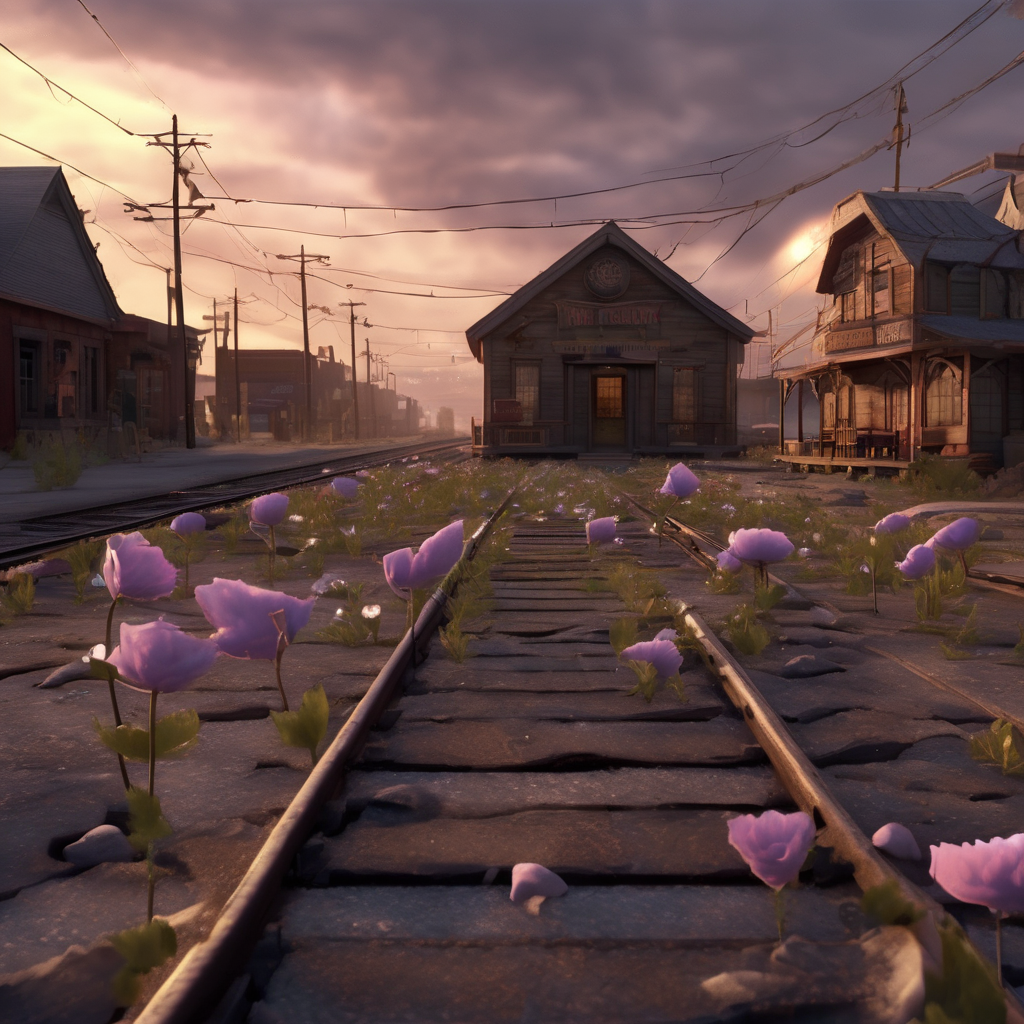
The town of Terminus had long suffered from a failure of imagination. It was the last stop on a freight line that was perpetually deprioritized, a place where the supply chain thinned to a thread before snapping. We were a town defined by what we lacked. The rising cost of living here wasn’t a headline; it was the quiet hum of the refrigerator chewing on what little it held.
I am the town archivist, Elara. My job was to curate this slow decay, filing away brittle deeds and faded photographs in a stone building that smelled of dust and finality. Before the Bloom, a general malaise had settled over us. It was a kind of communal quiet quitting, not from our jobs, but from the act of hoping. Young people who used to dream of leaving now just… stayed, slipping into hazy situationships that promised neither love nor loneliness, but a shared, gentle apathy.
Then, overnight, it appeared in the barren patch of earth at the center of the square.
It was not a flower of this world. Its stalk was the color of a storm-bruised sky, and its petals, if you could call them that, were membranes of solidified light, swirling with patterns like distant nebulae. It emitted no scent, only a low, resonant thrum that you felt more in your bones than your ears. The town’s whole vibe shifted in a single sunup.
Old Man Hemlock, who had spent a decade predicting a ‘sky-reckoning,’ was the first to approach it. We’d always dismissed him as delulu, a harmless crackpot. But as he stood before the Bloom, his face slack with vindication, he looked less like a madman and more like a prophet whose god had finally shown up. He didn’t touch it. He just wept.
The changes in the townsfolk were subtle at first, then profound. Mara, who ran the half-empty diner, stopped complaining about the price of flour. Instead, she began tracing the Bloom’s star-patterns into her countertop with a wet rag, her movements fluid and mesmerizing. Jasper, the lanky, shy boy who stocked shelves at the general store, suddenly developed a startling case of main character energy. He started wearing his grandfather’s old pilot jacket and would stand by the Bloom for hours, not looking at it, but looking out *from* it, as if the town square were a stage and he was finally ready for his monologue.
I documented it all in my ledger. I am a creature of words, of definitions. This… this was an unprecedented phenomenon. It felt cosmic, an emissary from a place beyond all our maps and charts. I found the term in a dusty astronomy text from the 19th century, a book about the theoretical boundaries of the solar system. I wrote it down, the only name that felt right for the impossible thing that had taken root in our square.
Weeks passed. The Bloom did not wither. If anything, its light grew more complex. It seemed to feed not on sun or water, but on our attention. The quiet quitting evolved. The blacksmith no longer shod the few remaining horses; he hammered thin sheets of scrap iron into delicate, spiraling sculptures that mimicked the Bloom’s form. The mayor stopped holding council meetings about our dwindling municipal funds and instead taught the children a strange, silent dance of orbits and ellipses. They weren’t ignoring their problems; they were simply operating on a different axis. The existential dread that had been our constant companion was replaced by a vast and patient curiosity.
One evening, as twilight bled purple into the sky, I left my archives and walked to the square. The thrum was stronger tonight, a clear, pure note that seemed to align the very atoms of the air. Jasper was there, and Mara, and Old Man Hemlock, and the dancing children. No one spoke. We were all just watching.
Slowly, one by one, the star-patterns inside the petals began to move. They swirled and coalesced, not into random shapes, but into images. I saw a harbour I’d never visited, the sails of its ships full with an impossible wind. I saw a city of glowing spires under a binary sun. I saw faces I didn’t know, their expressions alight with emotions for which we had no names. It wasn’t a projection; it was a sharing. A transmission.
I looked away from the Bloom and at the faces of my neighbors. The weary lines around their eyes were gone. The slump of their shoulders had straightened. They were still poor. The supply trucks still wouldn’t come tomorrow. But they were no longer residents of Terminus, the end of the line. They were pilgrims who had just been shown a map of the infinite.
I felt a hand take mine. It was Elara, the baker’s wife, a woman I’d known my whole life but had never truly spoken to. Her eyes, reflecting the light of the Bloom, were filled with galaxies.
“Do you see?” she whispered, her voice full of the same wonder that was lodged in my own throat. “It wasn’t an ending at all.”
I looked back at the luminous flower, this impossible blossom at the edge of our known world. It was a beginning. It was a promise. It was an invitation to bloom, ourselves.


Leave a Reply