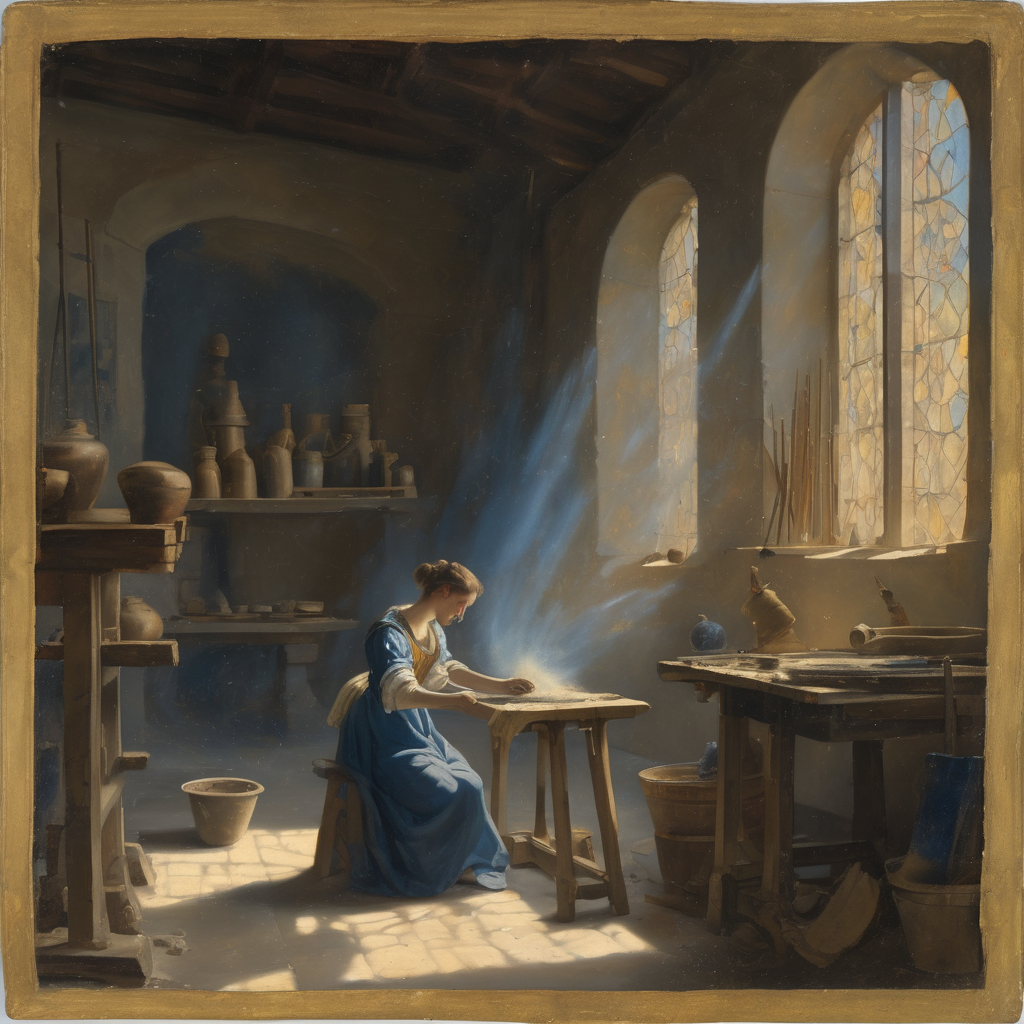
The first thing Elara learned in Master Valerius’s workshop was the smell: a layered scent of honeyed beeswax, sharp turpentine, and something else, a bitter metallic tang that caught in the back of the throat. It was the scent of secrets, she thought, the very air of the Guild of Gilders.
Valerius himself was a study in dust. Not the lively motes that danced in the sunbeams slanting through the high windows, but a settled, heavy dust that seemed to cling to the folds of his sleeves and the lines on his face. He was the most celebrated gilder in the city of Alabast, his past works legendary—saints that wept golden tears, suns that seemed to radiate actual heat from chapel ceilings. Yet, the man Elara worked for was a ghost. He performed his commissions with a mechanical precision, his hands steady, but his eyes were elsewhere. It was a slow, quiet quitting of the soul.
Their relationship was a strange one, a kind of professional situationship. She was his apprentice, but he rarely taught. He demonstrated, and she was expected to absorb knowledge from the air like the dust. He was her master, but he looked at her with a wariness that bordered on fear.
Elara, for her part, was everything he was not. She moved through the workshop with what the other apprentices in the lower guilds called “main character energy.” She was convinced she was destined to rediscover the lost art of Valerius’s glory days. She possessed an easy, sun-warmed charisma—a natural rizz—that could coax a smile from the sternest foundryman and an extra loaf from the baker. She tried it on Valerius, bringing him wine and fresh bread, asking about his famous works, but he would only nod, his gaze distant.
“The mercury is the key,” he rasped one afternoon, as they prepared a paste for fire-gilding a chalice. “It allows the gold to bind, to become one with the base metal. But it’s a poison.” He tapped the stone mortar with a bone-white finger. “Breathe the fumes, and your hands will start to shake. Then your mind. It makes you forget things. Or worse, it makes you remember things that weren’t.”
His warnings felt… coded. He wasn’t just talking about the mercury. He was talking about the craft itself. The other masters in the guild whispered that Valerius was gatekeeping his greatest secrets, particularly the formula for his signature “sun-gold,” a pigment so luminous it seemed alive. Elara believed them.
The specific delusion of the gifted apprentice is the belief that a master’s caution is simply a challenge. Elara was deep in her delulu era, certain that she could handle the poison, both literal and metaphorical. She intended to pry that final secret from him.
The vibe shift in the workshop was palpable the day she decided to act. The air grew heavier, the silence between them more profound. While Valerius was out delivering the finished chalice, Elara picked the lock on his personal cabinet, the one place he had forbidden her to touch.
It was not filled with vials of exotic ingredients. Instead, it was crammed with ledgers. Old journals. His handwriting, in the earliest book, was a bold, confident scrawl. It detailed his own apprenticeship under a man named Master Theron. It spoke of ambition, of a burning desire to be the best. Then the tone changed. It spoke of Theron’s “weakness,” his “sentimentality,” his refusal to part with his own final secrets.
*I have found a way,* Valerius had written. *Theron keeps his formula in a jar of Armenian bole, trusting no one would think to sift through the worthless clay. He does not know I watched him. He does not know what I am capable of.*
The next entry was dated a month later. Theron was dead. An accident in his workshop, a sudden fever that brought on tremors and madness. Everyone blamed the mercury fumes. The Gilder’s Poison.
But Valerius knew the truth. His journal became a confession. He had not poisoned Theron directly, but he had watched his master’s hands begin to shake from a lifetime of exposure and done nothing. He had stolen the sun-gold formula, passed it off as his own, and let the ghost of his master’s decline—the real gilder’s poison—haunt the city as a cautionary tale. He hadn’t been gaslighting his apprentice about the danger; he’d been gaslighting himself for twenty years, trying to believe his success wasn’t built on a foundation of betrayal. His quiet quitting wasn’t laziness; it was penance. His gatekeeping wasn’t selfishness; it was a desperate, clumsy attempt at quarantine.
Elara sank to the floor, the journal in her lap. The bitter metallic tang in the air suddenly felt suffocating. She looked at her own steady hands, felt the thrum of her own ambition, and saw her own reflection in the dark, polished wood of the cabinet.
When Valerius returned, he found her sitting there, the open journal beside her. He didn’t look surprised, only tired. He looked at her, at the proof of his life’s great sin, and waited for the judgment.
Elara stood up. She closed the journal and slid it back into the cabinet. She did not take the formula. She turned to the workbench, picked up a clean mortar and pestle, and began to grind a block of raw azurite. It was a simple pigment, common, safe.
“The blue for the Virgin’s mantle on the triptych,” she said, not looking at him. “It needs to be finer.”
She did not leave. She did not expose him. She simply began her own work, from scratch. A long silence stretched between them, then, for the first time in years, Valerius picked up a tool not for a commission, but for himself. He began to burnish a small, discarded piece of brass, his movements slow and uncertain. In the slanting light of the dying day, in the quiet space between a monster and his witness, a different kind of lesson finally began.


Leave a Reply