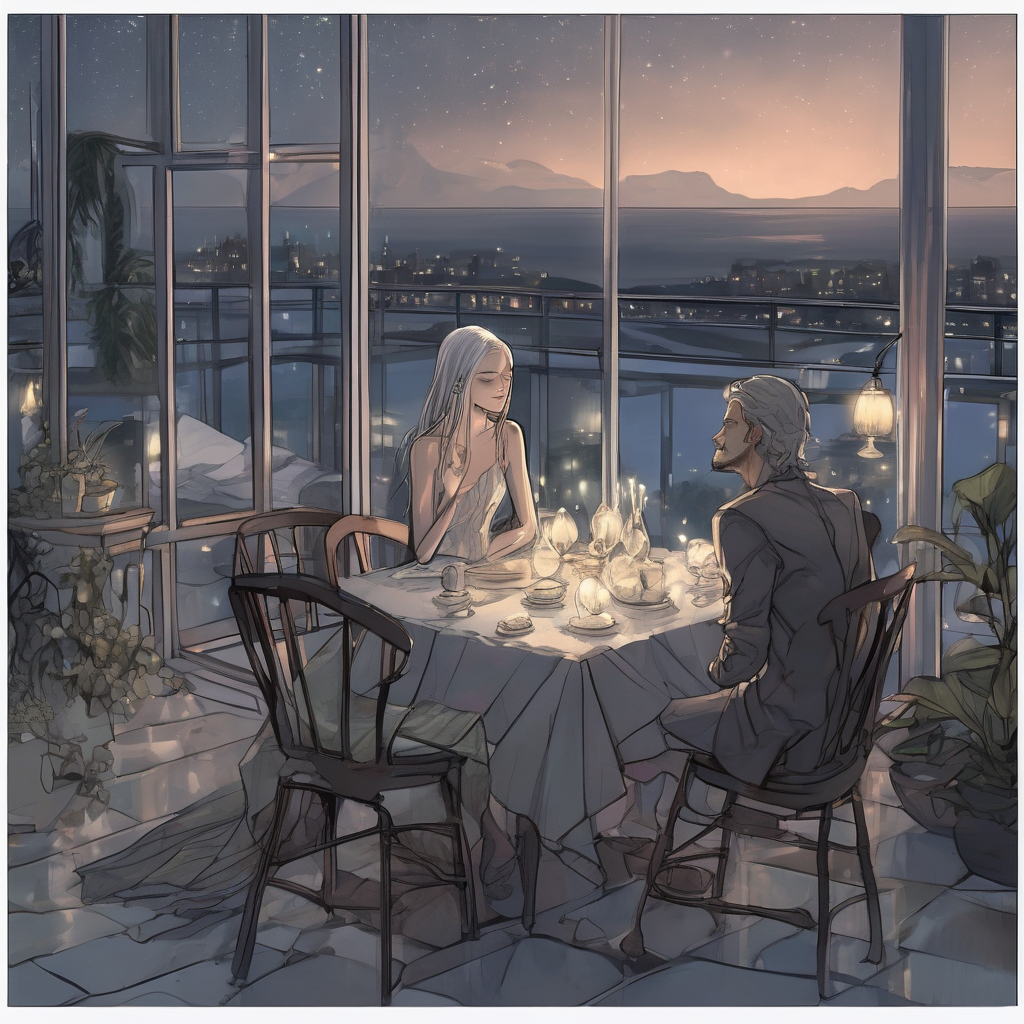
The first degree of absence was his laugh. One Tuesday it was there, a sound like gravel and honey, and the next it was gone, replaced by a polite, hollow exhalation. When Elara mentioned it, Silas just tilted his head, the light in the conservatory catching the silver in his hair. “I’ve always been a quiet laugher,” he said, and she felt a prickle of unease, the first chill of a winter she didn’t know was coming.
The second degree was his signature. The flamboyant ‘S’ that looped into the ‘i’ became a simple, spidery scratch. A bank teller refused his check, and Elara, watching over his shoulder, felt that same chill. He had to sign it three times before the teller, with a sigh, finally accepted it. Silas shrugged it off, but later Elara found his old letters and laid them side by side. The change was stark, a slow fading of personality into anonymity.
By the fourth degree, a patch of his reflection in the hallway mirror had vanished. He’d stand there, tying his shoes, and there would be a Silas-shaped hole of antique brass and floral wallpaper in the glass. He never seemed to notice. When Elara pointed, her finger trembling, he looked at her with such profound, gentle confusion that she started to believe she was the one coming undone. Her friends were no help. “It was always just a situationship, Elara,” Maya said over coffee, stirring her latte with brutal efficiency. “Maybe you’re just projecting. This is your post-him era, you need to let it be.” It felt like a diagnosis. It felt like gaslighting, but with good intentions.
The seventh degree was his scent. Sandalwood and rain. One morning she woke up and the pillow beside her smelled only of cotton and laundry soap. She buried her face in it, inhaling desperately, trying to recall the fragrance, but it was like trying to remember the exact shape of a cloud. She spent that weekend in what she later recognized as a state of pure goblin mode: door bolted, curtains drawn, surrounded by his unwashed shirts, sniffing at them like a distraught hound until they all smelled of nothing but her own panic.
She began to think of it as a broken supply chain. Some celestial quartermaster had misplaced the invoice for one Silas Croft, and his stock was not being replenished. His presence in the world was being recalled, piece by piece. She found a book by his bedside, a slim volume on theoretical metaphysics, with a corner folded on a chapter titled “The Economy of Being.” It spoke of existence as a finite resource, of souls mortgaging their future vividness for a burst of present-day brilliance. Had he done that? Had all that effortless charm, that blinding main character energy he’d possessed when they met, been a loan?
Her friends thought she’d gone mad. “You sound delulu,” Maya told her, her voice thick with pity. “People don’t just… evaporate.”
But he was. The tenth degree was his shadow, which thinned and then detached, pooling on the floor beneath him like a spill of dark water before vanishing entirely. Streetlights no longer illuminated a shape at his heels. The eleventh was his name in the mouths of strangers. A barista would call out his coffee order for “Simon,” a doorman would greet him as “Mr. Scott.” Each time, he answered without correction. He was becoming a universal placeholder.
Elara tried to de-influence the process. She would speak his name, loudly and often. “Silas,” she would say, her voice a defiant anchor. “Silas Croft. You remember that concert in the park, Silas?” She would tell stories about him to anyone who would listen, trying to reinforce his narrative, to weave him back into the tapestry of the world with the sheer force of her memory.
The twelfth degree was the touch. His hand on her arm was no longer warm, but neutral, the temperature of the air. His kiss held no pressure. He was a hologram of a man, and she was the only one with the projector.
The night of the thirteenth degree, he sat across from her at the dinner table. The chair, the wine glass, the fork were all accounted for, but the space he occupied felt porous, translucent. He was looking at her, she thought, though his eyes seemed to be looking through her, at the wall, at the city, at the stars beyond.
“I have to go,” he whispered, and the words had no vibration. They were the idea of sound, not the thing itself.
Elara didn’t cry. She reached across the table, her hand passing through the space where his was supposed to be. She picked up a small, smooth stone he had given her from a beach in another lifetime. It felt solid, real, heavy with the weight of what it had once represented.
“I will remember you,” she said to the empty air, to the shiver of absence that was the last of him. “I will be your ledger.”
The room was still. The chair was empty. The world outside the window was unchanged. But Elara remained, clutching the stone. The account was settled, the balance paid. He was gone, completely and utterly, in thirteen perfect, heartbreaking increments. And in the terrible quiet that followed, she was the sole, stubborn proof that he had ever been there at all.


Leave a Reply