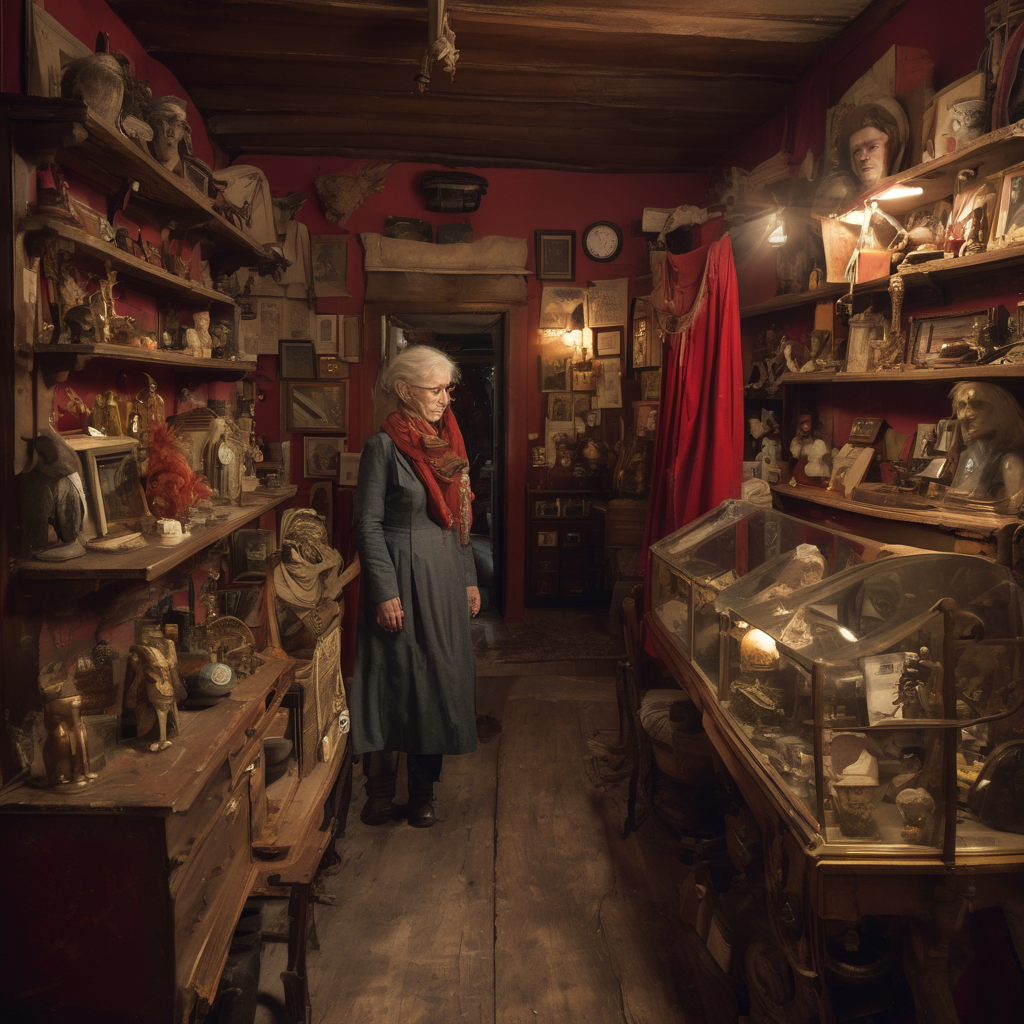
The dusty shelves of Elara’s shop held more than antiques—they contained fragments of lives once lived. Each piece hummed with the echo of its former owner’s most precious moments: a grandmother’s last lullaby trapped in a music box, a father’s pride crystallized in a military medal, a lover’s whisper embedded in a silk scarf.
She was the last of her kind in this sprawling city where people had grown too busy to remember, too rushed to hold onto anything that couldn’t be monetized or optimized for productivity. The art of memory preservation, once revered among her people, had become as obsolete as handwritten letters.
The brass bell above her door chimed as Marcus entered, his designer coat dripping November rain onto her worn Persian rug. He’d been circling her shop for weeks, she’d noticed, always pausing at the window but never entering until now.
“I need something that doesn’t exist anymore,” he said, his voice carrying the particular exhaustion of grief.
Elara set down her tea and studied him—the hollow beneath his eyes, the way his hands trembled slightly. “What did you lose?”
“My daughter.” The words fell like stones. “Cancer. She was eight.” He pulled out his phone, showed her a photo of a girl with gap-toothed grin and paint-stained fingers. “I have thousands of pictures, hours of video, but I can’t… I can’t remember the sound of her breathing when she slept. The way she hummed when she was happy. The things that made her her.”
Elara felt the familiar tug in her chest, the pull toward someone whose memories were fracturing like old film. She’d helped countless clients over the decades, but her gift was fading. Each memory extraction took more from her now, leaving her own past hazier, more fragmented.
“Memory work isn’t like photography,” she warned. “It’s archaeology. Dangerous archaeology. And expensive.”
“I have money.”
“I don’t want your money.” She moved toward a cabinet filled with crystalline vials. “I want something else. A fair trade—one of your memories for one of hers.”
Marcus stepped back. “Which memory?”
“I won’t know until I’m inside. The memories choose themselves.” She turned to face him, her weathered hands steady despite her age. “Your daughter’s essence is still clinging to things she touched, places she loved. But accessing it means I have to sift through your grief, your joy, your entire relationship with her. Some fragment of that will stick to me, and some piece of you will be… quieter afterward.”
The rain drummed harder against the windows. Marcus walked the perimeter of her shop, past the wedding dress that still held echoes of dancing, past the cookbook splattered with a mother’s Sunday morning patience. He stopped at a child’s wooden horse, painted red with a golden mane.
“She had one like this,” he whispered.
Elara nodded. “Toys are powerful vessels. They absorb wonder, imagination, the particular brand of love that comes from holding something close during sleep and sickness and secret fears.”
“Do it.”
She prepared the ritual with practiced precision—candles arranged in specific patterns, herbs that would help her navigate the labyrinth of memory, tools inherited from her grandmother’s grandmother. The old ways, nearly extinct but still potent.
“Give me something that was uniquely hers.”
Marcus pulled a small notebook from his jacket, pages filled with crayon drawings and invented words in careful eight-year-old handwriting. “She was always making up stories.”
The moment Elara touched the notebook, the world dissolved.
She was underwater in Marcus’s mind, swimming through years of bedtime stories and scraped knees and birthday mornings. She felt his terror in hospital waiting rooms, his fierce protectiveness, his helpless rage at a universe that would take children. But deeper, beneath the sharp edges of loss, she found the golden threads—quiet moments that had settled into his subconscious like sediment.
There: the particular melody his daughter hummed while coloring, a wordless tune that seemed to channel pure contentment. There: the soft whistle of her breathing during afternoon naps, when fever finally broke and sleep came peaceful. There: the way she’d whisper “I love you, Daddy” not just at bedtime but randomly, spontaneously, while building blocks or watching cartoons, as if the feeling simply overflowed and had to be spoken.
Elara gathered these fragments carefully, pulling them from the deep places where Marcus couldn’t consciously reach. But the extraction demanded payment, as it always did. She felt one of her own memories loosening—her first kiss, tender and nervous under spring moonlight—and watched it drift away into the ether, the price of her gift.
When she surfaced from the trance, Marcus was crying soundlessly. In her hands, three small vials glowed with captured warmth.
“Wear them close to your heart,” she instructed, her voice hoarser than before. “When you need to remember how she sounded when she was truly happy, break the seal on the first. When missing her feels unbearable, the second will remind you how peaceful she could be. The third…” she paused, studying the brightest vial. “The third contains something rarer. Her love for you, distilled. Use it wisely.”
Marcus cradled the vials like they held stars. “What did you take from me?”
Elara couldn’t quite remember anymore—the extracted memory was already integrating into her own consciousness, becoming part of her collection of borrowed experiences. But she felt lighter somehow, as if she’d been carrying his grief alongside her own and hadn’t realized the weight until it shifted.
“Nothing you’ll miss,” she lied gently. “The important things remain.”
After he left, Elara sat among her shelves of crystallized moments and felt the familiar melancholy of her calling. She was dying, she knew. Each memory extraction aged her, wore away at the borders of her own identity. Soon there would be no memory merchants left, no one to preserve the intangible treasures that made life more than mere existence.
But in saving Marcus’s connection to his daughter, in ensuring that a father’s love could transcend death itself, perhaps she’d done something that mattered. Perhaps the old ways would find new practitioners. Perhaps some things were worth preserving, even at great cost.
Outside, the rain continued its ancient song, washing the city clean while Elara tended her garden of borrowed dreams, keeping vigil over the fragments of lives that refused to be forgotten.


Leave a Reply