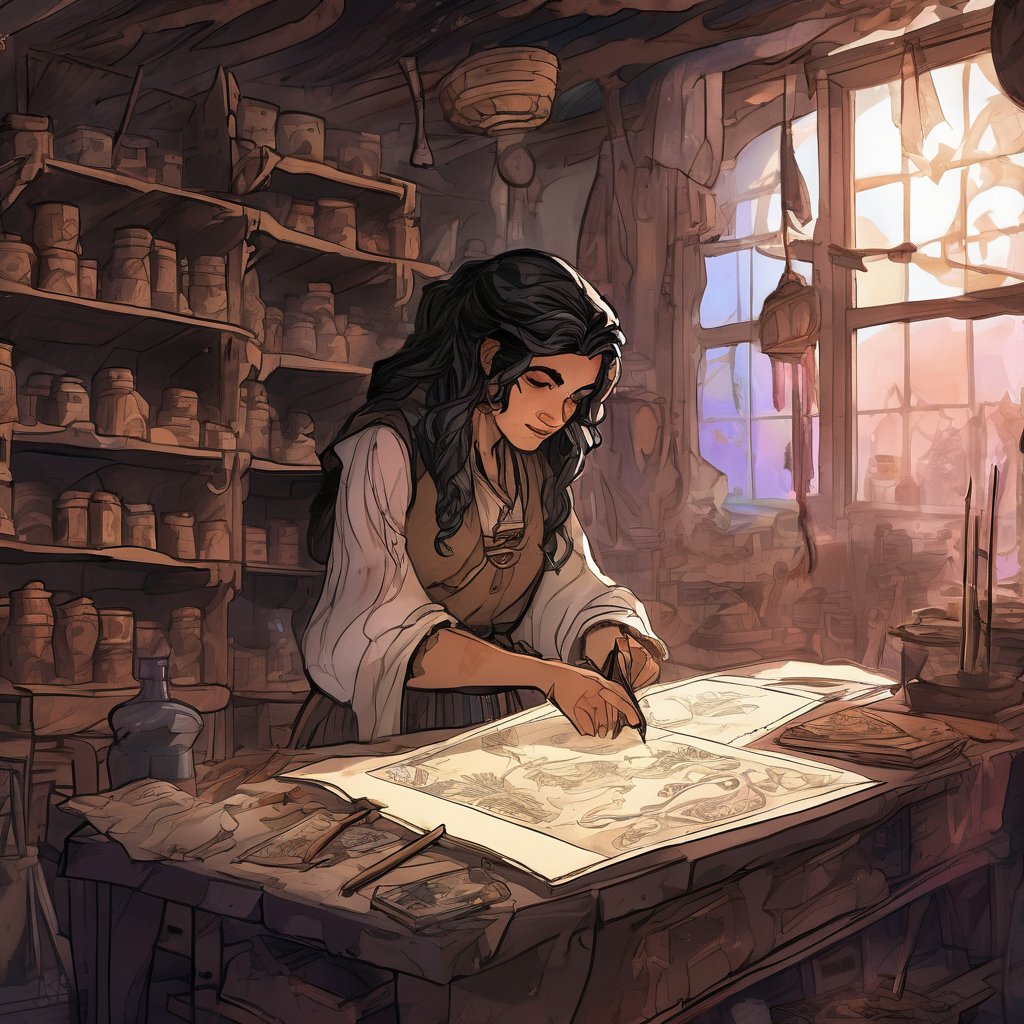
The cartographer’s shop smelled of ink and longing. Esmeralda traced her fingers across the newest commission—a map of the Forgotten Archipelago, where islands supposedly shifted position with the tides of human memory. Her father had been dead three weeks, leaving behind only debt and a curious notation in his final journal: “The spaces between places hold more truth than the places themselves.”
She’d discovered his secret room that morning, hidden behind a false wall of ordinary street maps. Inside, hundreds of charts covered every surface, but these weren’t ordinary maps. They showed the geography of things that shouldn’t exist: the Valley of Unspoken Words, the Mountains of Lost Socks, the Sea of Algorithms (which her father had noted “flows backward on Tuesdays”).
The bell above the shop door chimed. A woman entered, wearing a dress that seemed to be cut from storm clouds, its fabric shifting between states of matter.
“You’re Esmeralda,” the woman said. It wasn’t a question. “I need a map to find my daughter. She’s been canceled.”
“Canceled?” Esmeralda set down her pen.
“Not in the way your generation means. Literally erased. She spoke the name of a place that doesn’t want to be found, and now she exists only in the margins.” The woman placed a leather pouch on the counter. It rattled with what sounded like dice made of moonlight. “Your father once mapped the Sustainable City of Unbecoming. I need to go there.”
Esmeralda had seen that map in the secret room—a city that existed only for those who needed to cease existing, temporarily or otherwise. It was drawn in an ink that changed color depending on the viewer’s intentions.
“The journey requires cryptocurrency,” Esmeralda said, remembering her father’s notes. “Not the kind you’re thinking of. Actual encrypted currency—words that mean one thing but carry another. You’ll need to speak in riddles at the border.”
She began drawing the map on vellum made from recycled shadows. The route wound through the District of Collective Resilience, where survivors of various apocalypses had built homes from the bones of their former worlds. Past the Tower of Viral Sorrows, where every human grief eventually found its way, spreading from person to person like a beneficent disease.
“There’s been a recession in reality lately,” Esmeralda explained as she worked. “Places are pulling back, becoming less accessible. The bridges between here and there are experiencing inflation—they demand more belief than before.”
The woman watched the map emerge. “Your father said you had the gift, but that you denied it.”
Esmeralda’s hand paused. She’d spent years creating ordinary maps for ordinary people, refusing to acknowledge that she could see the hidden territories, the places that existed in parallel to consensus reality. But her father’s death had left the shop vulnerable to audit by the Ministry of Tangible Things.
“When you find the city,” Esmeralda continued, adding a small notation in the corner, “look for the Diversity Gardens. That’s where the canceled ones tend to gather—people and places and ideas that were erased for being too much or not enough. They exist there in a state of mindful rebellion.”
She finished the map with a warning written in disappearing ink: “This place practices radical inclusivity. You may find your daughter changed.”
The woman took the map, studying it as if it were a medical diagnosis. “What do I owe you?”
“A story,” Esmeralda said. “Something true that never happened.”
The woman smiled for the first time. “Your father asked for the same payment. Very well. Once, I fell in love with a man made entirely of electoral promises. He dissolved every four years and reconstituted himself based on polling data. We had three children together—your customer service representatives of the world, actually. They live everywhere and nowhere, speaking from scripts written by the universe itself.”
After the woman left, Esmeralda returned to her father’s secret room. She understood now why he’d hidden this work, why he’d pretended to be an ordinary mapmaker. The world was experiencing disruption on a metaphysical level. Places were becoming self-aware, developing climate anxiety, demanding sustainable practices for existing.
She pulled out a blank sheet of impossible paper—made from trees that had decided not to grow—and began her first real map. It would show the route to her father, wherever death had taken him. She suspected he’d simply relocated to one of his mapped territories, probably the Peninsula of Productive Procrastination, where nothing ever truly ended.
The ink flowed like leaked classified information, revealing more than intended. As she drew, Esmeralda felt the shop itself beginning to shift, becoming what it had always been meant to be: a clearinghouse for the geographically displaced, a hybrid space where the mapped and unmappable could coexist.
Tomorrow, she thought, she’d hang a new sign: “Resilient Cartography for Transparent Destinations.” Let the Ministry come. She’d map them a route to their own irrelevance.
The last line she added to her father’s map was a small note in the margin: “All destinations subject to availability. Reality may vary.”


Leave a Reply