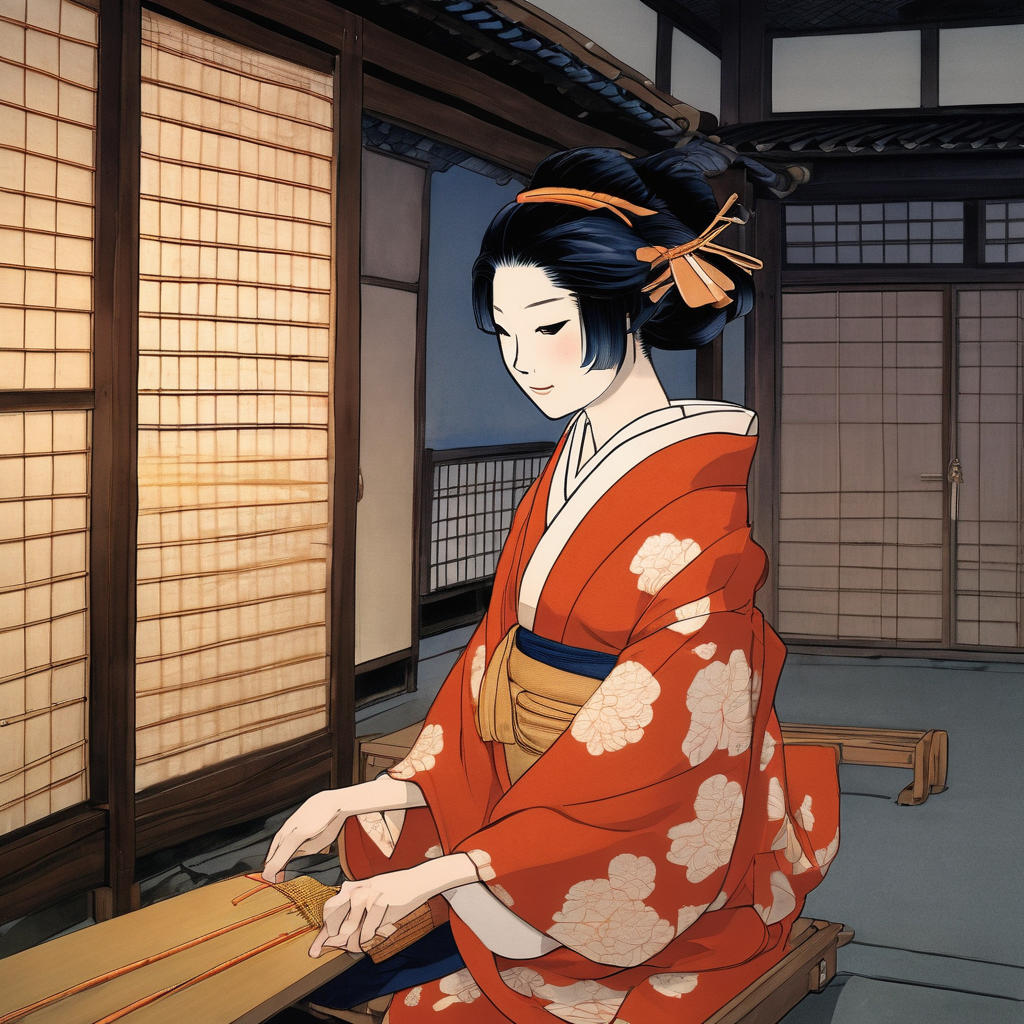
In the heart of Kyoto’s Gion district, where geishas still glided through the narrow alleys like ethereal beings, a young woman named Emiko lived a life woven from the threads of tradition and innovation. She was the daughter of a revered silk weaver, known for his exquisite kimonos that told stories of ancient myths and samurai legends. Emiko’s fingers were deft, her eyes keen, and her imagination ablaze with the vibrant hues of the Kyoto gardens, where cherry blossoms burst forth like pink-tinged fireworks against the grey stone temples.
As a child, Emiko had watched her father work his loom, the rhythmic clack-clack-clack a lullaby that transported her to a world of fantasy. She learned to weave the intricate patterns that danced across the fabric, but her true passion lay in experimenting with sustainable dyes derived from the city’s flora – indigo from the tsuyukusa flowers, saffron from the crocuses that bloomed in the temple gardens. Her father’s clients adored the resulting kimonos, which seemed to capture the essence of Kyoto’s spiritual landscape.
One fateful evening, as the sun dipped behind the Fushimi Inari torii gates, casting a vermilion glow over the city, Emiko received an enigmatic commission from a mysterious patron. The client requested a kimono that embodied the essence of ‘yūgen’ – a profound, mysterious sense of the beauty of the world. Intrigued, Emiko set to work, pouring her heart and soul into the fabric. She wove in threads of silver and gold, and dyed the silk in shades that evoked the soft luminescence of the city’s lantern-lit nights.
As she worked, Emiko found herself drawn into a world of surreal beauty, where the boundaries between reality and dreams blurred. The kimono began to take on a life of its own, as if it were a portal to a realm where the ancient and the modern coexisted in harmony. When the garment was complete, Emiko beheld a masterpiece that seemed to shimmer with an otherworldly light. The mysterious patron appeared, a figure shrouded in shadows, and accepted the kimono with a bow that was almost reverent.
As the patron vanished into the Kyoto night, Emiko felt the fabric of her reality subtly shift, as if the essence of ‘yūgen’ had seeped into her very being. She knew that her father’s art, combined with her own innovative spirit, had created something truly transcendent – a garment that would be cherished for generations to come, a testament to the timeless beauty of Kyoto, and the boundless creativity of its people.


Leave a Reply