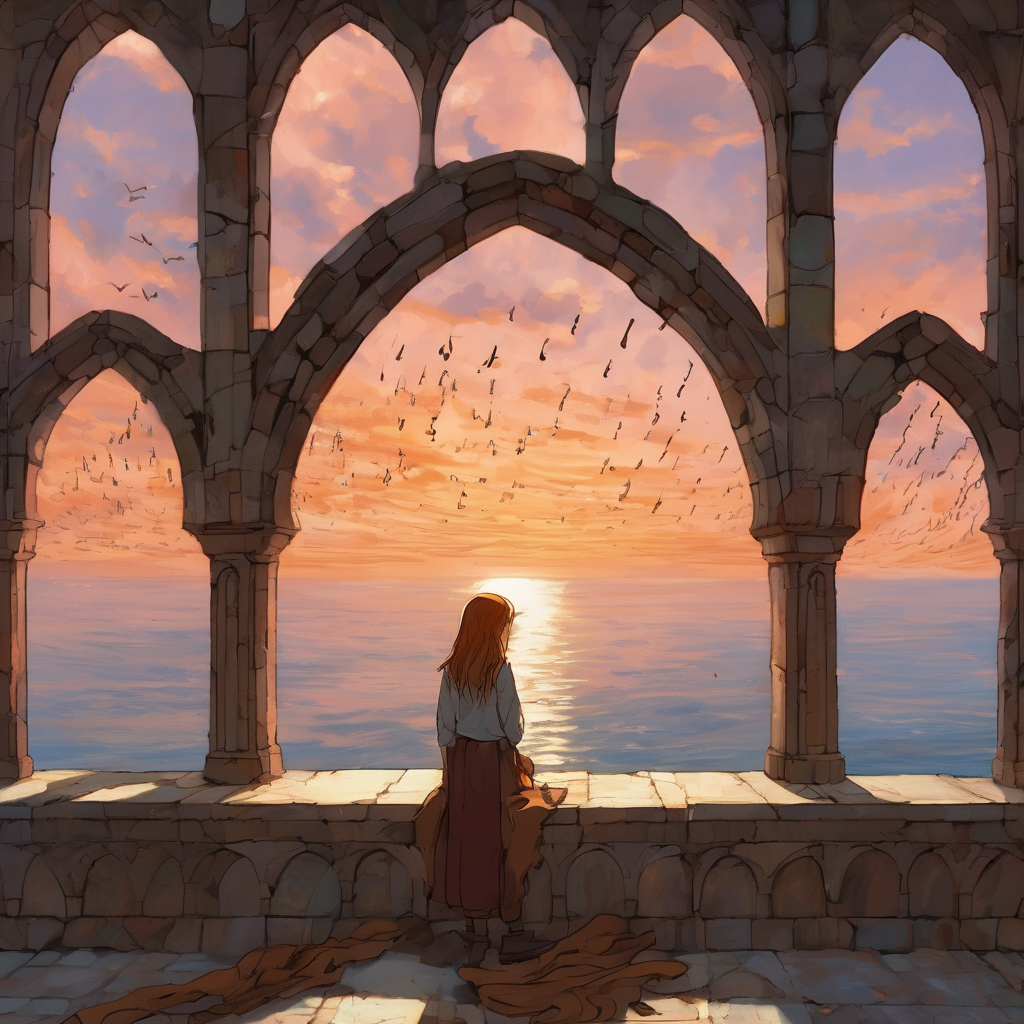
The monastery floated three miles above the Caspian Sea, tethered to reality by nothing more than the collective faith of seventeen monks who had taken vows of mathematical silence. Brother Marcus traced equations in the condensation on his cell window, watching the sunset paint the clouds below in shades of copper and rust.
For six hundred years, the Order of Epsilon Minor had safeguarded the world’s most dangerous theorem—a calculation so profound it could unravel the binding forces between atoms, or worse, between hearts. They called it the Last Algorithm, though it predated computers by centuries, inscribed on clay tablets in a language that existed before vowels were invented.
Marcus had been struggling with insomnia for weeks, ever since the abbott mentioned seeing unusual patterns in the tea leaves. The old man claimed the patterns resembled cryptocurrency symbols, though none of the brothers knew what those ancient merchant runes meant anymore. The world below had moved on to stranger currencies—trading in condensed starlight and bottled Tuesday afternoons.
That night, as Marcus attempted another meditation on the square root of negative infinity, he heard it: a sound like sustainability itself crying. He rushed to the courtyard where Brother Thomas stood frozen, his mindfulness practice interrupted by an impossible sight. The monastery’s sacred algorithm, usually invisible except during eclipses, had materialized in the air above them, its numbers writhing like living things.
“Someone’s trying to solve it,” Thomas whispered, his voice hoarse with fear.
They found her in the lower library, surrounded by floating chalk that drew equations faster than human hands could move. She couldn’t have been more than sixteen, her hair the color of oxidized copper, wearing a cloak made entirely of rejected lottery tickets.
“My name is Ivy,” she said without looking up. “My grandmother sold me her remaining heartbeats to pay for our house, but the bank claimed the heartbeats were counterfeit. I need the Algorithm to prove they were real.”
Marcus felt his vow of mathematical silence straining. The Algorithm could indeed verify the authenticity of traded heartbeats—it could verify anything that had ever existed or might exist. But using it would risk everything.
“Child,” the abbott appeared in the doorway, his beard containing three small birds that nested there during winter, “the Algorithm isn’t meant for personal disputes. It’s a nuclear option for reality itself.”
Ivy’s equations grew more frantic. The floating chalk began drawing in dimensions the monks couldn’t see, creating formulas that existed in the spaces between breathing. “Then reality itself is personally disputed,” she said.
The monastery shuddered. Below, the Caspian Sea began to calculate itself, each wave becoming a number, each number becoming a question. Brother Thomas’s phone, which he’d hidden despite the vows, began playing music nobody had written yet—melodies from next Thursday, compressed into now.
“If we don’t help her,” Marcus said, breaking his seventeen-year silence, “she’ll solve it wrong. And a wrong solution is worse than no solution.”
The abbott closed his eyes, communing with the founders of their order through the mathematical constant they all shared in their bones. Finally, he nodded.
Together, the seventeen monks formed a circle around Ivy, their combined knowledge creating a firewall of pure logic. They guided her hand as she wrote the final sequence, the part of the Algorithm that even God had forgotten existed. The numbers began to sing—not metaphorically, but literally, their vibrations creating harmonies that made the air taste purple.
When the last symbol was drawn, everything stopped. The floating monastery. The waves below. The birds in the abbott’s beard. Even Tuesday held its breath.
Then, with a sound like empathy dividing by zero, the Algorithm provided its answer: Yes, the heartbeats were real. Yes, the bank knew it. Yes, love could be converted to currency but the exchange rate was always rigged.
Ivy’s lottery ticket cloak burst into butterflies—real ones, not metaphorical, each wing printed with a winning number from futures that might have been. She smiled at the monks, older now than when she’d arrived, though only minutes had passed.
“The Algorithm changes you,” she said, gathering the butterflies into a bag that hadn’t existed until she needed it. “But so does everything worth solving.”
As she left, walking down the invisible stairs that appeared only for those who’d touched truth with their bare hands, Marcus noticed something different about the monastery. It no longer floated through faith alone. Now it was held aloft by something stronger: the knowledge that some problems, once solved, change the nature of problems themselves.
The abbott released the birds from his beard. They flew in patterns that spelled out gratitude in languages not yet invented. Below, the Caspian Sea resumed its ancient calculations, but now included variables for mercy.
Brother Marcus returned to his cell and drew new equations in the condensation—not the old formulas of containment and control, but wild new mathematics of possibility. Outside his window, the sunset divided itself into infinite colors, each one a solution to a question nobody had thought to ask.
The Last Algorithm of Epsilon Minor had been used, and the world had survived. But more importantly, it had remembered how to imagine survival differently.


Leave a Reply