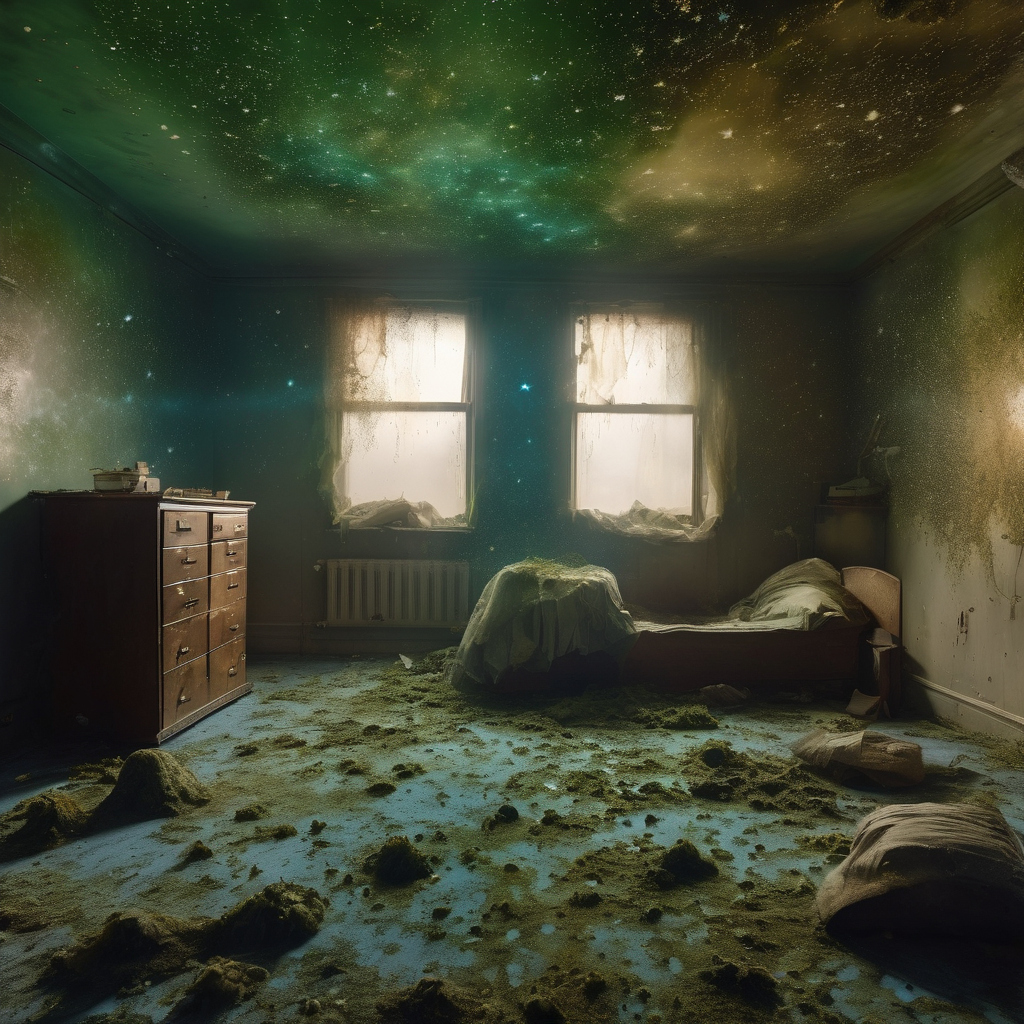
Margot’s fingers traced the constellation of mold spots on the apartment ceiling, mapping territories that existed nowhere else. The eviction notice lay crumpled beside her mattress, but she barely noticed anymore. Three months behind on rent, her phone disconnected, she’d become invisible to everyone except the fungi that bloomed across her walls like unexplored continents.
She discovered her gift during a fever dream, when the water stains above her bed revealed themselves as portals. Not metaphorical ones—actual doorways to places that had slipped through the cracks of reality. The first time she pressed her palm against the damp plaster, her hand passed through into somewhere else entirely.
The Forgotten Realms, she called them. Places that had once existed but were now accessible only through decay—through the democratic spread of rot that connected all abandoned things. A burned library in Alexandria where scrolls still whispered. A Venetian palazzo that had sunk not into water but into forgetting itself. Each realm required a map, and Margot drew them on napkins stolen from the coffee shop where she pretended to job hunt.
Her landlord, Mr. Chen, knocked again. “Margot, I know you’re in there. We need to talk about a payment plan.”
She pressed her eye to a penny-sized hole in the wall—another portal, this one opening onto a Victorian photography studio where silver nitrate ghosts still posed for portraits that would never develop. Through the hole, she watched a woman in a bustle arrange her hands just so, waiting eternally for the flash that had already come and gone.
“I’m creating content,” Margot called through the door, which wasn’t entirely a lie. She was documenting worlds, even if no algorithm would ever serve them to anyone.
Mr. Chen sighed. “The sheriffs come tomorrow, Margot.”
After his footsteps faded, she returned to her work. The bathroom mirror, cracked in seven places, showed seven different reflections—each crack a longitude line on her impossible atlas. In one reflection, she wore a crown of newsprint. In another, her face was made entirely of departed subway routes.
She’d been mapping the same realm all week: a place where canceled TV shows continued their storylines, where character arcs completed themselves without audiences. It was accessible through a burn mark on her hotplate, shaped vaguely like a ship. The realm fascinated her because it suggested something profound about incompleteness, about narratives that refused to stop existing simply because humans had stopped watching.
That night, climate change arrived in her apartment as a personal apocalypse. The pipes burst—not from cold but from heat, the water boiling as it emerged. Steam rose and condensed on every surface, creating new maps, new doorways. The Forgotten Realms were destabilizing, borders shifting like caucus results nobody trusted.
Margot understood then: she wasn’t just their cartographer but their sustainability plan. These places needed someone to remember them, to trace their boundaries before they dissolved entirely. She was their last witness, their final constituency of one.
She began to pack—not her belongings but herself, piece by piece, into the various realms. Her hunger went to the Victorian studio, where it could feast on silver and light. Her debt went to the burned library, where it transformed into scholarly footnotes nobody would read. Her loneliness she sent to the realm of canceled shows, where it became a character beloved by no one but itself.
When the sheriffs arrived the next morning, they found only an empty apartment with unusual water damage. The walls were covered in what looked like maps, but maps of nowhere anyone recognized. The bathtub contained seventeen different colors of mold, arranged in a pattern that hurt to perceive directly.
Mr. Chen stood in the doorway, holding the master key that now felt alien in his hand. “She paid everything she owed,” he said quietly, though he couldn’t explain the seventeen mint-condition Spanish doubloons he’d found in his mailbox, coins that carbon dating would later prove were simultaneously brand new and three hundred years old.
The apartment sat empty for months. New tenants came to view it but always left with headaches, claiming the space felt “too full” despite being vacant. Eventually, Mr. Chen stopped showing it. Sometimes he’d unlock the door and stand there, looking at the water stains that seemed to shift when he wasn’t watching directly.
Once, he thought he saw Margot in the bathroom mirror, drawing maps on fog that wasn’t there. She looked healthy, purposeful, her hands moving with the confidence of someone who had finally found their true work. When he blinked, she was gone, but a new water stain had appeared on the ceiling—shaped exactly like a door.


Leave a Reply