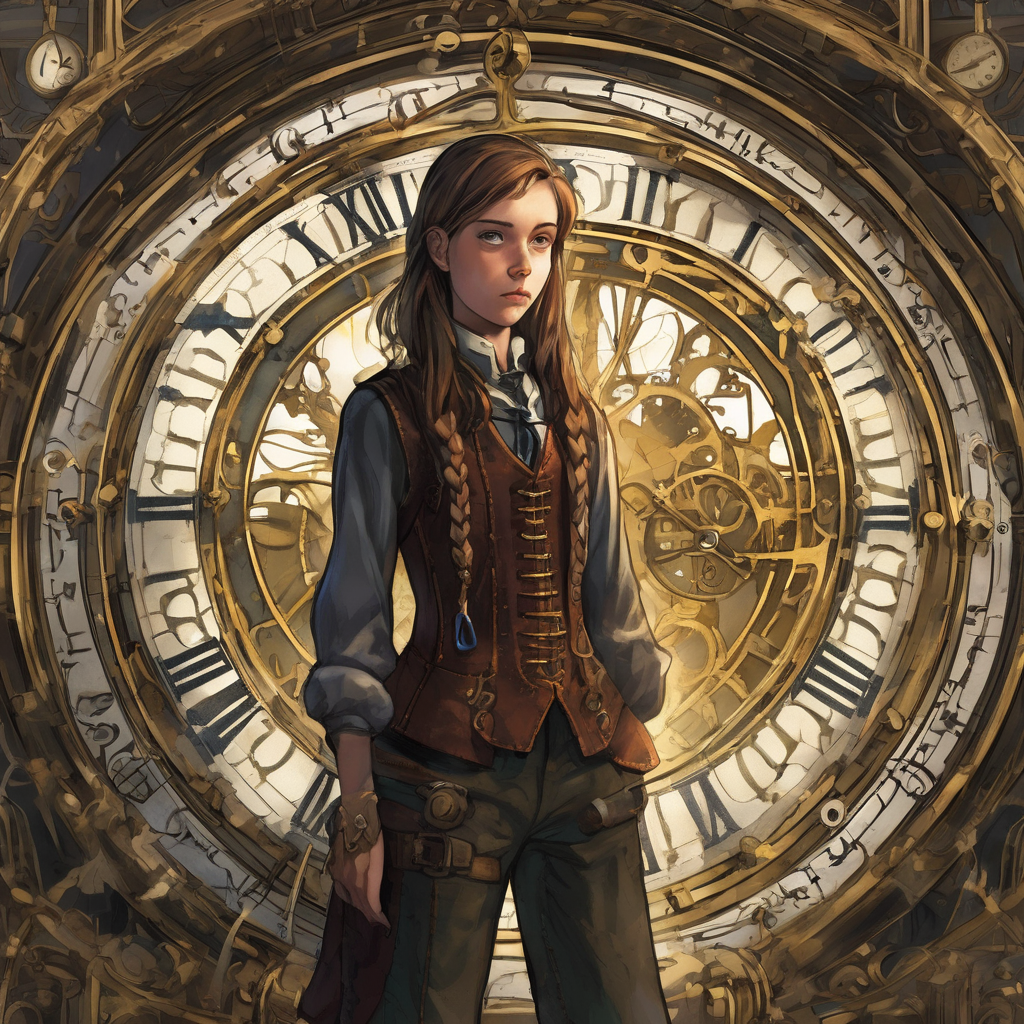
Iris had always known she was different from the other children in the village. While they played with wooden dolls and rolling hoops, she spent her afternoons in her father’s workshop, watching him coax life from brass gears and delicate springs. The townspeople whispered that Magnus the Clockmaker had made a pact with time itself, but Iris knew better. Her father simply understood that every moment held its own heartbeat.
The trouble began the morning after her sixteenth birthday, when the great clock in the town square began chiming thirteen times at noon. The villagers gathered in confusion, pointing at the ornate timepiece that had kept perfect time for three generations. Iris felt a strange pulling sensation in her chest, as if invisible threads connected her to the errant mechanism.
“It’s broken,” declared the baker, flour still dusting his apron. “Magnus must fix it immediately.”
But when they arrived at the workshop, they found it empty save for a peculiar note written in her father’s careful script: “The thirteenth hour has come. Iris knows what must be done.”
The villagers turned to her with expectant faces, but Iris had no idea what her father meant. She had helped him repair countless timepieces, but never had he spoken of a thirteenth hour. As the crowd dispersed, muttering about unreliable craftsmen, Iris remained alone with the ticking chorus of unfinished clocks.
She searched through her father’s papers, finding sketches of impossible mechanisms and calculations that spiraled into infinity. Hidden beneath his workbench, she discovered a leather journal bound with copper wire. The first page bore her name in elegant script, followed by words that made her hands tremble: “For when the world needs more time.”
The journal revealed her father’s greatest secret. Every clock he had ever made contained a fragment of borrowed time—minutes stolen from moments of boredom, seconds skimmed from periods of waiting. He had been collecting these temporal crumbs for decades, storing them in a great reservoir that existed between the twelfth and first hours. Now that reservoir was full, and time itself was beginning to overflow.
As Iris read deeper, she learned that she was not merely the clockmaker’s daughter, but his apprentice in ways she had never understood. The pulling sensation in her chest was her inheritance—the ability to feel time’s rhythm, to sense where it gathered and where it ran thin. The great clock’s thirteenth chime was not an error but a warning. Without intervention, time would continue to accumulate, creating pockets where minutes stretched into hours, where seconds became sticky as honey.
She found the key to her father’s most secret workshop hidden inside the pendulum of an old grandfather clock. The room beyond the hidden door hummed with temporal energy. Thousands of tiny clockwork butterflies hung suspended in glass spheres, their wings beating in perfect synchronization. At the center sat a magnificent timepiece unlike any she had ever seen—its face showed not twelve hours but thirteen, and the thirteenth segment glowed with captured moments.
Her father stood beside it, not absent as she had feared, but translucent, caught between moments like a photograph exposed to too much light.
“You came,” he said, his voice echoing strangely. “I wasn’t certain the journal would be enough.”
“Father, what’s happening to you?”
“I tried to fix the overflow myself, but I became caught in the thirteenth hour. Time moves differently here—I am everywhere and everywhen in this moment.” He gestured to the great timepiece. “But you can complete what I started. You have the touch, Iris. I’ve seen you unconsciously adjusting the small clocks, making them run true. You’ve always known when time felt wrong.”
The clockwork butterflies began to glow more brightly, their synchronized beating growing urgent. Through the workshop’s windows, Iris could see the village frozen in the midst of daily activities—the baker’s wife suspended mid-step, a cat hanging motionless as it leaped between fence posts.
“How do I fix this?”
Her father pointed to thirteen small keys arranged around the great timepiece. “Each key releases the borrowed time back to where it belongs. But they must be turned in the precise order that time was taken, or the moments will scatter chaotically.”
Iris approached the magnificent clock, feeling the temporal currents flowing around her like invisible rivers. She closed her eyes and let her inherited sense guide her to the first key. As she turned it, she felt a rush of lazy summer afternoons flowing out of the mechanism—time stolen from children waiting for the school bell, from lovers lingering over long goodbyes.
Key by key, she released decades of collected moments. Minutes taken from tedious sermons flowed back to Sundays past. Seconds skimmed from watched pots returned to impatient kitchens. Hours borrowed from sleepless nights found their way back to worried mothers and anxious students.
With each key turned, her father became more solid, more present. The clockwork butterflies began to slow their frantic beating, and through the windows, she could see the village gradually returning to motion.
As she reached for the thirteenth and final key, her father caught her hand.
“This one is different,” he warned. “This contains not borrowed time, but gifted time—moments freely given by those who loved deeply, who wished they could give their beloved just a little more time together. If you release this, you’ll be giving the world something precious: the ability for love to create its own moments, for deep connection to stretch seconds into small eternities.”
Iris turned the final key without hesitation. The release of gifted time felt different—warm and golden, like sunlight made tangible. The great timepiece chimed once, a pure note that seemed to harmonize with every heartbeat in the village.
When the sound faded, her father stood before her completely solid again, smiling with pride and relief.
“The thirteenth hour?” she asked.
“Is now where it belongs—not as an extra hour to be counted, but as the space between moments where love lives, where inspiration strikes, where people find exactly the time they need for what matters most.”
As they walked back to the main workshop, Iris noticed that every clock now bore a subtle difference—a tiny crystal embedded in each face that caught the light and threw it back as rainbow fragments. Her inheritance, she realized, was not just the ability to repair time, but to help it flourish.
The great clock in the town square chimed noon with twelve perfect notes, and in the space between the final chime and the first sound that followed, Iris felt the presence of the thirteenth hour—not as chaos or overflow, but as grace made temporal, as love’s gift to a world that would always need just a little more time.


Leave a Reply