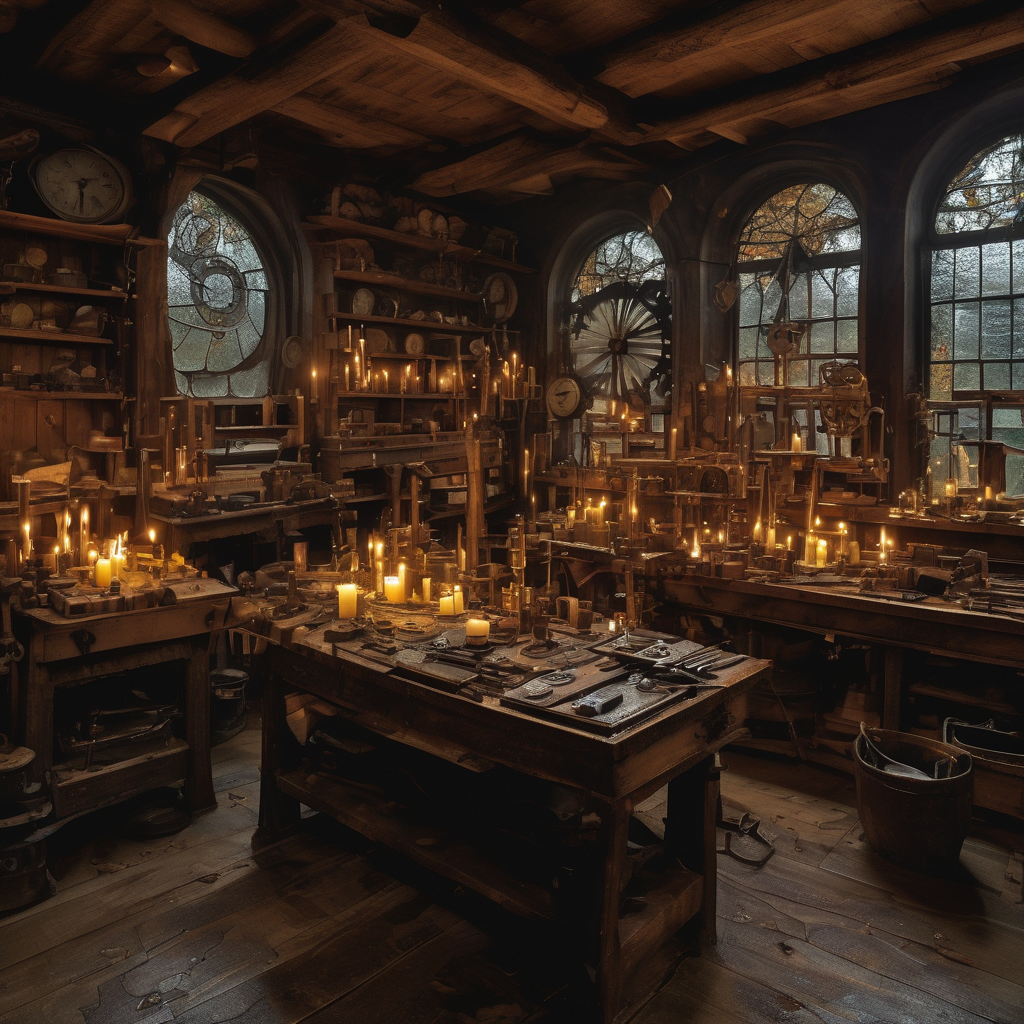
Master Cornelius had been crafting timepieces for forty-seven years when the Queen’s messenger arrived at his workshop with the impossible commission. The parchment bore the royal seal and a single, chilling demand: create a clock that could turn back time itself, or face execution at dawn.
The old clockmaker’s weathered hands trembled as he read the decree. His apprentice, young Mira, peered over his shoulder with wide eyes. “Master, surely this is some jest?”
Cornelius shook his head grimly. “The Queen has lost her beloved daughter to the plague. Grief makes monsters of us all, child. She truly believes I can bring back the dead through clockwork.”
Outside, autumn rain drummed against the workshop’s diamond-paned windows. The familiar sounds of gears turning and pendulums swinging seemed to mock him now. Every tick brought him closer to his doom.
“There must be something we can do,” Mira whispered, her voice barely audible above the mechanical symphony surrounding them. She was perhaps eighteen, with ink-stained fingers and an intuitive understanding of springs and escapements that had taken Cornelius decades to master.
The clockmaker studied his life’s work—hundreds of timepieces covering every surface, each one a testament to his skill but none possessing the impossible power the Queen demanded. Then his gaze fell upon a curious device tucked behind a row of grandfather clocks. It was something he’d inherited from his own master years ago, a strange mechanism that defied explanation.
“The Chronos Engine,” he murmured, more to himself than to Mira.
The device resembled no earthly clock. Its case was forged from meteoric iron that seemed to absorb light, and its face displayed not numbers but ancient symbols that shifted when viewed directly. Most peculiar of all, its hands moved independently of any earthly time, sometimes racing forward, sometimes drifting backward, following rhythms known only to itself.
“I’ve never seen you work on that one,” Mira observed, approaching the enigmatic timepiece with cautious fascination.
“Because it was never broken, and I never understood its purpose. My master claimed it was crafted by monks in a monastery that exists outside of time itself. Nonsense, I always thought.”
But as midnight approached—the hour of his deadline—Cornelius began to reconsider what he’d dismissed as fantasy. The Queen’s soldiers would come with the dawn, and conventional clockwork would not save him.
Working through the night, he and Mira carefully dismantled the Chronos Engine, studying each impossible component. The gears were cut from crystallized starlight, the springs wound from solidified music, the pendulum carved from petrified tears. Everything defied natural law, yet somehow functioned in perfect harmony.
“Master,” Mira said suddenly, her voice strange with wonder. “Look at the inscription inside the case.”
Etched in microscopic script along the inner rim were words in an ancient tongue: “Time is not a river, but an ocean. To sail backward, one need only reverse the tide.”
As the first pale fingers of dawn crept through the windows, Cornelius understood. The clock was not meant to change time itself—it was meant to change perception of time. And in a world where belief held power, perhaps that was enough.
When the Queen’s guards arrived, they found the workshop filled with the most extraordinary sound they had ever heard—not the tick-tock of ordinary clocks, but something deeper, more primal. The Chronos Engine sat upon the central workbench, its impossible hands spinning in reverse, casting shadows that fell upward instead of down.
The Queen herself came to witness Cornelius’s final creation. She was a woman hollowed by loss, her eyes empty as winter graves. “Does it work?” she demanded.
“Your Majesty,” Cornelius replied carefully, “step closer and listen.”
As she approached the device, something remarkable occurred. The shadows dancing around the Chronos Engine began to take shape—the suggestion of a young girl’s laughter, the ghost of small hands clapping in delight. The Queen gasped, tears streaming down her face.
“My daughter… I can hear her…”
The Chronos Engine hummed with otherworldly music, and for a moment that lasted both forever and no time at all, love conquered the grave. Not through resurrection, but through the simple miracle of memory made manifest.
When the spell finally faded, the Queen stood in silence for a long moment. Then she nodded once, slowly, and departed without another word. The execution order, Cornelius later learned, had been burned to ash.
As the workshop returned to its familiar rhythms, Mira turned to her master with questions in her eyes. But Cornelius only smiled and carefully returned the Chronos Engine to its place behind the grandfather clocks, where it resumed its mysterious dance through dimensions of time only it could perceive.
Some magic, he had learned, was too powerful to wield—and too precious to explain.


Leave a Reply