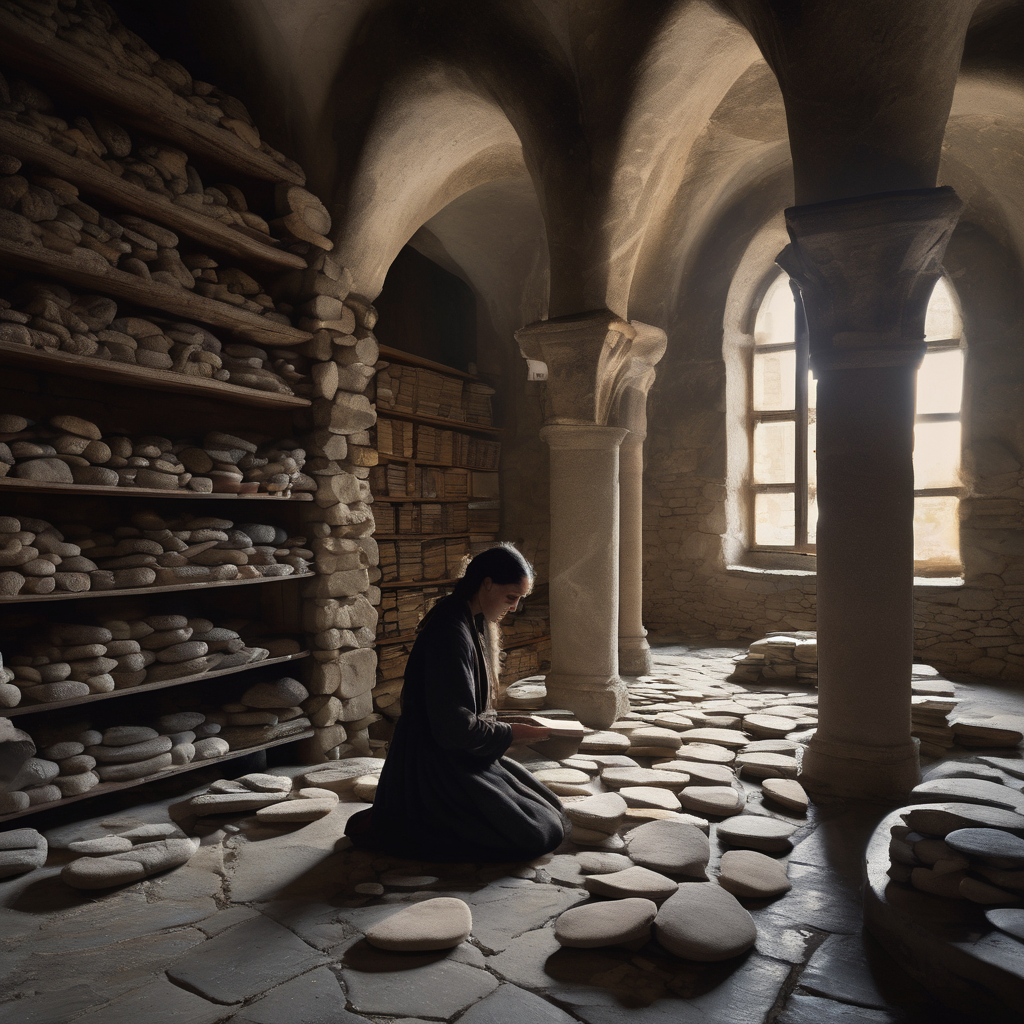
Elena Vasquez traced her fingers along the dusty spines in the abandoned monastery’s library, where books hadn’t been touched since the monks fled during the revolution. She’d come to this remote corner of the Pyrenees seeking something far older than computers—the legendary Algorithm of Names, a medieval system of divination that supposedly revealed one’s true destiny through elaborate calculations using birthdates, lunar phases, and the numerical values of letters.
The villagers below whispered that she was conducting some kind of sustainability project, studying ancient farming techniques. They didn’t need to know about her real work. Elena had spent fifteen years as a mathematician before everything changed—before she discovered that her grandmother’s stories about their family’s gift were true.
She could see the patterns. Not in data or code, but in the world itself. The way morning frost formed fractals on windows. How flocks of starlings created momentary equations in the sky. The hidden mathematics that governed which prayers were answered and which weren’t.
Her phone buzzed with another message from her former colleagues. The tech world was in chaos—markets swinging wildly, everyone obsessed with the latest trends, the newest breakthrough. But Elena had deleted her social media months ago. She had more important work.
The manuscript she sought was supposed to be bound in white leather, marked with a compass rose. Three weeks of searching had yielded nothing until today, when she noticed how the afternoon light through the stained glass created a perfect golden ratio on the floor. Following its point, she found a hidden compartment behind a painting of St. Jerome.
Inside lay the book, smaller than expected, its pages filled with intricate diagrams that looked almost like mandalas. The text was in Latin, but with strange symbols she recognized from her grandmother’s notebooks. As she began to decode it, Elena realized this wasn’t just divination—it was a complete system for understanding the underlying structure of human fate.
The Algorithm required three components: the querent’s birth chart, a specific arrangement of natural objects (stones, feathers, seeds), and most crucially, a state of perfect mental clarity achieved through days of fasting and meditation. It was alchemy meets mathematics meets something ineffable.
Elena had come prepared. She’d been fasting for two days already, drinking only spring water and herbal tea. As twilight approached, she arranged her materials on the monastery floor: seven river stones, three owl feathers her grandmother had left her, and seeds from a pomegranate that grew in her childhood garden.
The calculations took hours. She worked by candlelight, filling page after page with equations that seemed to flow from somewhere beyond her conscious mind. The numbers began to take on colors, tastes, textures. She could feel her grandmother’s presence, and her grandmother’s grandmother, stretching back through generations of women who had carried this knowledge in secret.
As dawn broke, Elena completed the final calculation. The answer wasn’t what she expected—not a fortune or a prophecy, but a single word that appeared in her mind like a bell being struck: “Choose.”
She understood then that the Algorithm didn’t reveal fate; it revealed the moment when fate became choice. This was her moment. She could return to her old life, share this discovery, probably win prizes and acclaim. Or she could stay here, become the keeper of this knowledge, waiting for the next seeker who would come, as she had come, driven by something deeper than curiosity.
Elena smiled, remembering her grandmother’s last words: “Mathematics is just another word for magic, mija. The only difference is who believes in it.”
She closed the manuscript gently and returned it to its hiding place. But she kept her calculations, folding them carefully into her journal. Outside, she could hear the village waking up, roosters crowing, church bells ringing the hour.
She had work to do. Not the Algorithm itself, but something more important—preparing the way for whoever would come after her, leaving the right clues in the right places, ensuring the knowledge survived without being corrupted or commercialized.
As she walked down the mountain path, Elena pulled out her phone and typed a brief message to her former advisor: “Research complete. Results inconclusive. Staying indefinitely.”
Then she threw the phone into the ravine below, watching it disappear into the morning mist. The last algorithm of Elena Vasquez would be one of subtraction—removing herself from every database, every record, every system, until she existed only in the space between mathematics and mystery, keeping watch over an ancient wisdom that the modern world wasn’t ready to understand.
The villagers would remember her as the strange woman who restored their monastery’s garden, teaching them old methods of cultivation that somehow produced the most abundant harvests in living memory. They never questioned why she insisted on planting according to mathematical patterns, or why the vegetables grew in perfect spirals.
Some algorithms, Elena knew, were meant to remain unwritten, living instead in the careful tending of soil and soul, in the patient preservation of mysteries that belonged to no age and every age at once.


Leave a Reply