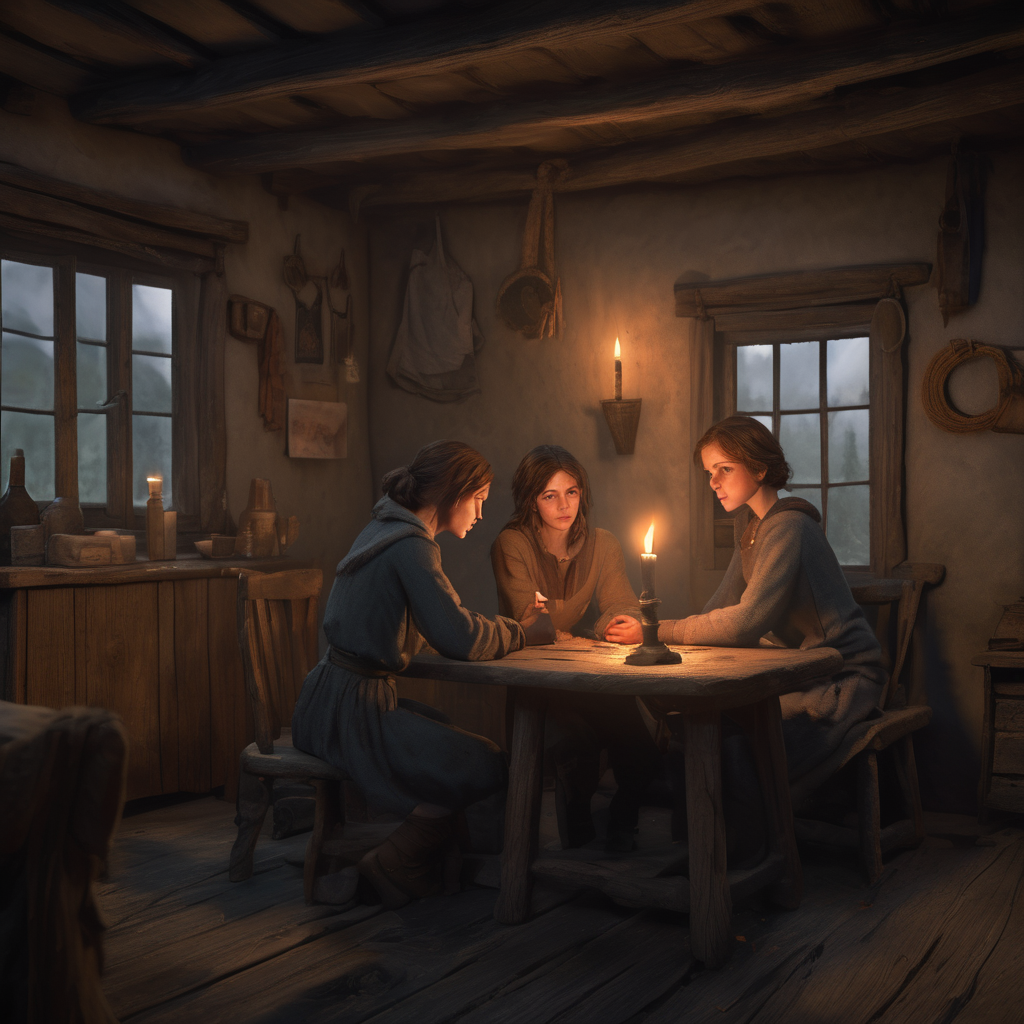
The first sign was always the spiders. They’d stop their weaving mid-thread, abandon their half-finished orbs, and scuttle into the cracks of the world as if a great, silent god had put its finger to its lips.
Elara felt it next, in her lungs. The air grew heavy, like wet wool. Each breath was a conscious effort, a drag. Outside her window, the aspen leaves, which chattered in a constant state of gossip, hung frozen and mute. The Occupation had begun.
She went to the door and peered out. Down the cobbled street, Old Man Hemlock was performing what the village youth called a “vibe check,” his hand held palm-up to the sky, his head cocked. He nodded gravely, his face a mask of grim satisfaction. He was one of the few who considered The Occupation a holy event, a time of cleansing. Elara thought he was, to use her younger brother’s term, completely delulu.
The rest of the village began its ritual retreat. This was the time for goblin mode. Shutters were latched, doors bolted. All pretense of productivity or social grace was abandoned. The baker would not bake for the town, the smith would not smith. The town’s quiet quitting was in full effect, an unspoken, unanimous strike against the oppressive stillness. For the duration of The Occupation, everyone was on their own.
Elara’s own preparations were simple. She pulled a tin of pickled eggs from the pantry, a hard heel of cheese, and three withered apples. A veritable girl dinner, she thought with a wry smile. Sustenance without effort.
A soft knock came at her door, a muffled, dense sound that barely carried through the thick air. It could only be Kael. She unlatched the door.
He stood there, his usual easy smile looking strained, like it was too much work to hold up. Kael was the sunniest soul in the village, a boy whose natural charm—his rizz, the girls called it—usually cut through any gloom. But The Occupation flattened him.
“Just checking,” he said, his voice strangely thin.
“It’s a heavy one this time,” Elara replied, stepping aside to let him in.
He sank onto a stool, running a hand through his hair. “Feels like the world’s holding its breath.” He looked around her small cottage, at the half-mended fishing net on the table and the wilting herbs hanging from the rafters. “This permacrisis of ours… you ever wonder if one time, it just won’t lift?”
The thought was a familiar one, a cornerstone of the mental doomscrolling that The Occupation encouraged. In the dead quiet, with nothing but the sound of your own blood in your ears, your mind would start to cycle through every past failure, every future fear. Elara had learned to fight it by focusing on the tangible: the grain of the wood table, the scent of dried lavender.
“We always think that,” she said softly. “And the wind always comes back.”
“Does it?” He looked at her, his gaze direct and uncharacteristically vulnerable. The stillness stripped away his defenses. “What are we, Elara?”
The question hung in the air between them, as solid and unmoving as the air itself. It was the question of their long, undefined dance. Friends, but not. Lovers, but not. Their whole relationship was a tentative, fragile thing. A situationship, built in the lulls between Occupations.
“We’re here,” she said, which was the only honest answer she had.
He nodded slowly. He picked up one of her withered apples, turning it over in his hands. Usually, at this point, he’d find a way to make her laugh, to weave a joke or a compliment that would make her forget the pressure in the air. But his words wouldn’t fly. They just fell from his lips and landed with a thud.
The silence that followed was different. It wasn’t just an absence of sound, but an active presence. It was the weight of everything unsaid between them, magnified by the weight of the air. Elara noticed a bottle of dandelion wine on her shelf, untouched. She hadn’t wanted any. The tavern keeper had told her last week that more and more people were becoming sober curious during the Occupations; the stillness clarified things in a way that made you want to face them without a crutch.
Hours passed. The sun set, but the light didn’t change much, the sky already a hazy, uniform grey. Kael didn’t leave. They sat in the thickening silence, sharing Elara’s meager meal. This was the heart of The Occupation: a forced intimacy with oneself, and with anyone you happened to be trapped with.
Then, Kael spoke again, his voice a near-whisper. “I’m scared.”
It was the simplest, truest thing he had ever said to her. In the still, occupied air, it was a confession, a prayer, a breaking point.
Elara reached across the small table and her fingers found his. His hand was cold. She didn’t offer platitudes. She didn’t say the wind would come back. She just held his hand, grounding him, grounding herself.
And in that moment, a flicker.
The flame of the candle on the table, which had been as motionless as a painted image, trembled. A single, violent shudder. Faintly, from outside, came a sound so foreign and so welcome it was like a forgotten song: the rustle of a single leaf.
Kael’s head snapped up. On the other side of the window, an aspen leaf shivered, then another. A spider, bold and pioneering, began to drop a new line of silk from the rafters.
Elara felt the change in her own chest first. A breath, suddenly light and easy. The pressure was gone. The air was just air again.
Kael’s grip on her hand tightened, then relaxed. The easy smile returned to his face, but this time it was different. It was softer, less of a performance. The stillness was broken, but something it had forced into the open remained.
They stood and walked to the door, unbolting it together. A cool, sweet breeze washed over them, carrying the scent of damp earth and distant pines. The Occupation was over. The leaves were chattering again, sharing the secrets of the quiet. The world was loud and alive once more. Their situationship was still undefined, but for the first time, it didn’t feel like it was floating. It felt like it had found solid ground.


Leave a Reply