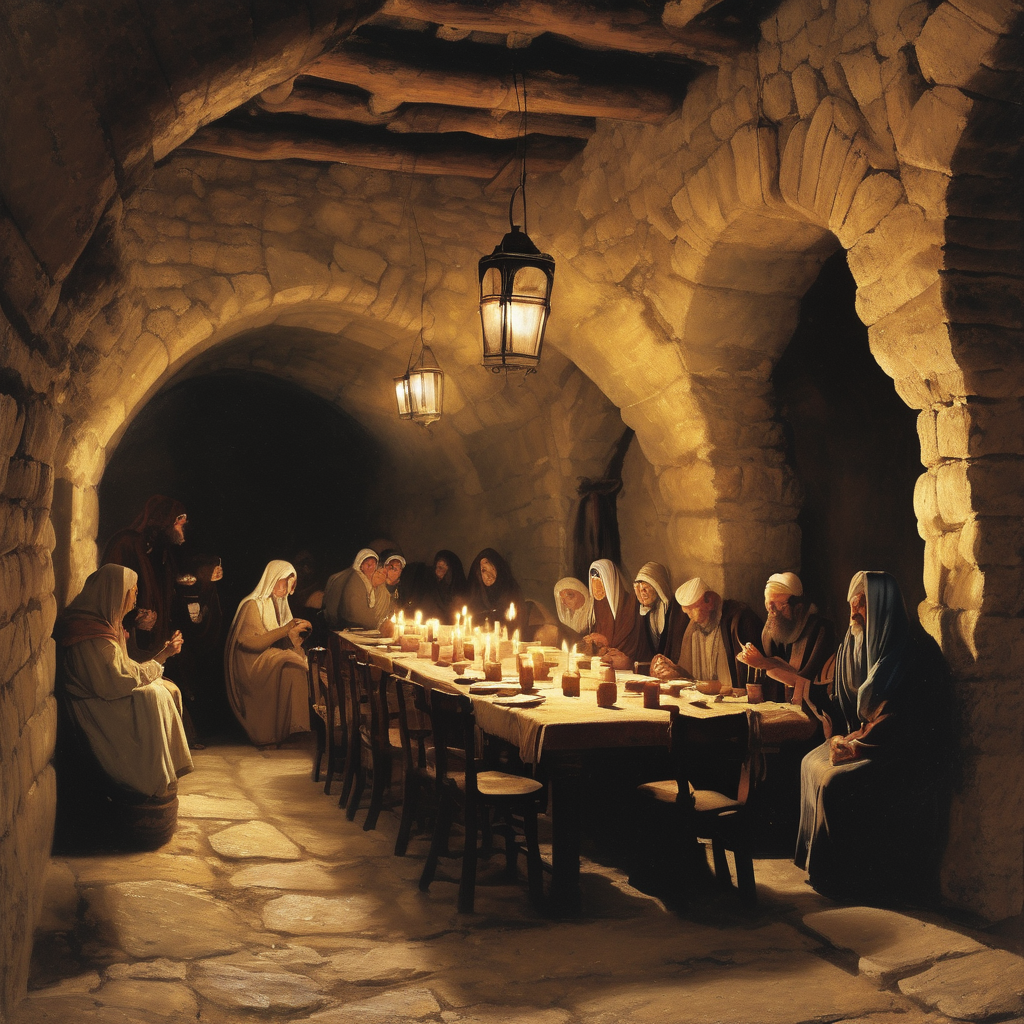
The invitation arrived on parchment that smelled of frankincense and regret. Magdalena held it to the candlelight, watching the elegant script shimmer: *You are cordially invited to partake in what remains.*
She found the address in Jerusalem’s oldest quarter, down a narrow stone passage where tourists never ventured. The door opened before she could knock.
“Ah, the food critic,” said a man whose eyes held too much history. “I am Thomas. We’ve been expecting you.”
The room upstairs was exactly as she’d imagined from countless paintings—long wooden table, rough-hewn beams, oil lamps casting dancing shadows. But instead of thirteen chairs, only five remained. The others sat in careful arrangement around the walls, as if waiting for occupants who would never return.
“The others?” Magdalena asked, though she somehow already knew.
“Scattered to the winds. Some by choice, others by…” Thomas gestured vaguely. “Time has a way of thinning the guest list.”
A woman emerged from the kitchen carrying a wooden bowl. Her movements were graceful, purposeful. “Mary,” she introduced herself simply. “We saved what we could.”
The feast was modest—bread that somehow never seemed to diminish no matter how much they broke off, wine that tasted of promises both kept and broken, fish that flaked apart like prayers. But it was the leftovers that drew Magdalena’s attention.
“Every meal leaves something behind,” explained another guest, introducing himself as John. “The question is whether what remains nourishes or haunts.”
They ate in comfortable silence as rain began pattering against the windows. Magdalena found herself thinking about sustainability—not the buzzword that filled her restaurant reviews, but something deeper. How do you sustain hope when the world insists on breaking your heart? How do you continue feeding people when the guest of honor has left the building?
“He said to do this in remembrance,” Mary said quietly, refilling Magdalena’s cup. “But nobody mentioned what to do with the crumbs.”
“We adapt,” Thomas replied. “We make soup from bones. We plant seeds from pits. We tell stories that make the absent feel present.”
A young man arrived late, shaking rain from his cloak. “Sorry, sorry—the vendors in the market were in complete chaos today. Some cryptocurrency crash, apparently. Bitcoin down to practically nothing.” He paused, looking around the ancient room. “Though I suppose that’s not exactly relevant here.”
“Judas,” John explained to Magdalena with surprising warmth. “He’s been trying to understand modern economics. Thinks he can somehow balance the books.”
Judas settled into his chair with a self-deprecating smile. “Thirty pieces of silver seemed like so much at the time. Now my portfolio’s worth less than a decent NFT.” He helped himself to bread. “Mary, this sourdough starter must be ancient.”
“Two thousand years and counting,” she confirmed.
As the evening wore on, Magdalena realized she wasn’t just witnessing history—she was participating in it. The conversation flowed from cosmic questions to mundane concerns with the ease of old friends catching up. They discussed everything from the wellness trends flooding Jerusalem’s tourist districts to the way social media had complicated the business of miracles.
“Remember when a simple resurrection was enough to trend for centuries?” Thomas mused. “Now you need a TikTok strategy.”
“The message remains the same,” Mary insisted. “Love one another. Feed the hungry. Welcome strangers.” She smiled at Magdalena. “Share meals with food critics who stumble into sacred spaces.”
Near midnight, they began clearing the table together. The leftovers—fragments of bread, drops of wine, stories half-told—were carefully gathered. Nothing was wasted.
“This is the secret,” John explained as they worked. “The last supper never actually ends. It just gets reheated.”
Magdalena pocketed a small piece of bread, knowing somehow it would never grow stale. Outside, the rain had stopped, and Jerusalem gleamed wet and clean under ancient stars.
Walking home through empty streets, she tried to compose her review in her head. How do you rate eternity? How do you describe the taste of grace? Some meals, she realized, were never meant to be reviewed—only remembered, shared, and somehow, impossibly, continued.
The bread in her pocket felt warm against her palm, ready to break and share again tomorrow.


Leave a Reply