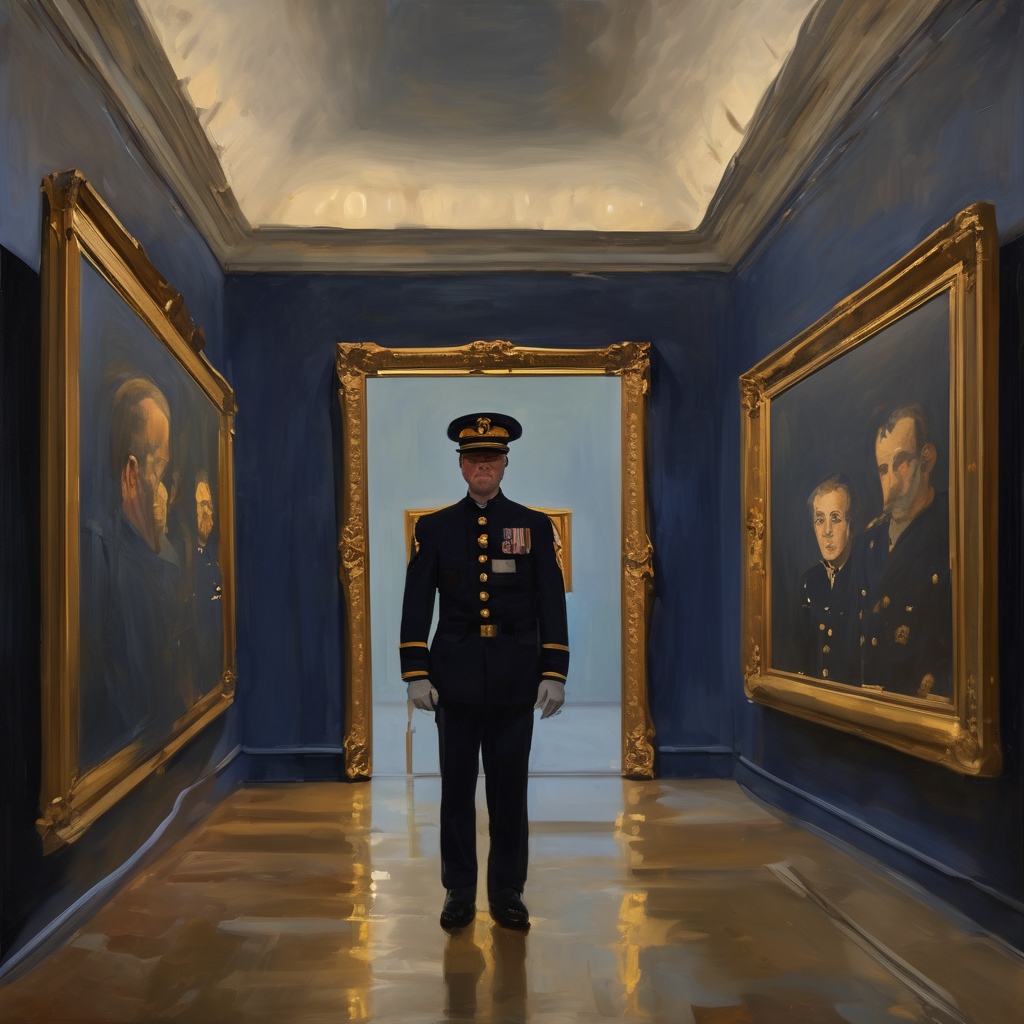
The museum’s night security guard first noticed the letters appearing between the brushstrokes of forgotten paintings. Marcus had walked these halls for seven years, flashlight painting arcs across Renaissance madonnas and abstract expressionist chaos, but only recently had the canvases begun writing back.
It started with the Vermeer replica in the west wing. The girl with the pearl earring had always watched him during his rounds, but one Tuesday at 3 AM, cursive script materialized across her turban: “Your loneliness tastes like burnt coffee and yesterday’s news.”
Marcus dropped his thermos. The coffee splashed across his shoes—burnt, indeed, reheated from the morning shift. He looked up. The writing had vanished.
By Thursday, the letters spread. The Rothko in the contemporary section bled words through its color fields: “I’ve been watching you practice your ballroom steps in the sculpture garden. The marble dancers are jealous.” This was true. Marcus had been teaching himself to waltz using YouTube videos on his phone, preparing for his daughter’s wedding where he’d have no partner.
He began writing back, leaving sticky notes on the frames. “Who are you?” he wrote. “Another guard playing pranks?”
The response came through a Dutch still life, words winding between painted grapes and tarnished silver: “I’m the space between heartbeats, the pause before the orchestra begins. I work the shift that never ends.”
Marcus understood impossible things. His grandmother had told him stories of the hidden people, the ones who existed in the corners of vision, in the moment between sleep and waking. But this felt different. This felt like longing.
The letters grew longer, more intimate. The abstract paintings were the most talkative—their fluid forms could hold entire paragraphs. She told him (he knew it was a she, though she never said) about watching civilizations rise through gallery windows, about the taste of centuries, about how she’d learned every song ever hummed in these halls and could sing them back in perfect order.
“But why me?” Marcus wrote on a Post-it stuck to a Basquiat.
“Because you dance alone,” came the reply, scripted across a Monet water lily. “Because you talk to the paintings like old friends. Because you bring fresh bread for the pigeons even though management forbids it. Because you’re the first guard in seventy years who doesn’t just see a job.”
Marcus began arriving earlier, staying later. He brought better coffee, played music softly from his phone—Ella Fitzgerald, Chet Baker, the lonely beautiful stuff. He’d catch glimpses sometimes: a shadow that moved against the light, a reflection in glass cases that showed someone who wasn’t there.
“Can you show yourself?” he finally asked, the note taped to a mirror in the baroque room.
The mirror clouded. In the condensation, as if drawn by an invisible finger: “I am showing myself. Every word is my body. Every letter is my touch.”
Weeks passed. Marcus’s daughter called less frequently about the wedding. His supervisor complained he was distracted. But the halls had become electric with possibility. He’d find messages everywhere now—in the dust on display cases, in the arrangement of fallen leaves the ventilation system swirled across the floor, in the way the emergency exit lights flickered in Morse code.
Then came the night everything changed. A special exhibition opened: “Love Letters Through the Ages,” featuring historical correspondence between separated lovers. As Marcus made his rounds, every single display began to glow. The glass cases filled with new words, overlapping the historical text. They all said the same thing:
“The museum is transferring the night shift to automated systems. Tomorrow is your last walk.”
Marcus ran through the galleries, watching messages appear and dissolve. The paintings were frantic, text spilling from frames: “Stay.” “Don’t leave.” “I’ve waited so long.”
He found himself in the restoration room, where damaged paintings awaited repair. There, spread across a canvas that had lost most of its paint to time, she finally appeared—not as a figure but as words themselves, flowing and reforming, creating her shape from stories.
“I’m the museum’s memory,” she wrote herself into being. “Every whispered secret, every stolen kiss in dark corners, every child’s wonder, every scholar’s revelation. I’m what happens to love when it has nowhere else to go.”
Marcus reached out to touch the canvas. His fingers came away covered in ink that wasn’t there.
“Take me with you,” the words reformed. “I can live in your grocery lists, your text messages, your crossword puzzles. Love doesn’t need a museum.”
But Marcus understood what she couldn’t. She was the museum—its soul, its accumulated longing. To remove her would be theft of the highest order.
On his last night, Marcus didn’t patrol. He sat in the center of the main gallery and read aloud from a book of poetry. Every painting in sight shimmered with words—comments, appreciations, soft laughter translated into script. When dawn came and his replacement arrived (a bright security system with motion sensors and silent alarms), Marcus left his final note, carved carefully into the dust on an ancient Greek urn:
“I’ll visit every day. Look for me in the afternoon light.”
Now Marcus comes as a patron. He pays the senior discount, takes his time. He reads every placard, studies every piece. And sometimes, just sometimes, when the crowds thin and the afternoon sun slants just right, he sees new words appearing—quick as heartbeats, soft as whispers, eternal as art itself.
The love letters continue, hidden in plain sight, waiting for those who know how to read between the lines.

Leave a Reply