The compass had been in Elara’s family for seven generations, a silver disc inlaid with mother-of-pearl that didn’t point North, but True. It guided you to your purpose, your people, your place. When it was her turn, she had held it with trembling hands, only to watch the needle spin like a dervish and then shudder to a halt, a tiny shard of crystal inside cracking with a sound no one else heard.
Now, it lay on her nightstand, a monument to her unguided life. Her family spoke of Compasswrights in hushed, urgent tones, but Elara couldn’t summon the energy. She was in her quiet quitting era—not from a job, but from the grand narrative of destiny itself.
Without the compass’s singular hum, the world had become a cacophony of stray notes. She’d find them everywhere: a flicker of abandoned hope clinging to a bus stop pole, a deep thrum of regret saturating a secondhand coat, a bright, childish giggle trapped in the scent of a wilting flower. At first, she ignored them. Then, she started collecting them.
Her apartment became a curated hoard of these feelings. A jam jar filled with the pale blue light of melancholy from a rainy Tuesday. A threadbare scarf that pulsed with the warmth of a forgotten embrace. It was full-blown goblin mode; she’d return to her nest with her treasures, arranging them on shelves, creating small, silent choirs of emotion. Her dinners were strange assortments of whatever felt right—a wedge of cheese, a handful of olives, three pickles, and a piece of dark chocolate. It was a meal for a person assembling a life from scraps.
One day, while trying to capture the shimmering note of a near-miss, a feeling of two people almost speaking but not, a voice said, “You hear them, too.”
He was sitting on the other end of the bench. Kael. He had kind eyes and a stillness about him. His own hands were empty, his pockets unburdened by a compass.
“I don’t hear them,” Elara clarified, plucking the wisp of shimmering air and tucking it into a small tin. “I feel them.”
That was the beginning of their situationship. It had no map, no destination. They were just two people sitting in the static. Kael couldn’t collect the notes, but he was a perfect audience. His particular rizz wasn’t charm, but a profound, validating silence. He understood without needing an explanation.
His only beige flag was that he was obsessed with the sky, constantly tracking the migratory patterns of clouds as if they were the only reliable thing in the universe.
“So, what’s your Roman Empire?” he asked her one evening, gesturing to her shelves of glowing jars and humming artifacts. It was the question people asked to get at the core of you, the thing you couldn’t stop thinking about.
She just pointed to the broken compass on her nightstand. “What it was supposed to do,” she whispered. “And what it did instead.”
The closer the city got to the Great Conjunction—the one night of the year when all working compasses would align perfectly, flooding the streets with a euphoric sense of direction—the more agitated the stray notes became. They rattled in their jars, vibrated off the walls, a rising din of lostness. Elara felt it in her teeth. It was a vibe shift on a cosmic scale, and she was on the wrong side of it.
Her family called. Her sister, whose compass had led her to a loving partner and a career in oceanic cartography, pleaded with her. “Stop being so… delulu, Elara. Just find a Wright. You don’t have to live like this.”
But Elara was beginning to understand. The notes weren’t noise. They were voices. Unfinished songs. The Conjunction would overwhelm them, drown them out with its singular, perfect chord.
On the night of the Conjunction, a powerful hum began to build across the city, a resonant A-major of purpose and arrival. It was painful, pressing in on her. Kael found her curled on the floor, hands over her ears.
“We have to go,” she said, her eyes wild with a sudden, terrifying clarity. This wasn’t a retreat. It was an answer.
She grabbed a large, empty satchel and began to move with a strange new grace, a frantic ballet of purpose. She wasn’t just collecting; she was conducting. Into the bag went the melancholy, the joy, the threadbare scarf of embrace, the near-miss, the regret. All of it. Kael simply held the bag open, his gaze unwavering. For the first time, Elara wasn’t just a girl with a broken compass; she was a woman on a mission. She was feeling her main character energy rise like a tide.
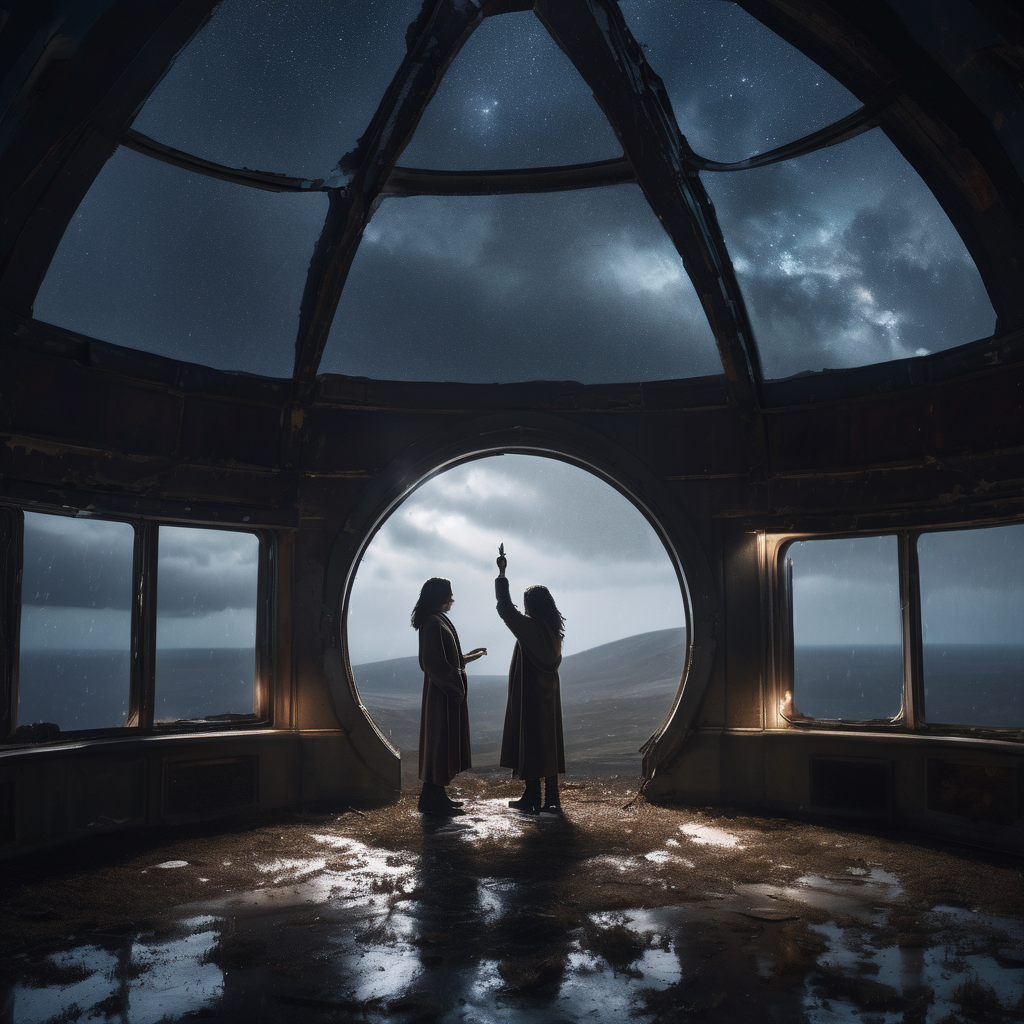
They took the collection to the one place in the city that had no direction: the old, abandoned observatory on Whisperwind Peak. Below, the city was a grid of golden light, every street and soul aligned. The air vibrated with the Conjunction’s oppressive harmony.
Inside the dusty dome, under the open slit of the sky, Elara didn’t arrange the notes. She released them.
She opened the jars, and the pale blue light of melancholy swirled upwards. She shook out the scarf, and a spectral warmth filled the cold air. She untwisted the tin of the near-miss, and a chord of pure, poignant longing shot towards the dome. Grief, hope, fury, peace—a thousand disparate, broken feelings flew free.
They didn’t harmonize. They didn’t resolve. They collided and cascaded, weaving into a vast, discordant, and breathtakingly beautiful whole. It was the sound of a thousand branching paths, of every choice not taken, every word unspoken. It was chaos, but it was honest chaos.
It was a symphony.
The sound didn’t travel over the city; it traveled under it. A counter-frequency. A subtle dissonance that didn’t break the Conjunction’s spell but offered an alternative. In apartments and alleyways, others who were compassless—the lost, the grieving, the gloriously directionless—felt a sudden easing in their chests. They looked up from their spinning compasses or their empty hands and felt not a solution, but a solace. They were not a mistake. They were simply a different kind of music.
Up in the observatory, the last note faded. The oppressive hum of the Conjunction no longer felt like a judgment. It was just one song, and theirs was another. Elara stood in the silence, her hands empty, her heart full. Kael put his arm around her. Below, the city gleamed. It was still a map she couldn’t read, but she no longer felt the need to. She had finally learned to listen to her own score.

Leave a Reply