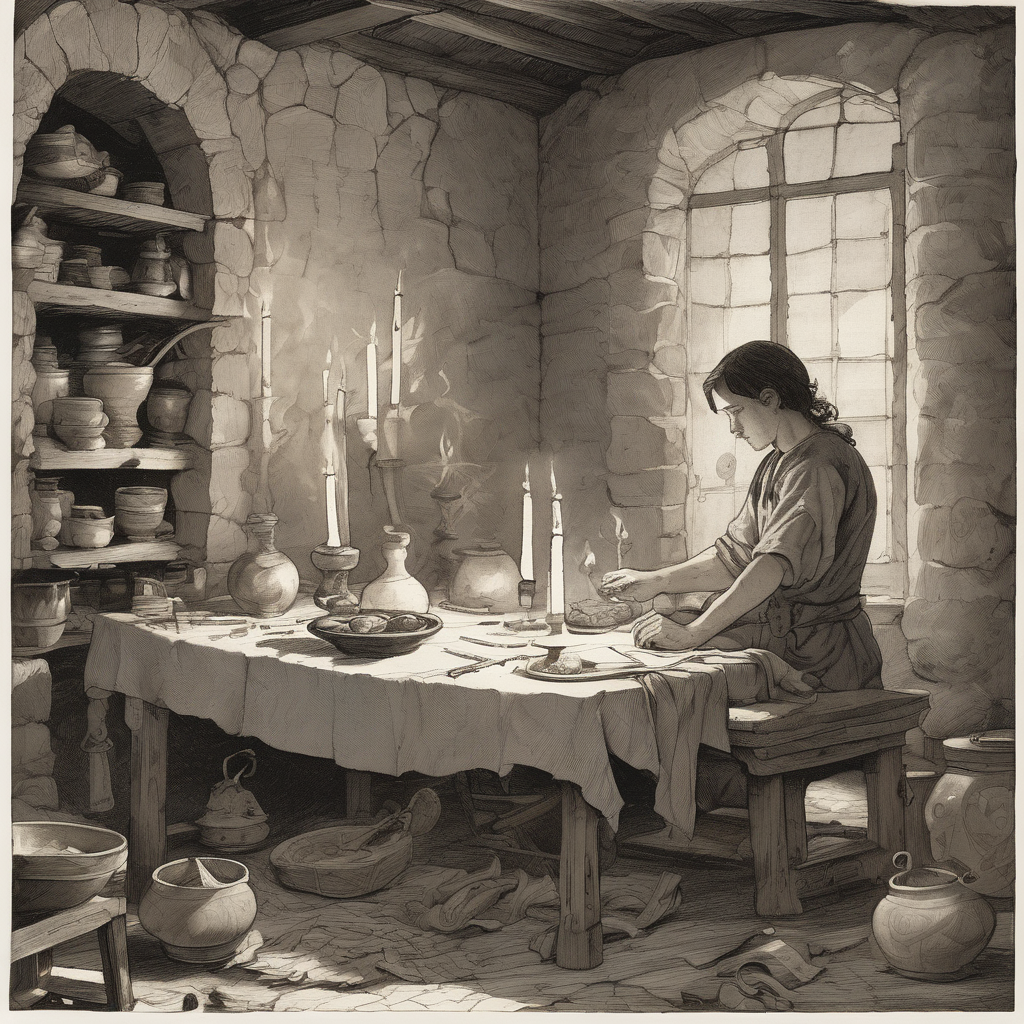
Elias inherited the Atlas from his mother, the same way she had from hers. It wasn’t a book of maps, but of marrow. Each person in the valley was a page, their skeleton drawn in shimmering ink that shifted with every breath. A hairline fracture on a rib might show a future heartbreak. The slow calcification of a knuckle, a life of hard, unrewarding labour. His mother had taught him the cardinal rule: “We are readers, Elias, not writers.”
He was setting young Finn’s wrist when he first felt the pull to disobey. Finn, a lanky boy with an almost preternatural charm—a strange, golden hum along his bones that the old-timers called ‘the shine’ and the girls in the market simply called his *rizz*—had fallen from a roof. As Elias’s fingers traced the boy’s radius, the Atlas, open on its stand, showed the break not as an accident, but as a plotted point. A *canon event*, his mother would have called it. The injury that would keep Finn from the summer conscription, saving him from a border skirmish that would claim his entire platoon. Elias’s hands trembled. To know the shape of a life was a heavy, quiet thing.
Most people in the valley were content with their skeletal paths. Joric, the merchant’s son, was a classic case. A pure nepo baby, his page in the Atlas showed a life paved in comfort, his bones destined to grow stout and unbroken from easy living. Others, like Old Man Hemlock who lived in the fetid woods, had entered a kind of self-imposed *goblin mode*; Hemlock’s page was a tangle of inactivity, his spine slowly curving into a question mark of solitude. Elias saw it all. He saw the baker’s son, whose passion had cooled, now just going through the motions—a career of quiet quitting made visible in the dull grey of his finger bones. He saw the nascent romances, the messy, undefined entanglements the young folk called *situationships*, sketched as faint, overlapping lines that might, or might not, ever fuse.
Then Lyra was carried in.
She had fallen from the old watchtower, a place of crumbling stone and foolish dares. Her leg was a ruin. As Elias cleaned the wound, he feared looking at the Atlas. When he finally did, he gasped. Lyra’s page was unlike any he had ever seen. The break in her femur wasn’t a definite point, but an explosion of possibilities. Dozens of shimmering, ghostly pathways radiated from the fracture, each a different future. One line showed her marrying Joric, her bones settling into a comfortable, terrestrial rhythm. Another showed her travelling, the bones of her feet wearing thin on foreign soil. A third, darker line, simply faded into nothingness beyond the break.
“She speaks of sailing to the Jade Archipelago,” her father whispered to Elias a week later, his face a mask of worry. “It’s a delusional fancy. A girl’s *delulu* dream, the sailors call it. She needs to be sensible. Stay here. Be safe.”
The town agreed. They wove a narrative cocoon around Lyra, a gentle, insidious *gaslighting* that painted her ambition as folly and safety as the only virtue. And Elias watched, in the Atlas, as the adventurous pathways on her page began to flicker and dim under the weight of their collective certainty. The safe, boring future with Joric was solidifying, its ink glowing brighter.
Elias found himself in a new, terrifying *era* of his own existence. He was no longer a passive reader. He was a participant, his heart a dull ache that wasn’t recorded in his own skeletal chart. He’d look at Lyra’s determined face, then at the Atlas, and feel the crushing weight of a fate being chosen for her, not by her.
One night, under a sliver of moon, he stared at her page. The path to the sea was now just a gossamer thread. He thought of his mother’s warning. He thought of Finn, alive because of his fated injury. But this felt different. This wasn’t fate; it was foreclosure.
He made a choice. He ignored the book and focused on the girl. During her treatments, he spoke not of healing, but of navigating by the stars. He described the anatomy of a ship’s mast as if it were a spine. He told her stories his seafaring grandfather had passed down, tales that were not in the valley’s approved lexicon. It wasn’t much, but it was a quiet rebellion. He was trying to give her hope, a counter-weight to the town’s fears.
The day came for him to remove the last of the splints. Lyra’s leg was healed, the bone a clean, strong line. That night, Elias opened the Atlas with dread. He looked at Lyra’s page. The line showing her marriage to Joric was still bright. But next to it, the sea-path, the one that had almost vanished, now pulsed with a faint, stubborn light. It was no longer just a possibility; it was a choice.
He had not written her future. He had only kept the page from being closed.
A week later, Lyra was gone. She’d used her dowry money to buy passage on a wool freighter, leaving a note that spoke not of delusion, but of *manifestation*. She was going to manifest her own map.
Elias ran a hand over his own page in the Atlas. It was, as always, a simple chart, the life of a valley bone-setter, unchanging. But as he looked, he noticed something new. At the very edge of the page, a tiny, almost invisible line had appeared, branching off from his own, and pointing toward the sea. He hadn’t drawn it. It had simply… appeared. A consequence. An echo. He smiled, a genuine, bone-deep smile. He was still a reader, yes. But he was finally learning to read between the lines.

Leave a Reply