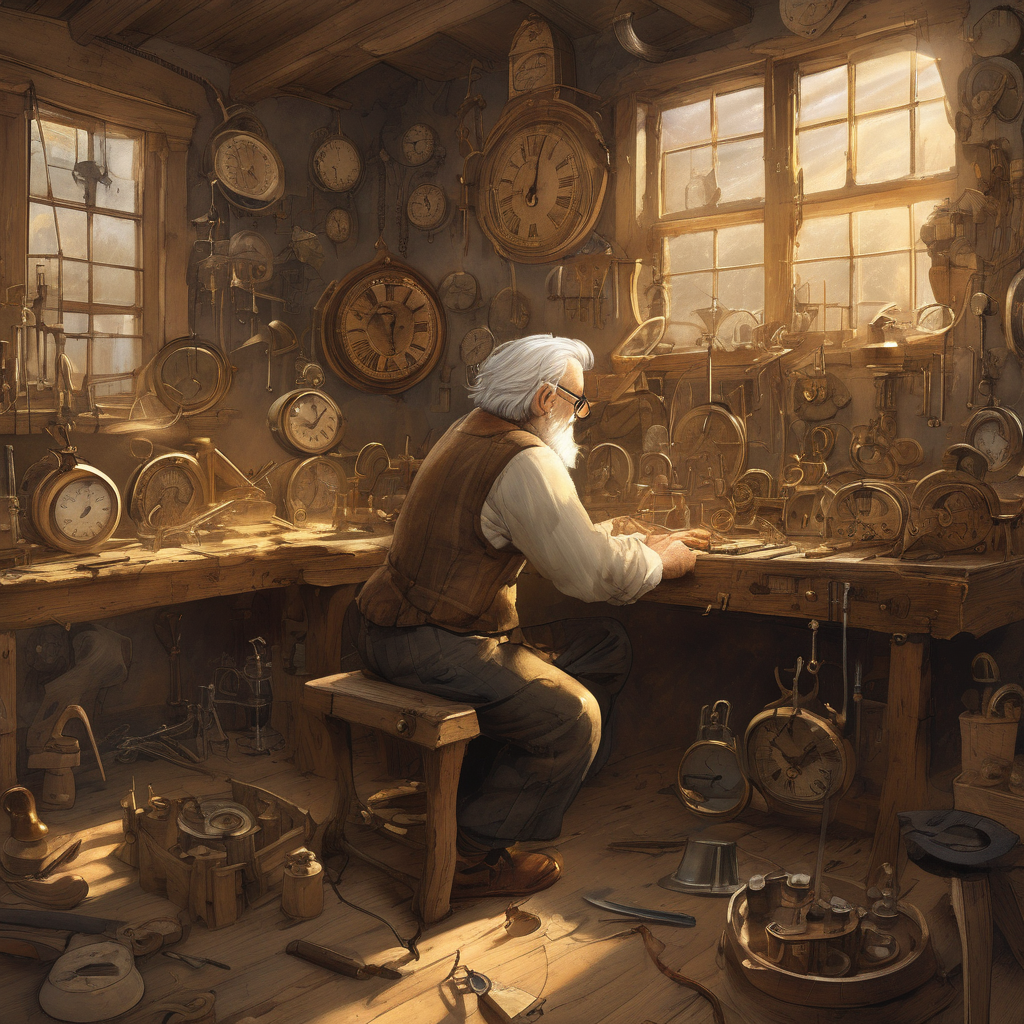
The workshop smelled of brass shavings and bergamot tea, where Elias Pendleton had spent sixty years crafting timepieces that defied explanation. His clocks didn’t merely tell time—they whispered secrets to those who knew how to listen.
When his granddaughter Maya arrived for their weekly visit, she found him hunched over his workbench, silver hair catching the amber light filtering through dusty windows. Before him lay the most peculiar mechanism she’d ever seen: gears that seemed to shift between copper and starlight, springs that hummed with an otherworldly resonance.
“This one’s different, isn’t it?” Maya said, settling into the worn velvet chair beside his bench.
Elias’s weathered hands paused their delicate work. “Indeed. This clock doesn’t measure hours or minutes. It measures possibilities.”
Maya leaned closer, watching the ethereal components pulse with life. In recent months, she’d noticed her grandfather becoming increasingly secretive about his work, muttering about “temporal echoes” and “borrowed moments.” The other family members whispered concerns about his mental state, but Maya had always been the only one who truly understood that Elias operated on a different frequency than ordinary people.
“What kind of possibilities?”
“The kind that slip through our fingers when we’re not paying attention,” he said, his voice carrying the weight of unspoken regrets. “Every choice we don’t make, every path we don’t take—they don’t simply vanish, Maya. They pool somewhere in the spaces between seconds.”
He lifted a component that looked like crystallized moonlight. “I’ve been collecting them. The lost possibilities. They accumulate in the corners of time like dust, and if you know how to gather them…” He trailed off, his eyes distant.
Maya felt a chill run down her spine. “Grandfather, what are you planning?”
Elias set down his tools and turned to face her fully. His eyes, usually bright with curiosity and mischief, held a profound sadness. “I’m dying, my dear. Not today, perhaps not this month, but soon. The doctors confirmed what I already knew.”
The words hit Maya like a physical blow. She’d sensed something was wrong but had attributed his recent frailty to age, not illness.
“But this clock,” he continued, gesturing to the impossible mechanism, “represents a lifetime of work. A way to capture all those moments I let slip away. The words I never said to your grandmother before she passed. The time I didn’t spend with your father before our falling out. The risks I was too afraid to take.”
Maya’s throat tightened. “And you think this machine can somehow recover those moments?”
“Not recover. Experience. For just a little while.” His hands trembled slightly as he picked up a gear that seemed to contain swirling galaxies. “But there’s a catch, as there always is with such things. The clock can only be activated once, and it requires something precious as fuel—not money or gold, but a cherished memory. The activation will erase that memory forever to power the experience of all the lost possibilities.”
Maya stared at the clock, its components seeming to pulse with anticipation. “What memory would you sacrifice?”
Elias’s smile was bittersweet. “The day you were born. The moment I first held you and felt hope for the future again after years of regret. It’s my most treasured memory, which makes it the most powerful.”
“No.” Maya’s voice was sharp with panic. “You can’t. That memory is part of who you are, who we are together.”
“But think of all I could experience instead,” Elias said, his voice taking on a dreamy quality. “I could tell your grandmother I loved her one more time. I could reconcile with your father before his pride hardened into permanent distance. I could take that trip to Morocco I always planned but never managed.”
Maya stood abruptly, her mind racing. She’d grown up surrounded by her grandfather’s impossible inventions, had learned to see the world through his lens of infinite possibility. But this felt different—not like creation, but like desperate grasping at shadows.
“What if,” she said slowly, “the possibilities you’re chasing aren’t the real treasure?”
Elias looked up from his work, confusion flickering across his features.
“You taught me that time isn’t linear,” Maya continued, her voice growing stronger. “That past, present, and future dance together in ways most people can’t perceive. But what if the possibility you should embrace isn’t in the past, but right here, right now?”
She moved to the window, pulling back the heavy curtains to let in more light. The workshop transformed, dust motes dancing like tiny stars in the golden rays.
“You talk about all the words you never said, but what about the words you can still say? You regret the time you didn’t spend with Dad, but what if there’s still time to reach out? You want to tell Grandma you love her, but you do that every day when you wind the anniversary clock you made for her and whisper to her photograph.”
Elias set down the crystalline component, his hands stilling for the first time in hours.
“The present moment,” Maya said, “is itself a possibility. One that’s still unfolding, still changeable. What if instead of building a machine to chase phantom alternatives, you simply picked up the phone and called my father?”
The workshop fell silent except for the gentle ticking of dozens of clocks, each keeping its own rhythm, its own version of time. Elias looked at his creation—this magnificent, impossible device that could reshape reality—and then at his granddaughter, whose eyes held the same spark of infinite curiosity that had driven him all his life.
Slowly, deliberately, he began dismantling the possibility clock, removing each component with the same care he’d used to assemble it. The gears lost their otherworldly glow, returning to simple metal and crystal. The springs quieted their cosmic humming.
“You know,” he said, carefully placing each piece into a velvet-lined drawer, “I think I’ll save these components for something else. Perhaps a clock that helps people notice the possibilities right in front of them, rather than the ones that got away.”
Maya smiled, feeling the weight of crisis lift from her shoulders. “That sounds like a much better use of temporal mechanics.”
Elias chuckled, the sound warm and familiar. “Spoken like a true Pendleton. Now, would you mind helping an old clockmaker find his phone? I believe I have a son to call and some words to finally say.”
Outside the workshop windows, the afternoon sun continued its ancient journey across the sky, measuring out moments that were not lost or wasted, but simply waiting to be filled with intention, connection, and the radical possibility of choosing love over regret.

Leave a Reply