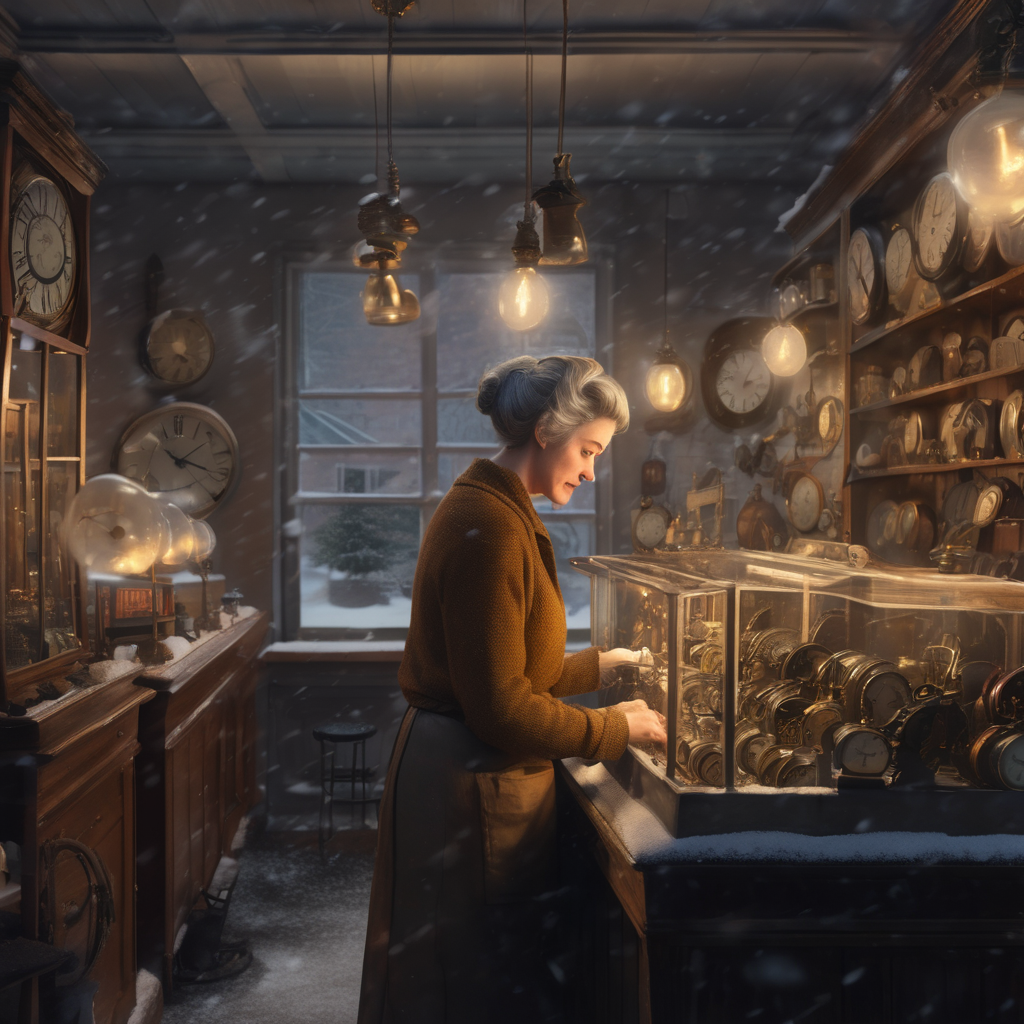
The grandfather clock in Margot’s shop had been striking thirteen for three days straight, and with each impossible chime, another memory of her late husband disappeared from the world.
She noticed it first when Mrs. Chen from the bakery stopped recognizing Edmund’s name. Then the postman quit asking about “the old clockmaker” altogether. By the third day, even the wedding photo on her mantle showed only Margot, smiling alone in her white dress, her arm curved around empty air.
The shop felt heavier now, thick with the scent of oil and metal shavings that somehow grew stronger as Edmund’s presence faded. Margot ran her fingers along the workbench where he’d spent forty years coaxing life from broken timepieces, willing herself to remember the sound of his humming, the way he’d tap his fingers against wood when he was thinking.
She’d always known the clocks in their shop were different. Customers brought them broken hearts disguised as timepieces—a widow’s mantle clock that had stopped the moment her husband died, a young father’s pocket watch that ran backwards through sleepless nights. Edmund had a gift for healing more than just their mechanisms.
But the grandfather clock was Edmund’s masterpiece, built in secret during the final months of his illness. He’d worked on it between treatments, his hands steady despite everything, whispering to its gears in words she couldn’t quite catch.
“It’s for when I’m gone,” he’d told her the night before he died, pressing a small brass key into her palm. “Promise me you’ll wind it every day at sunset. Promise me you won’t let time forget.”
She’d kept that promise for two years, until this week, when grief had finally worn her down and she’d missed a day. The clock had begun its impossible chiming, and now with each thirteen strike, the world was editing Edmund out of existence.
Margot understood what was happening. The clock wasn’t just keeping time—it was keeping Edmund’s memory alive in the world’s collective consciousness. Without her daily winding, it was running down, taking his echo with it.
She climbed the narrow stairs to their apartment above the shop, where wedding gifts had become housewarming presents for one, where love letters had transformed into postcards from relatives. In the bedroom, she opened Edmund’s dresser drawers, now filled with her winter sweaters instead of his carefully folded shirts.
The brass key felt warm in her palm as she descended back to the shop. Outside, the first snow of December was beginning to fall, each flake catching the amber light from the store windows. The grandfather clock loomed before her, its pendulum swinging with hypnotic determination.
As she inserted the key and began to wind, Margot made a choice. Instead of the careful, measured turns Edmund had taught her, she wound it fully, completely, pouring all her love and loss into the motion until the spring was taut with memory.
The clock’s chiming shifted, becoming deeper, richer. Thirteen became fourteen, fifteen, sixteen—each impossible hour ringing out like a bell calling souls home.
And then she heard it: the front door chime, followed by familiar footsteps on the old wooden floors.
“Sorry I’m late,” Edmund’s voice called softly. “Lost track of time.”
Margot turned to find him there, translucent as morning light but unmistakably real, his tool apron tied around his waist, silver hair catching glints from the clock faces surrounding them.
“The clock,” she whispered.
“Gives us stolen hours,” he said, moving to embrace her. His arms felt like the memory of warmth, like the ghost of comfort. “Not many, but enough.”
Through the window, the world outside had taken on a sepia quality, as if time itself had become negotiable. Other figures moved through the snowy street—translucent people reuniting with solid ones, borrowed moments playing out under the amber streetlights.
“How long do we have?” she asked.
Edmund glanced at his masterpiece, where the hands were already beginning to move faster, counting down their stolen time. “Until the spring runs out. Until the world remembers how to forget.”
Margot pressed her face against his chest, breathing in the familiar scent of metal polish and winter air. Around them, the other clocks in the shop had begun to chime as well—all the broken hearts Edmund had mended, all the time-pieces that had learned love was stronger than chronology.
She understood now why he’d built the grandfather clock, why he’d made her promise to wind it. Love wasn’t meant to be forgotten, even by time itself.
As the final chimes echoed through the shop and Edmund’s form began to fade, Margot picked up his tools and began examining a broken watch left by a customer that morning. She would learn to fix what was broken. She would teach others Edmund’s secrets.
And tomorrow, at sunset, she would wind the clock again.

Leave a Reply