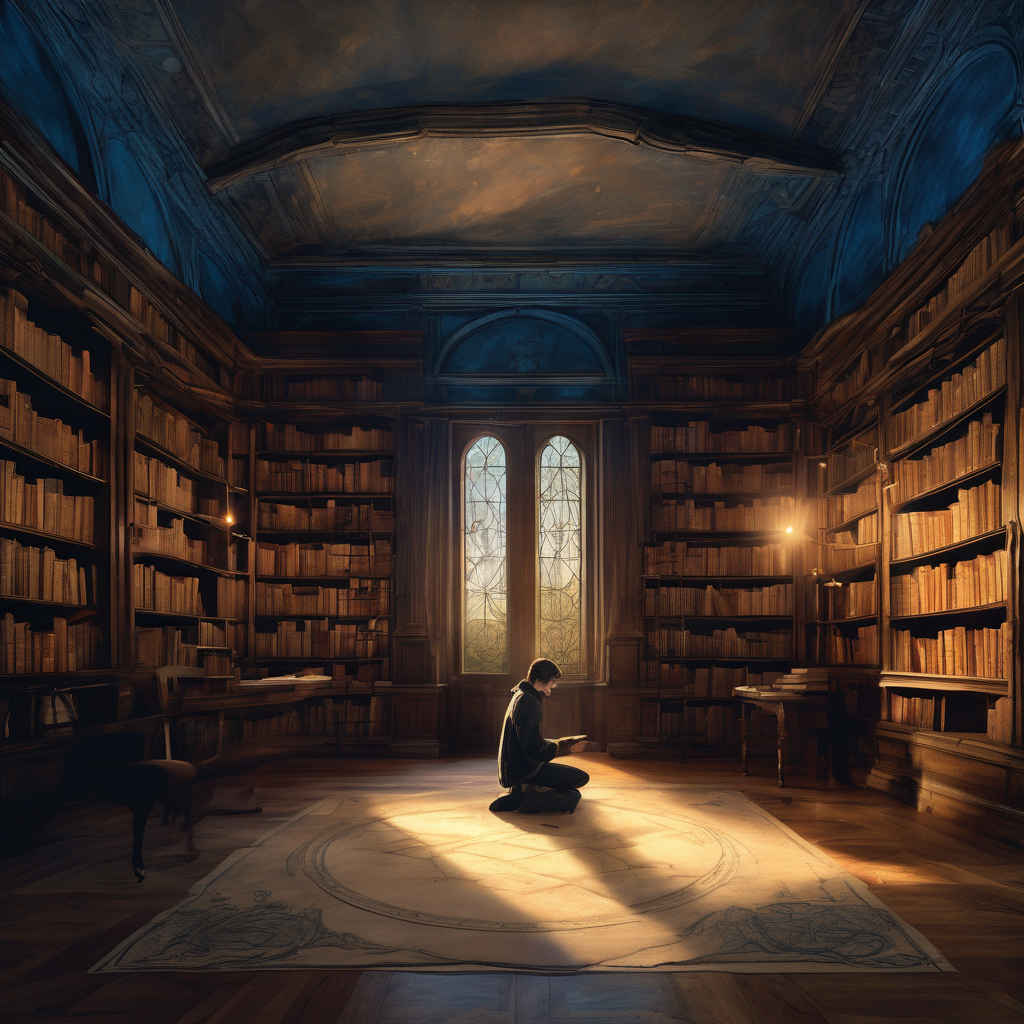
The Alderworth Manor didn’t have a ghost; it had a glitch in its spatial-temporal signature. That’s how Elias explained it to himself, chalk dust clinging to his trousers as he knelt on the parquetry. He was a Residual Cartographer, a practitioner of a dying art, and the Alderworth haunting was a masterpiece of chaos.
“The whole atmosphere is just… off,” Mrs. Alderworth had told him, her teacup rattling in its saucer. “There’s been a definite vibe shift since autumn. My Julian says it’s like he’s in a… a situationship with the library. He just sits in there for hours, staring at the empty wingback chair.”
Elias now understood. He could see the echoes, shimmering in the air like heat haze. Not one ghost, but dozens, layered over each other like translucent architectural drafts. A Victorian butler perpetually reached for a fallen vase, his hand dematerializing an inch from contact. A flapper from the twenties danced a frantic Charleston on a loop, her phantom beads soundlessly clicking. They were predictable, harmless.
The problem was the primary. A young woman from the turn of the century, Elara. Elias had pieced her story together from diaries left in a cedar chest. Her family had considered her eccentric, lost in what they termed her “delulu era,” obsessed with esoteric mathematics and the belief that reality could be redrawn.
She was the source of the glitch. Her sorrow wasn’t a simple echo; it was an active, malevolent equation. Her despair radiated from the library’s wingback chair—her locus poenitentiae—in sharp, geometric vectors that sliced through the other hauntings, causing them to stutter and fray.
Elias had spent two days mapping her influence. He used plumb bobs to find the vertical lines of her regret and stretched silk threads to trace the horizontal planes of her loneliness. He found that her misery intersected with the spectral butler at a precise forty-five-degree angle, causing the old man to perform a kind of supernatural quiet quitting. Halfway through his reach, the butler would sigh, a sound like dust settling, and simply fade out, abandoning his task for hours at a time.
The work was draining. At night, in his guest room, Elias found himself performing a non-digital form of doomscrolling, poring over his complex diagrams of the house’s sorrow, tracing the nested polygons of pain until his own spirit felt thin and frayed. The house was trying to pull him in, make him another variable in its unsolvable proof. He saw it in the way young Julian was losing his own main character energy, his presence in the house becoming as faded and repetitive as the flapper’s dance.
The breakthrough came on the third day. Elias found it tucked in Elara’s diary: a frantic sketch of a complex, star-like sigil. She hadn’t just been grieving; she had been trying to build something. A new reality. But her formula was incomplete. It was a loop without an exit, a question without an answer, and it was collapsing in on itself, pulling the living in with it.
He knew what he had to do. He couldn’t erase her geometry. He had to complete it.
That evening, he brought Julian to the library. The air was cold, thick with the pressure of an unsolved problem. The flapper flickered. The butler was nowhere to be seen. Elias handed Julian a piece of chalk.
“She’s not an intruder,” Elias said softly, his voice cutting through the oppressive silence. “She’s an architect who forgot the door.”
He pointed to a space on the floor, empty within the chaotic web of Elara’s faintly glowing lines. “Her equation is missing its constant. A point of stillness. You are alive. Your presence is the only thing in this house that is not a repetition. Draw a circle. Right there.”
Julian, pale and trembling, knelt. As his chalk touched the floorboards, the phantom energy in the room focused, arcing towards him. The scent of ozone and old roses filled the air. He hesitated, looking at Elias with wide, terrified eyes.
“Finish it,” Elias urged. “Balance the equation.”
With a final, desperate push, Julian completed the circle.
For a moment, everything went white. The silent Charleston stopped. The pressure in the room vanished, like a diver surfacing. A single, clear note, like a struck crystal glass, hung in the air and then faded. The shimmering lines on the floor pulsed once, a soft, golden light, and then resolved, contracting into a single, perfect point within Julian’s circle before vanishing completely.
The wingback chair was just a chair again.
Elias watched as the phantom butler reappeared by the mantelpiece. He looked not at the fallen vase, but around the room, a faint, surprised smile on his face. Then, with a quiet nod, he dissolved, not with the exhaustion of before, but with the finality of a task completed.
Mrs. Alderworth found them an hour later. The vibe had indeed shifted. The air was light. The manor felt old, yes, but peaceful. Julian was talking animatedly about returning to university.
As Elias packed his case of threads and chalk, he drew ஒரு small, almost invisible symbol on the corner of his final schematic—a dot within a circle. It was a footnote only another Cartographer would understand, a quiet inscription among the dead. An IYKYK for the few who walked the strange angles of the past. The haunting was over. The geometry was at rest.

Leave a Reply