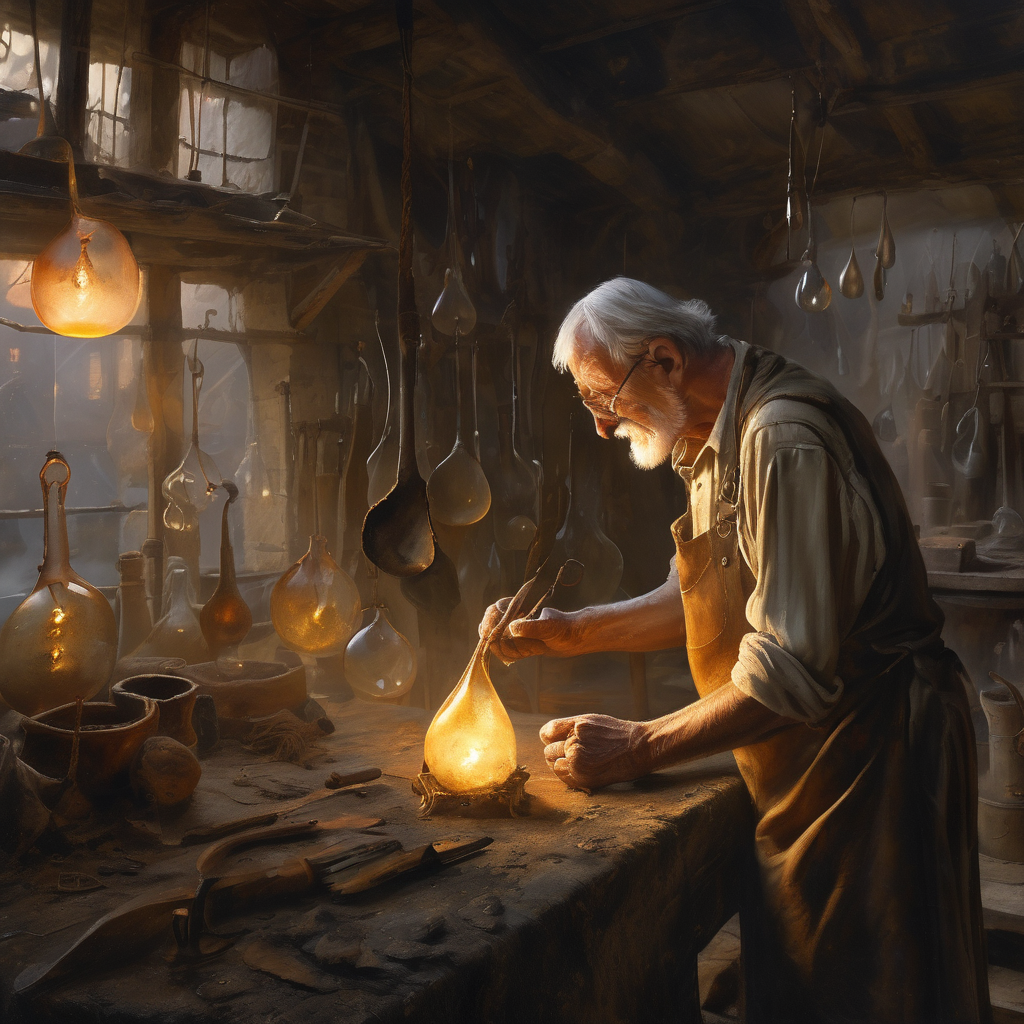
The furnace was a hungry god, and Silas was its oldest, most devoted priest. He fed it birch logs and secrets, and in return, it gave him liquid light. For sixty years, the heat had been his confessor, the roar of the flames his only choir.
His apprentice, Finn, called this his “hermit era,” a phrase the boy had picked up in the market square. Silas didn’t mind. Eras were for young men. Silas had only the long, incandescent present of the fire.
“He’s delulu, I tell you,” Finn would mutter to the delivery girl who brought their soda ash. “Thinks he can trap a feeling in a bottle. Not a ship, not a flower. A feeling.”
Finn was a good boy, but his heart wasn’t in the glass. It was in the tavern, with the wagers and the wenches. He showed up, he turned the pipes, he did the minimum. A classic case of quiet quitting, though he’d never use those words to his master.
Silas ignored him. He was trying to capture the memory of his wife, Elara. Not her face, not her form, but the specific, gut-punching joy of her laughter on the day he’d proposed, the sun turning the dandelions in her hair to a halo. A memory so sharp it still drew blood.
Finn sighed, wiping sweat from his brow with a sooty hand. “It’s like your Sunken Kingdom of Aeridor, master. The thing you can’t stop thinking about.” It was true. Just as every man in the city had their peculiar obsession with the lost glories of that ancient, flooded empire, Silas had Elara. His Roman Empire, as Finn’s generation put it.
The Guild Master’s son, Corvus, sometimes sauntered into the workshop, reeking of expensive oils and unearned confidence. He was the city’s premiere nepo baby, his success cemented not by skill but by lineage. He had what the girls called ‘rizz,’ a slick, easy charm that sold his gaudy, uninspired chandeliers for a fortune.
“Still at it, old man?” Corvus sneered, gesturing with a gloved hand at Silas’s workbench, littered with a hundred flawed attempts—globules of glass, cloudy with imperfection. “Still trying to gatekeep the secrets of sadness for yourself? Let it go. The market wants color, flash. Not this… melodrama.”
Silas didn’t answer. He couldn’t explain that it wasn’t sadness he was chasing, but its opposite. Corvus wouldn’t understand. His world was surfaces. Silas sought the core.
That night, under a sliver of moon, Silas knew it was time. His bones ached with a finality he hadn’t felt before. He stoked the furnace until it screamed, its light painting the walls in strokes of orange and gold. He didn’t need Finn. This was a sacrament for one.
He gathered a dollop of honey-gold glass on his blowpipe. It was the color of Elara’s hair in the sun. He closed his eyes, shutting out the workshop, the city, the sixty years of labor. He summoned the memory.
The field of dandelions. The warmth of the sun on his eyelids. The weight of the silver ring in his pocket. He brought the pipe to his lips, but he did not blow. He *remembered*. He poured the entire, undiluted feeling of that moment—the terror, the hope, the blinding, explosive joy when she’d said yes—down the pipe. He didn’t push air. He pushed soul.
A flicker. A change. A tangible vibe shift in the oppressive heat of the room. He opened his eyes.
At the end of the pipe, where a bubble should have been, was a single, perfect drop. It wasn’t round, but shaped like a tear falling from a high place, elongated and flawless. It was as clear as spring water, yet it held a light of its own, a warm, captured mote of afternoon sun. It cooled rapidly, not cracking or clouding, but solidifying into impossible perfection.
He broke it from the pipe. It was cool to the touch. He held it in his calloused palm. There was no heat, no magic he could name, but as he looked into its depths, he felt it. Not the memory of joy, but the joy itself, radiant and pure, blooming in his chest like a resurrected flower. The grief that had been his shadow for decades receded, not gone, but quieted, put in its place by this solid, undeniable thing.
The next morning, Finn found him sitting on his stool, the furnace banked, the tear held loosely in his hand. The apprentice stopped, his usual cynicism dissolving. The light in the workshop was different. Softer.
“Master?” Finn whispered, inching closer.
Silas opened his hand. The glass tear lay on his palm, a piece of solidified laughter.
Finn stared. He reached out a hesitant finger and touched it. A jolt, faint but unmistakable, shot through him. A feeling of unearned, unexplainable happiness, like hearing a beautiful song for the first time. He pulled his hand back as if burned.
“By the gods,” he breathed. “You did it.”
Silas looked from the tear to his apprentice’s wide eyes. He saw not a boy who was quiet quitting, but a man who had just witnessed a miracle.
“Yes,” Silas said, his voice raspy. “I did. Now, shall we really begin?”

Leave a Reply