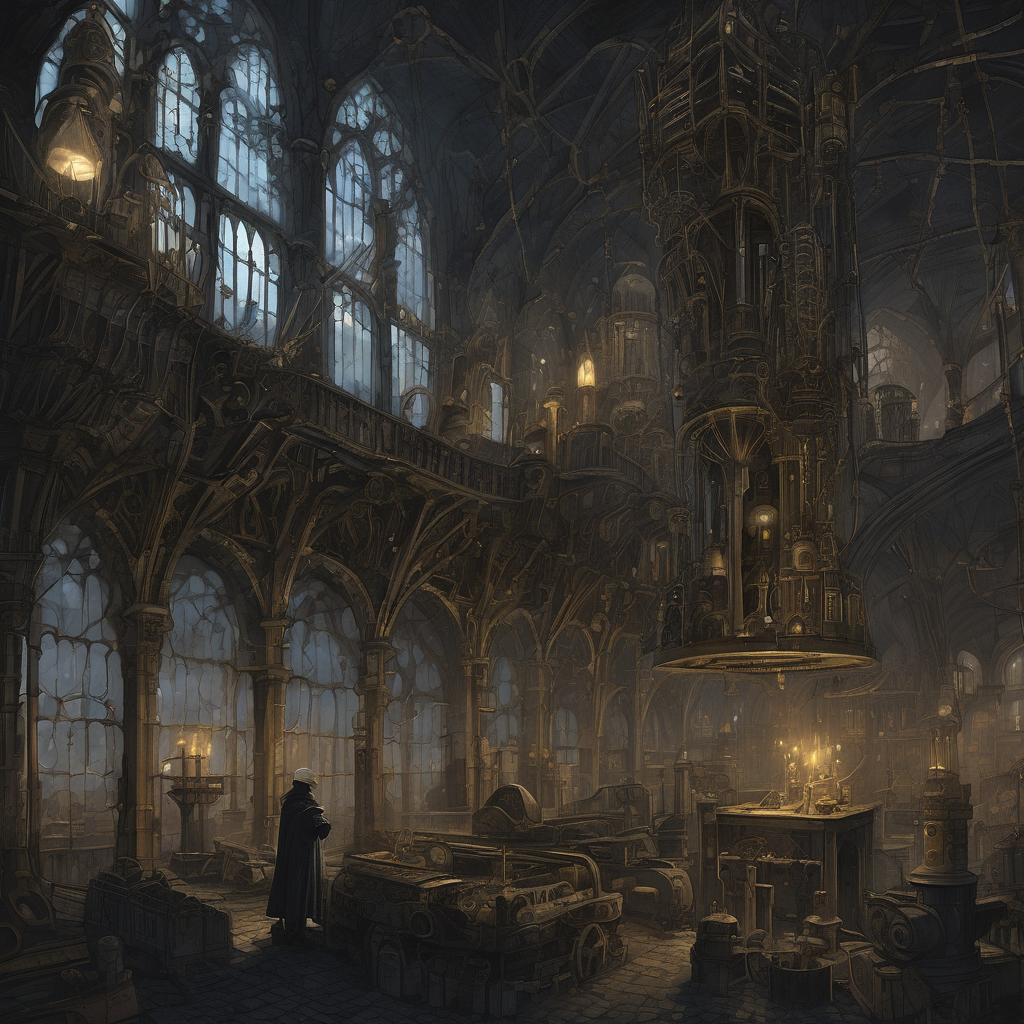
The Aethelburg city lights were failing. Not in a flicker, but in a slow, tired sigh. Elias, a third-generation Sentiment Tuner, laid a hand on the central gear of the Civic Engine. It was cool to the touch, its usual thrum a weak and listless pulse. The great machine, a filigree of spun moonlight and crystallized hope, was the heart of the city, and its heart was slowing.
He descended the spiral staircase, the silence of the engine room amplifying the metallic echo of his bootheels. In the observation chamber, he activated the Chimes—a series of polished glass panes that shimmered with the city’s collective consciousness. He’d hoped to find a grand passion to harness, a unifying wave of civic pride or righteous anger he could tune the engines to. Instead, the Chimes showed a million scattered points of faded light.
His mentor, old Master Valerius, had called it the Great Dissonance. Elias just called it a headache. He began the grim work of diagnosis, swiping a hand across the first Chime. Images fluttered: a young woman painstakingly arranging moss in a terrarium; a baker perfecting a single, exquisite croissant for his tiny morning stall; an accountant secretly writing poetry on his lunch break. Everyone had a **side hustle**, a small, private world of passion that burned just for them. It was energy, yes, but it was siloed, refusing to join the main current. It was the emotional equivalent of trying to power a locomotive with a thousand birthday candles.
The second Chime showed connections, or the lack thereof. Shimmering threads between people were frayed and translucent. He overheard a snippet of conversation, a ghost in the glass: “It’s not serious. It’s just… a **situationship**.” The word was new, but the feeling was ancient and weak. The engines craved the symphonic roar of love or the shattering crescendo of heartbreak. This lukewarm state of being offered them nothing but a dissonant hum.
Elias slumped into his chair, pulling up the archives. Valerius’s journals were filled with notes on past crises. The Iron Despair of the ’92 Famine. The Ecstatic Fervor of the Centennial. Those were monolithic emotions, easy to plug into, to amplify. Now? He scrolled through a public forum on the Chimes, a grim practice the young people called **doomscrolling**. The posts were a litany of muted anxieties about everything and nothing. Beneath one, scrawled in angry light, was a single word: **delulu**. He had to look it up. *Delusional hope.* So they knew. They knew they were running on fumes, pretending a spark was a fire.
He saw it everywhere he looked. A generation afflicted with what they strangely, proudly called **main character energy**. Each person saw themself as the protagonist of a story no one else was reading. They were heroes on quests with no dragons, lovers in romances with no partners, artists with an audience of one. Their energy was directed inward, a closed circuit that powered only their own meticulously curated narrative.
This was the source of the societal **quiet quitting**. Not a protest, but a quiet, collective turning-away. Citizens performed their duties for the city, but their spirits were elsewhere, tending their tiny, personal flames. Elias watched a group of young office workers through a street-level Chime. They moved with a practiced lethargy, their faces blank. But then one’s expression would brighten minutely as she glanced at a charm bracelet she was weaving under her desk. Her joy, so potent and real, was completely unavailable to the Gossamer Engines that kept the streetlights burning above her head.
A memory surfaced: Valerius, old and frail, tapping a dead gear in the engine room. “The hardest thing to tune for, Elias,” he had rasped, “is a lack of **authenticity**. When the people pretend, the engines choke on the lie.”
That was it. They were all pretending. Pretending their small lives were epic poems. Pretending their transient connections were meaningful. Pretending their disengagement was a form of rebellion.
Elias walked back to the central engine, its vast, web-like structure seeming more fragile than ever. The old way was to fight the trend, to try and generate a new, grand emotion with city-wide pageants or manufactured crises. But that wouldn’t work on a people who had collectively decided to opt out.
He couldn’t create a symphony. But maybe he could harmonize the whispers.
With trembling hands, he began to work, not on the grand gears, but on the tiny, peripheral regulators. He stopped trying to filter out the small, selfish joys. Instead, he began to tune the engine *to* them. He recalibrated a sub-harmonic filter to resonate with the quiet satisfaction of a perfectly tended plant. He adjusted a torsion rod to catch the fleeting pride of a well-made latte, served from a cart that was someone’s real dream. He linked the energy of all the lonely main characters, not to force them into a chorus, but to layer their solos, creating a complex, polyphonic hum. He was weaving the gossamer threads of a thousand **situationships**, a million **side hustles**, the strange, defiant hope of the **delulu**.
The great engine sputtered. A gear spun backward. A shower of cold, silver sparks rained down. For a terrifying moment, the hum died completely, and the vast chamber was plunged into an abyssal silence. Elias held his breath.
Then, a new sound began. Not the thunderous roar of the old days, but a soft, intricate whir. It sounded like a forest waking up, like a city breathing in its sleep. Elias looked at the primary power gauge. The needle wasn’t leaping, but it was climbing steadily, surely.
He ran to the observation chamber. The lights of Aethelburg were not the brilliant, uniform white of the past. They were a patchwork quilt of softer hues. A warm, golden glow from the artisan district, a cool, blue calm from the residential towers, a flickering, creative silver from the university quarter. The city was no longer powered by a single, monolithic heart. It was powered by a million tiny, authentic ones. It wasn’t perfect, and it wasn’t grand. But it was real. And it was enough.

Leave a Reply