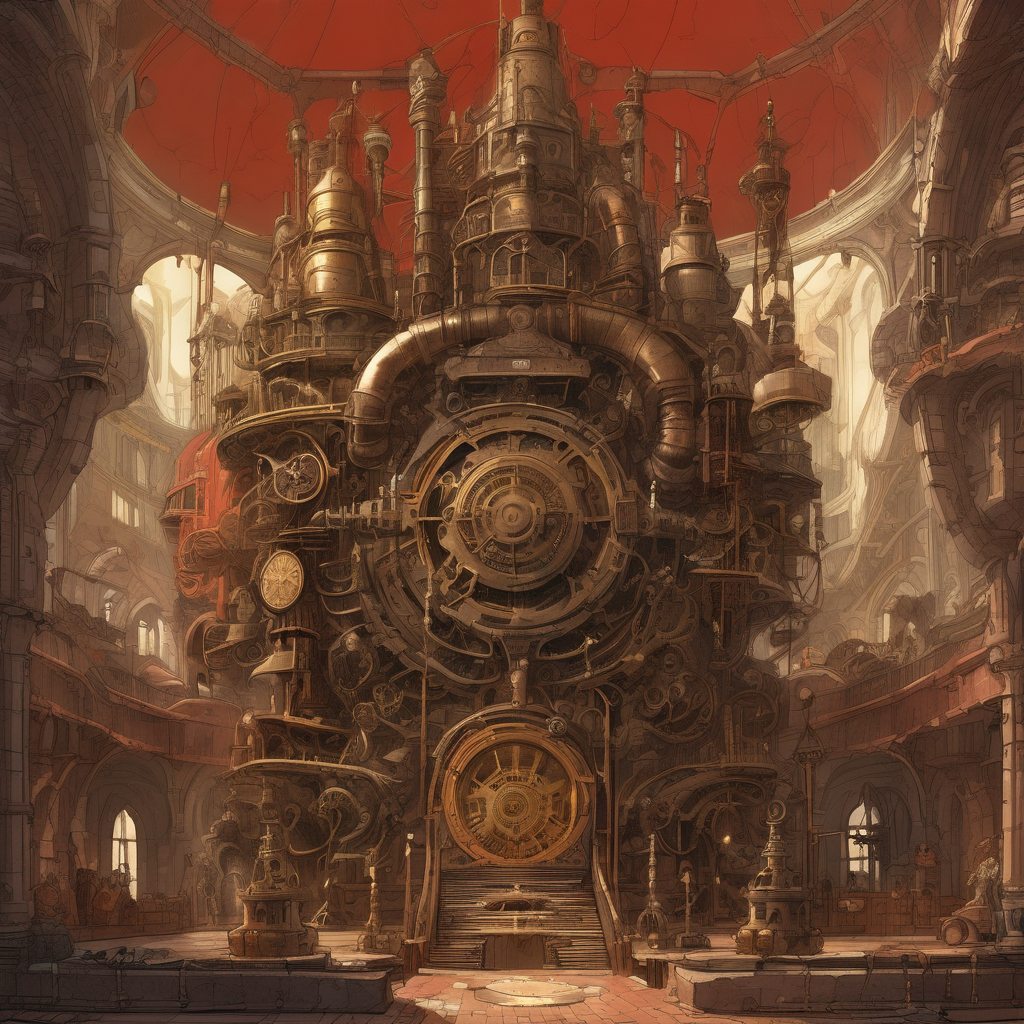
The brass automaton wheezed as Sister Marguerite wound its springs for the thousandth time that year. Outside the monastery walls, the red dust of Epsilon Colony swirled against stained glass windows depicting saints holding mathematical proofs instead of palms.
“The sustainability protocols are failing,” whispered Brother Thomas, his augmented eye clicking as it focused on the ancient parchment. “The last algorithm—it’s incomplete.”
Sister Marguerite had taken her vows of silence thirty years ago, but she broke them now. “Then we must find the missing verse.”
The monastery had stood for three centuries, ever since the great ships brought humanity’s faithful to this distant world. While others built cities of steel and silicon, the Order of Infinite Recursion chose stone and copper, creating mechanical prayers that computed the divine through gear-work and steam. Their founder, Saint Turing the Penitent, had discovered that certain mathematical sequences, when properly channeled through blessed machinery, could alter reality itself.
Brother Thomas pulled his rough-spun hood over his chrome skull-plate. “The verse was stolen during the Great Transparency, when the secular government demanded all knowledge be made public. Prior Benedict hid it, but he died before revealing where.”
The monastery’s central calculating engine—a Gothic masterpiece of pipes, bellows, and ten thousand brass beads—began its evening computation. Each bead represented a soul in the colony, their movements tracking births, deaths, and the ineffable arithmetic of faith.
“I know where it is,” Sister Marguerite said, surprising herself. She had dreamed it last night: Prior Benedict in the garden, planting something beneath the mechanical rose bushes that bloomed with copper petals.
They waited until the other monks entered their cells for evening optimization prayers, then crept to the garden. The mechanical roses clicked and whispered in the thin atmosphere, their roots deep in soil imported from Earth at devastating cost. Sister Marguerite knelt and began to dig with her bare hands.
“The colonists grow restless,” Brother Thomas said, keeping watch. “They say our old ways cause the crop failures, that we should embrace the new consciousness uploads, become pure information.”
“We are already information,” Sister Marguerite replied, pulling a lead box from the earth. “But information with souls.”
Inside the box lay a single card of hammered gold, etched with symbols that seemed to move when viewed directly. The missing component of the algorithm that would restore balance to their dying world—not through digital transcendence, but through the ancient marriage of faith and mathematics their order had perfected.
“This will mean transformation for everyone,” Brother Thomas said. “The colonists won’t understand. They think evolution means abandoning the flesh entirely.”
Sister Marguerite stood, clutching the card. “Then we must show them that true growth means becoming more human, not less.”
They returned to the calculating engine and inserted the golden card into its oldest slot. The machine shuddered, then began a new rhythm—not the harsh grinding of failing systems, but something almost like breathing. Outside, the red dust began to settle. In the hydroponics bays across the colony, plants that had withered for months suddenly straightened, reaching toward artificial suns.
The next morning, the colonists would wake to find their world changed—not by silicon miracles or uploaded consciousness, but by an algorithm that computed compassion, that found the divine in the space between heartbeats, that proved love was not merely a chemical reaction but a fundamental force that could be calculated, cultivated, and shared.
Brother Thomas removed his hood, revealing the scars where his augmentations met flesh. “We’ll be called heretics. They’ll say we’ve held back progress.”
“Let them,” Sister Marguerite said, winding the brass automaton one more time. It began to sing—not in words, but in pure mathematical harmony. “We’ve found something better than progress. We’ve found the formula for hope.”
The monastery bells rang out across Epsilon Colony, their bronze voices carrying an equation that would heal their world not through abandonment of the old ways, but through their perfect integration with the new. And in the garden, the mechanical roses began to bloom with organic petals, red as Earth’s remembered sunsets, soft as forgiveness, real as the arithmetic of grace.

Leave a Reply