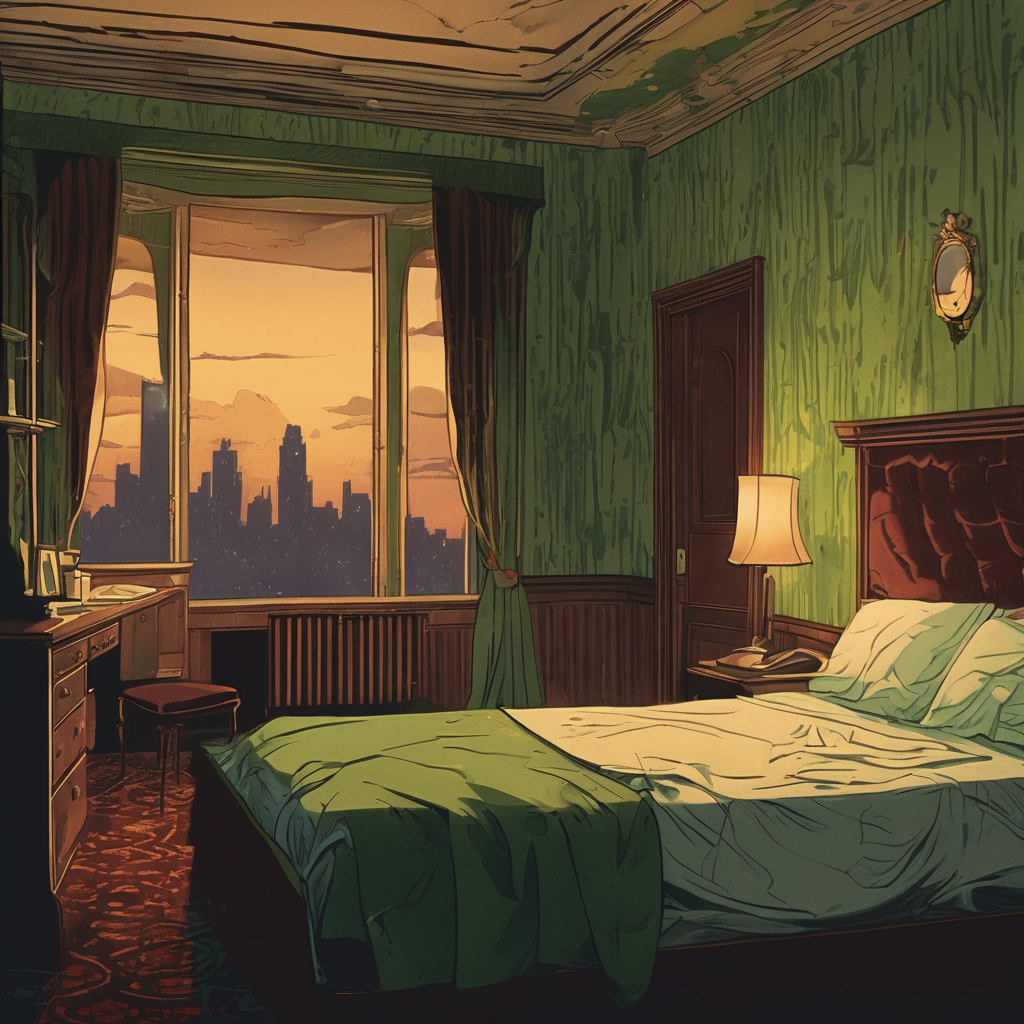
The wallpaper in Room 714 had been whispering for seventeen years, but only Margot could hear it. She’d inherited the position of night manager at the Bellweather Hotel from her aunt, along with a brass skeleton key and strict instructions never to rent out that particular room.
Tonight, however, she stood outside its door with a guest.
“I specifically requested this room,” the woman said, adjusting her emerald hijab. Her eyes were the color of burnt amber, and when she smiled, Margot noticed her canine teeth were slightly longer than they should be. “My grandmother stayed here in 1952. She left something behind.”
Margot’s hand trembled as she turned the key. The door opened with a sigh that sounded almost relieved.
Inside, the room was exactly as it had been since the hotel’s last renovation in 2006—sage green walls, mahogany furniture, a view of the city’s skeletal skyline. But the air felt thick, like breathing through honey.
“There,” the woman pointed to the ornate mirror above the dresser. “Do you see it?”
Margot saw only their reflections at first, but then the glass began to ripple. Behind their images, another scene emerged: a young woman in a 1950s dress standing in this same room, pressing her palm against the mirror from the other side.
“That’s my grandmother, Roya,” the visitor said. “She was a refugee from Tehran, working as a lounge singer downstairs. She fell in love with something that lived in this mirror. Something that fed on secrets.”
The woman pulled out a small vial of what looked like liquid starlight. “This is vervain oil mixed with tears from a phoenix. Very sustainable harvest, I promise you—the phoenix is quite happy to provide them. My grandmother’s journal said it would break the binding.”
As she uncorked the vial, the wallpaper’s whispers grew louder. Margot could finally make out words: confessions of every guest who’d ever stayed here, their secrets soaked into the very walls. Affairs, murders, stolen identities, hidden treasures, forgotten children.
“The thing in the mirror,” the woman continued, spreading the oil on the glass, “it’s been collecting confessions, feeding on guilt and shame. My grandmother tried to destroy it, but instead became trapped herself, her spirit split between two worlds.”
The mirror cracked, and through the fissure stepped the young woman from 1952. But her eyes were ancient, older than the hotel, older than the city itself.
“Granddaughter,” Roya said, her voice like wind through empty rooms. “You’ve come to finish what I started.”
Behind her, something else began pushing through the broken mirror—something made of accumulated secrets, worn like scales. It had too many mouths, each one spewing different confessions in different voices.
“The election was rigged,” one mouth whispered.
“I killed my husband’s mistress,” said another.
“The vaccine trials were falsified.”
“I started the fire.”
“I never loved them.”
The woman in the hijab raised her hand, and Margot saw she wore a ring that looked like crystallized music. “These secrets want to be free. They want to return to their owners, to stop being food for this thing.”
The creature lunged forward, but Roya caught it, her ghostly hands suddenly solid. Grandmother and granddaughter began to sing—a melody that sounded like home, like every homeland anyone had ever lost and found again. The song pulled at the secrets, unraveling them from the creature’s form like pulling threads from a tapestry.
Each confession flew out the window, a dark bird seeking its origin. Across the city, people would wake tomorrow remembering things they’d forgotten, or finally forgetting things they’d remembered too well.
The creature diminished with each departing secret until only a small, grey thing remained—barely larger than a hummingbird, with eyes like broken promises.
“This is what you really are,” Roya said gently. “Just a lonely thing that learned to eat sorrow because it was the only food available.”
Her granddaughter opened another vial, this one filled with what looked like crushed pearls and cinnamon. “This is forgiveness,” she said, offering it to the creature. “A different kind of sustenance.”
The creature hesitated, then drank. Its grey form brightened to silver, then to pure light, before vanishing entirely.
Roya turned to her granddaughter, already beginning to fade. “The confession I came to make in 1952,” she said, “was that I could see through the veils between worlds. I thought it was a curse. But looking at you now, I see it was a gift I passed on.”
She kissed her granddaughter’s forehead, then walked back through the mirror, which sealed itself whole again.
Margot stood in stunned silence as the woman in the hijab turned to her. “The room is clean now,” she said. “You can rent it out again. Though I’d suggest redecorating. That wallpaper has heard entirely too much.”
As they left Room 714, Margot noticed the whispers had stopped. The silence felt like a held breath finally released, like a very old debt finally paid.

Leave a Reply