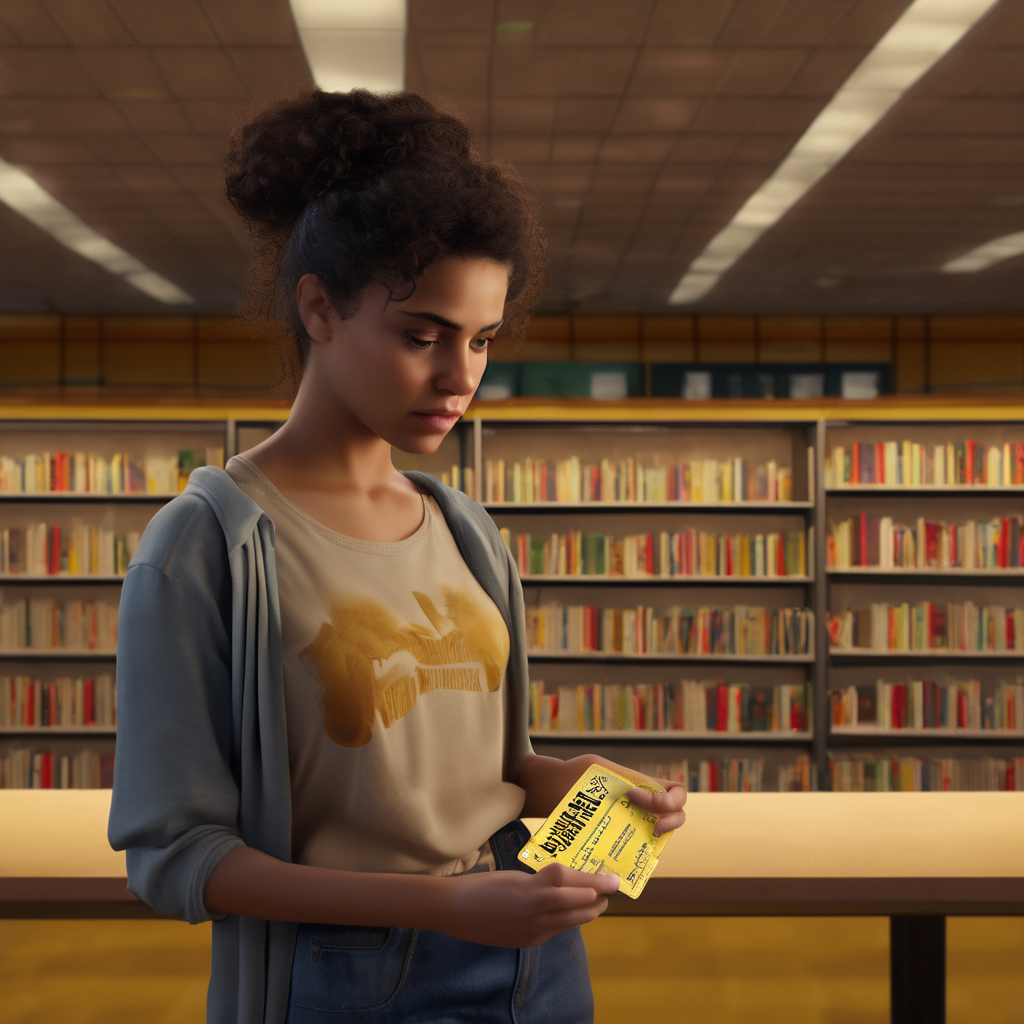
Mira pressed the worn card between her palms, feeling the raised letters spell out her grandmother’s name: *Elena Vasquez, Member Since 1987*. The plastic had yellowed with age, its magnetic stripe long since useless, but the head librarian had accepted it anyway when the demolition crews arrived.
“Take whatever you can carry,” Ms. Chen had whispered, her voice echoing in the cavernous space where books once lived. “The new owners want everything gone by morning.”
The Millfield Public Library had been Mira’s sanctuary through three foster homes, two failed adoptions, and countless nights when the world felt too sharp around the edges. Now luxury condos would rise where the poetry section once stood, where she’d discovered Rumi and Maya Angelou tucked between volumes that smelled of vanilla and time.
She wandered the empty shelves, their naked wood gleaming under fluorescent lights that would soon go dark forever. In the children’s corner, crayon marks still decorated the reading nook where her grandmother had first taught her that words were doorways. Elena had cleaned these very floors for thirty years, arriving before dawn to dust the reference section and water the plants that made the space feel alive.
“Libraries are magic,” Elena used to say. “They hold every story that ever mattered.”
Mira’s phone buzzed—a text from her roommate about splitting the electric bill—but she ignored it. Instead, she pulled out the worn notebook where she’d been writing her own stories, the ones that bloomed in coffee shops and bus stops, capturing conversations between strangers who thought no one was listening.
In the biography section, a single book remained: a collection of letters by ordinary people during extraordinary times. She opened it randomly and read about a woman in 1943 writing to her sister about victory gardens and ration cards, about finding beauty in scarcity. The margins were filled with another reader’s notes—questions and connections spanning decades of thought.
This was what they were losing. Not just books, but the democracy of shared space, the radical notion that knowledge belonged to everyone regardless of their ability to purchase it. The new development promised “curated retail experiences” and “artisanal lifestyle concepts,” but who would curate dreams for the teenager hiding from foster care? Who would craft lifestyle concepts for the elderly man who came here because his apartment was too quiet?
Mira slipped the letter collection into her backpack alongside the three other books she’d chosen: a cookbook filled with her grandmother’s handwritten modifications, a field guide to urban wildlife, and a slim volume of short stories by writers she’d never heard of. She made her way to the front desk where Ms. Chen was boxing up the card catalog—those beautiful wooden drawers that had been obsolete for twenty years but too beloved to discard.
“I have an idea,” Mira said, holding up her grandmother’s library card. “What if this doesn’t have to end?”
Ms. Chen looked up, hope and exhaustion competing in her expression.
“Little Free Libraries,” Mira continued, the plan crystallizing as she spoke. “We can’t save this building, but we can scatter the magic. Every neighborhood needs a place where stories live.”
By spring, tiny libraries had sprouted throughout the city like wildflowers after rain. Each one bore a small plaque: *In memory of Elena Vasquez and all who believed stories belong to everyone*. Mira tended them like gardens, restocking the shelves and leaving her own stories—handwritten on index cards—tucked between the pages of well-loved novels.
The last library card had become the first of many small revolutions.

Leave a Reply