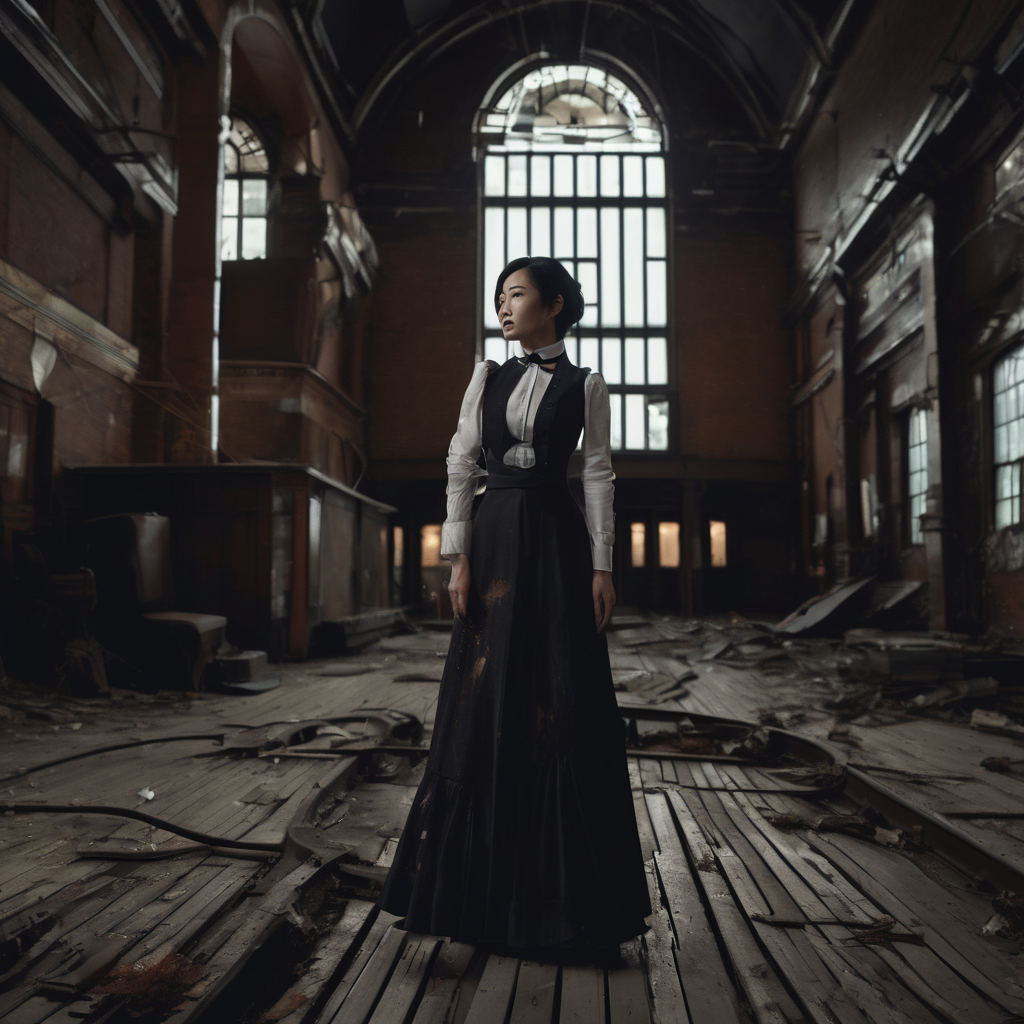
The séance table rattled against the warped floorboards as Margot Chen pressed her palms flat against its surface, feeling for the telltale vibrations that meant the dead were near. Outside, the abandoned Millbrook Station groaned in the October wind, its ticket windows dark for thirty years, ever since the last train carried away the town’s living population during the great exodus.
“They’re here,” Margot whispered to the empty waiting room, though she knew her podcast audience would hear every word through the wireless microphone clipped to her vintage dress collar. She’d chosen this location specifically—not just for the aesthetics that would make stunning promotional photos, but because stations were liminal spaces, thresholds between destinations. Perfect for someone who straddled the boundary between life and death.
The temperature dropped fifteen degrees in seconds. Her breath clouded the air as phantom footsteps echoed from the platform outside. Margot had been tracking this particular spirit for months, following whispers through her network of cemetery groundskeepers and estate sale coordinators. The ghost of Theodore Millbrook, the station’s architect who’d vanished during its grand opening in 1892, leaving only his leather-bound sustainability journal—decades before the concept even had a name.
“Theodore,” she called out, her voice carrying the particular resonance she’d inherited from her grandmother, the last medium before her. “I know about the merger. I know why you couldn’t rest.”
The footsteps stopped. In the silence, she heard something else—a sound like paper rustling, though no wind reached inside the station. Then she saw it: hovering above the table, a translucent document materialized, its letterhead reading “Millbrook Railways Consolidated.” The merger agreement that had been signed the day Theodore disappeared, the one that would have destroyed the valley’s ecosystem to lay new tracks through protected wetlands.
“You tried to stop them,” Margot said, understanding flooding through her. “But they killed you for it.”
The spirit manifested slowly, not as the elderly man from the portraits, but as he’d been that final day—young, desperate, his vest torn and spectral blood seeping through his shirt. He pointed toward the old ticket office.
Margot stood, her movement tracked by her audience watching live. The immunity she’d built up over years of spirit communication protected her from the worst of the psychic pressure, but she still felt the weight of Theodore’s urgency. In the ticket office, beneath a loose floorboard she’d never noticed before, lay a metal box.
Inside: the real merger documents, splattered with very real, very human blood. And beneath them, a confession signed by three members of the railway board, hidden here where they thought no one would ever look.
“Justice,” Theodore’s voice echoed, though his lips didn’t move. “Finally.”
As sirens wailed in the distance—her producer had already called the authorities—Margot felt the station grow warmer. Theodore’s spirit began to fade, but not in the violent way of banishment. This was resolution, a gentle dissolving like morning mist.
“Wait,” Margot called out. “The sustainability journal—you were planning something revolutionary. The innovations, the green initiatives you designed for the railway—”
Theodore smiled, the first human expression she’d seen from him. He gestured toward the walls, and suddenly Margot could see them: blueprints etched in spectral light, showing railway designs that used natural ventilation, rainwater collection systems, and building materials that would have been considered radical even today. Ideas that the world had lost for over a century.
“For the future,” he whispered, and then he was gone.
Margot stood alone in the station as red and blue lights painted the windows. She thought about endings and beginnings, about voices silenced and finally heard. The wooden bench where travelers once waited for their trains still bore the carved initials of long-dead lovers. The schedule board still showed arrivals that would never come.
But she had the blueprints now, captured on her camera. And she had the truth about Theodore Millbrook, who’d died trying to save a valley that eventually saved itself when the railway company went bankrupt six months after his murder.
As the police entered the station, Margot realized she might truly be the last medium of Millbrook Station. Not because the gift was dying out, but because after tonight, the dead here could finally rest. The station had given up its last secret, delivered its final passenger to peace.
She touched the séance table one more time, a farewell to the threshold she’d guarded. Somewhere, she swore she could hear the distant whistle of a train that existed only in memory, carrying Theodore Millbrook home at last.

Leave a Reply