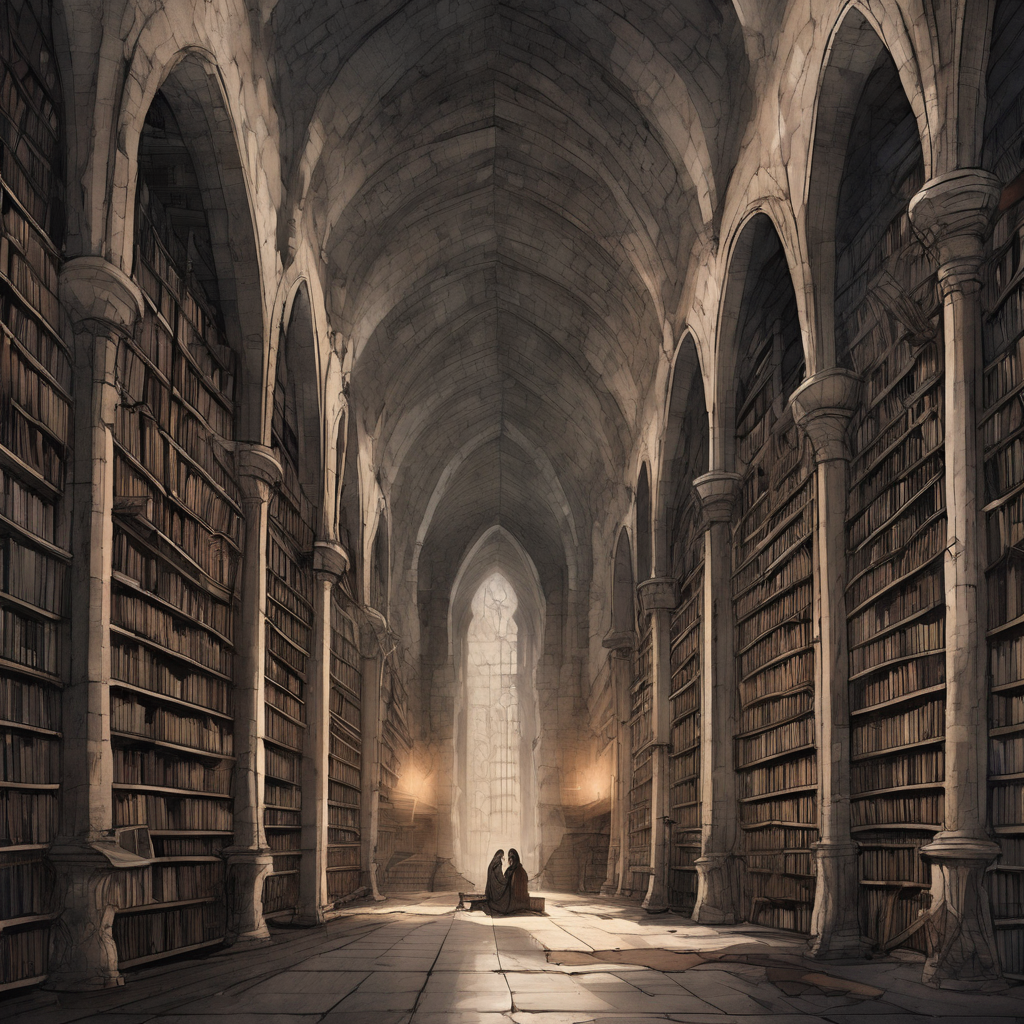
Elara no longer remembered if she had chosen the library or if it had grown around her, a calcification of duty. Its shelves were not shelves at all, but vast, cavernous looms that stretched into a gloom pricked by the soft glow of their contents. She was the sole archivist of this place, a repository for the pain of others.
People came to her, a trickle at first, now a river. They offered up their hurts—a betrayal, a deep loss, a moment of searing shame. Elara would listen, her face a mask of placid neutrality. Then, she would reach out, not to their skin, but to the air just above it, and pull. A shimmering, filament-thin line of light would emerge from them: a thread of memory. They would leave feeling lighter, the sharp edges of their trauma blunted, while Elara was left with the raw material of her work.
She sorted them into two great wings. To the left was the Rose Wing, where the air hummed with a high, fragile frequency. Here hung the tapestries of naive sorrows. There were coquette little threads of a first heartbreak, shimmering with pearlescent tears; threads of youthful ambition soured into jealousy, a sour apple green; threads of shattered ideals, the colour of a dollhouse violently thrown against a wall. Elara found this wing exhausting. It was a monument to the blithely delusional, to the belief that life was supposed to be fair.
To the right lay the Soot Wing. Silence reigned here, a heavy, absorbing quiet. The threads were thick and dark, woven into immense, brutalist tapestries. The leaden grey of a parent’s final breath; the jagged, obsidian shard of a city falling to fire; the oily, rainbow-slick black of a promise rotted from the inside out. This wing was honest, at least. It made no pretense. It was the Oppenheimer to the Rose Wing’s Barbie, a stark acknowledgment of endings.
Lately, Elara had found herself merely going through the motions. A quiet quitting of the soul. She’d pull the thread, sort it, and weave it with mechanical precision, her empathy worn down to a nub. She was at the end of her compassionate era. Her life outside the looms was a series of spartan rituals. Her evening meal was invariably what she thought of as a ‘girl dinner’—a wedge of hard cheese, two radishes, a stale crust of bread. It required nothing of her, a refuelling as joyless as her work had become.
Then he came.
His name was Kael, and the scar he carried was not on his skin. It pulsed in the air around his left hand, a frantic, confused light. He told her his story. He had built a beautiful, impossible machine to save his drought-stricken village, a machine that drew water from the clouds. It had worked, gloriously, for one day. The village celebrated. And then, at dawn, the stolen moisture had catastrophically returned to the sky, freezing into a storm of black ice that shattered the very foundations of their homes, rendering the land uninhabitable. He had created a miracle and a ruin in the same breath.
“Take it,” he pleaded.
Elara reached out. The thread that emerged from him was a paradox. It was a vibrant, hopeful pink, the exact shade of a sunrise over a thirsty field. But twisted inextricably within it was a cord of the deepest, most desolate ash. It was beautiful and it was horrific.
She carried the shimmering dichotomy through the library, but it belonged nowhere. In the Rose Wing, its blackness seemed to foul the air, a serpent in the garden. In the Soot Wing, its brilliant pink felt like a mockery, a cheap plastic flower on a fresh grave. For the first time in centuries, a History had no catalogue number.
Kael returned the next day, and the next. He didn’t ask if she’d filed it away, he just sat with her in the central hall, a silent companion in the heart of her strange kingdom. It was a situationship of the spirit; they were bound by this unclassifiable pain, a connection with no name. Elara found herself looking forward to his quiet presence, a disruption to her lonely meals and her emotional austerity. He was forcing her to think, to *feel*, again.
On the seventh day, as Kael sat watching, Elara took his thread from its temporary hook. She didn’t walk left or right. She walked straight ahead, to a vast, empty wall at the very back of the library she had not touched in an age.
She took a breath. She was delulu to even try, to think a new category could be willed into existence. But her fingers found the nascent loom. She did not try to separate the pink from the black. She did not try to hide one within the other. She began to weave them together, a double helix of creation and destruction. The pattern that emerged was new. It was not pretty, and it was not grim. It was simply true. The pink threads formed the outlines of homes, and the black threads showed the cracks in their foundations. The black formed the shape of a storm cloud, but the pink was the silver lining, not of hope, but of the memory of a single, perfect, rain-filled day.
She wove all through the night, Kael’s silent vigil her only witness. When she was done, a single, complex tapestry hung where before there had been only blank stone. It didn’t hum with hope or weigh heavy with despair. It resonated with a new chord: the sound of acceptance.
Kael stood and walked to the tapestry. He reached out, not to touch it, but to feel the strange, new warmth it gave off. A single tear traced a path down his cheek, but his face was not one of sorrow. It was the face of a man who could finally carry his own story.
He left without a word. Elara did not watch him go. She was already looking at the empty space beside the new tapestry, the immensity of it, the terror and the possibility. Her era of quiet quitting was over. A new, more difficult one had just begun. The work of understanding things that were both, and neither, and everything in between.

Leave a Reply