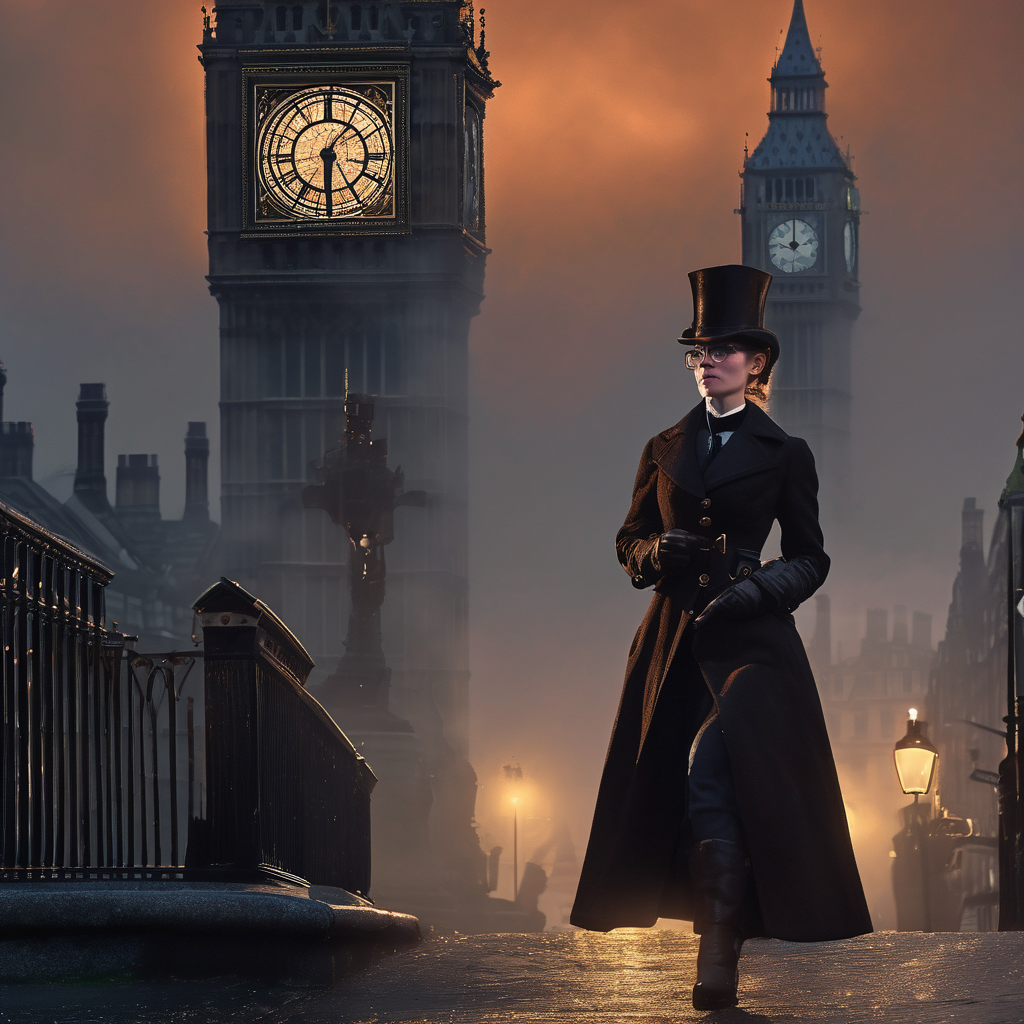
In the shadowed alleys of Victorian London, where gas lamps flickered like hesitant stars and fog whispered secrets to the cobblestones, Inspector Eliza Hart pursued a ghost. The Phantom Thief, as the broadsheets dubbed him, had struck again, this time vanishing with the priceless Emerald Diadem from Lady Abernathy’s ballroom during a glittering soiree. But it wasn’t the theft that baffled Eliza; it was the riddle left behind, scrawled in elegant script on a scrap of parchment: “In an era of swift changes, where the climate shifts like a lover’s mood, seek the doll that dances demurely under the mushroom cloud.”
Eliza adjusted her spectacles, her mind racing. The city buzzed with odd trends that season—parlor games inspired by far-off tours of ancient wonders, whispers of a “brat summer” where debutantes rebelled against corsets and curtsies, and fervent talks of climate action amid the coal-smoke haze. She suspected the thief wove these into his puzzles, turning the zeitgeist into a web of misdirection.
Her investigation led her to the Curiosity Shoppe on Baker Street, a haven of oddities run by the eccentric Dr. Julius Oppenheim, a man obsessed with explosive inventions and philosophical debates on destruction’s beauty. “Ah, Inspector,” he greeted her with a bow, his eyes twinkling behind thick lenses. “You’ve come about the phantom, haven’t you? He fancies himself a mindful trickster, very demure in his chaos, accumulating aura points with each heist.”
Eliza frowned. “Aura points? That’s nonsense from the spiritualist salons. What does it mean?”
Oppenheim chuckled, leading her to a glass case displaying a porcelain doll dressed in pink finery, its painted smile eerily serene. “Barbie, they call her—a relic from a traveling exhibit. But look closer.” He tapped the base, revealing a hidden compartment with a tiny model of a mushroom-shaped cloud, etched with runes that glowed faintly.
The riddle clicked. “Swift changes… Eras Tour,” Eliza murmured, recalling the trendy lectures on geological epochs that had swept the intellectual circles. “Climate shifts… the doll under the mushroom cloud.” Oppenheimer’s namesake invention, or something symbolic? No, it was a metaphor for the thief’s next move: stealing the city’s weather vane, a relic said to control London’s infamous fog, amid growing calls for cleaner air.
That night, under a sky bruised with storm clouds, Eliza waited atop the Clock Tower. The Phantom appeared as a swirl of mist, cloaked in shadows, his face a mask of porcelain delicacy. “You’ve solved my puzzle, Inspector,” he purred, his voice like velvet. “But why stop the game? In this brat summer of rebellion, we’re all thieves of fate.”
Eliza lunged, her handcuffs glinting. “Because some trends fade, but justice endures.” As they grappled, the diadem slipped from his grasp, shattering the illusion. The thief was no phantom, but Lord Harrington, ruined by gambling debts, using the city’s obsessions—Swift’s melodic tours, Barbie’s plastic perfection, Oppenheimer’s atomic dread, mindful demureness, and climate cries—to cloak his crimes.
With dawn breaking, Eliza sealed the case, the puzzle’s pieces fitting neatly. London awoke to a clearer sky, the fog lifting like a curtain on a new era.

Leave a Reply