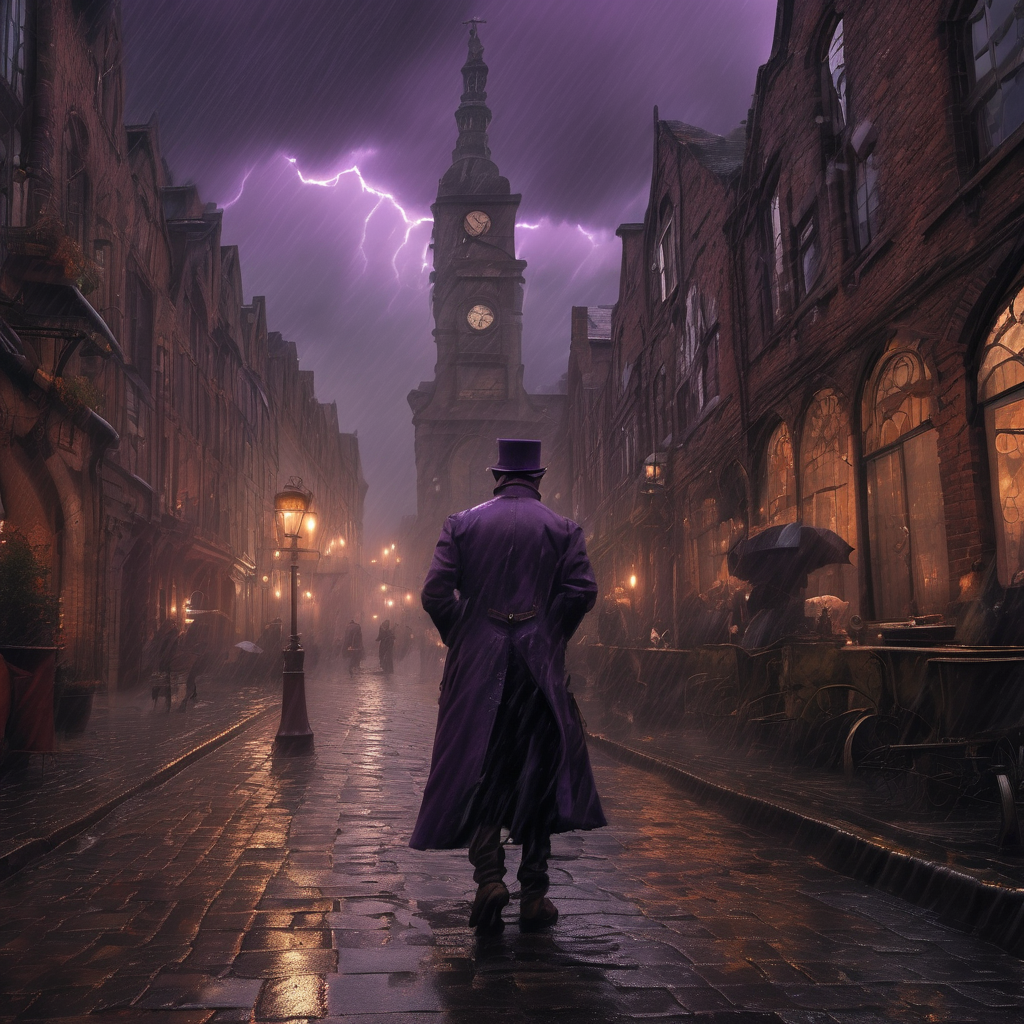
The old city of Alveron was built on a fault line of possibilities. Elias felt it every day, a low hum just beneath the threshold of hearing, a shimmering in the air like heat haze on asphalt. He called it the Static. For most people, it was nothing, the simple noise of a world in motion. For Elias, it was the sound of what-could-be, the rustle of unwritten pages.
He worked in a shop that repaired barometers, sextants, and astrolabes—instruments of certainty in a world he knew was anything but. It had been his father’s shop, and now it was his cage. He was in his quiet quitting era, but for existence itself. He polished brass, replaced cracked glass, and offered his customers polite, empty smiles, all while the Static churned around them, revealing the branching paths of their lives they blissfully ignored.
Then she walked in.
The bell above the door didn’t just jingle; it seemed to sing a new chord. The Static around her wasn’t a shimmer; it was a bonfire. It roared with color and intent. She had a kind of charisma he’d only read about, a fundamental rizz that seemed to persuade the universe itself to lean in a little closer. She placed a small, silver pocket watch on the counter. The hands were frozen at 3:14.
“It’s stopped,” she said, her voice like honey and smoke. “I need it to run again.”
As Elias picked it up, the Static intensified. A vision, sharp and brutal as a shard of glass, pierced the haze: a wrought-iron balcony, a sudden downpour, the crack of metal giving way. And her, falling. It was scheduled for Tuesday, at 3:14.
He looked from the watch to her face, his mask of polite indifference shattered. “This is a canon event,” he whispered, the words tasting like rust in his mouth.
She just smiled, a slow, knowing curve of her lips. “There’s no such thing.” Her name was Lyra, and she believed destiny was a rough draft, open to edits. She saw the Static too, but to her, it was a palette of paints, not a set of instructions. She was in her reality-bending era, and she saw his fearful reverence as a tragic lack of imagination.
“You think I’m delulu,” she said a few days later, leaning against a display case of compasses that all trembled, pointing toward her. “But I think you’re just scared to be the author.”
He tried to argue, to show her the intricate, unchangeable patterns he saw, the way a choice made on Monday morning would inevitably lead to a particular heartbreak on Friday night. But his arguments, his desperate pleas for caution, his entire vibe of bleak acceptance—it seemed to repel her. He could feel it in the way the Static between them soured. He gave her the ick. His certainty of her doom was, to her, the ultimate buzzkill.
On Tuesday, the sky was a bruised purple. A storm was coming. Elias couldn’t stay in the shop. He found her in the old merchant’s square, sipping tea under the awning of a cafe, directly across from a tenement with a filigree of wrought-iron balconies, already slick with the first drops of rain. She looked up and saw him, her expression a mixture of pity and defiance.
The storm broke. The time on the church clock tower was 3:10.
Elias walked toward her, his heart a frantic drum against the hum of the Static. It was deafening now, a physical pressure. He could see the event spooling out in the air, the threads of probability tightening into an unbreakable knot. The balcony above her groaned.
“It’s not too late,” he pleaded, his voice barely audible over the wind.
“It’s never too late to choose,” she countered, her gaze fixed on the balcony as if in a staring contest with fate itself. She was going to prove him wrong. She would simply be elsewhere when the moment struck, a last-second sidestep, a triumphant edit.
3:13. The iron screamed.
She hadn’t moved. She was waiting for the final, critical instant to exert her will. But Elias saw it then—the flaw in her philosophy. You couldn’t erase a sentence; you could only replace it. The event demanded a price. The balcony had to fall. Something had to be broken.
In the space between one breath and the next, with the static roaring in his ears, Elias didn’t try to pull her away. He didn’t scream a final warning. He simply stepped forward, grabbed the terracotta pot of geraniums from her table, and hurled it with all his might into the street.
A carriage, drawn by two powerful horses, swerved violently to avoid the shattering pot. The driver shouted in anger. The carriage lurched, one of its heavy iron-rimmed wheels mounting the curb and slamming into the cast-iron support pillar of the balcony.
The world held its breath. Then, at precisely 3:14, the entire structure tore away from the building with a sound like the world cracking open, and crashed onto the empty sidewalk where Lyra had been sitting just a moment before the commotion had made her leap to her feet.
She stood drenched and trembling, staring at the wreckage, then at Elias. The canon event had happened. The balcony fell at the appointed time. But she had been saved. He hadn’t defied causality; he had offered it a different sacrifice. A geranium, a carriage’s path, a moment of chaos. A rewrite, not an erasure.
The Static around them settled, suddenly quiet, like dust after a demolition. All that was left was the clean, clear air and the scent of rain on shattered stone.

Leave a Reply