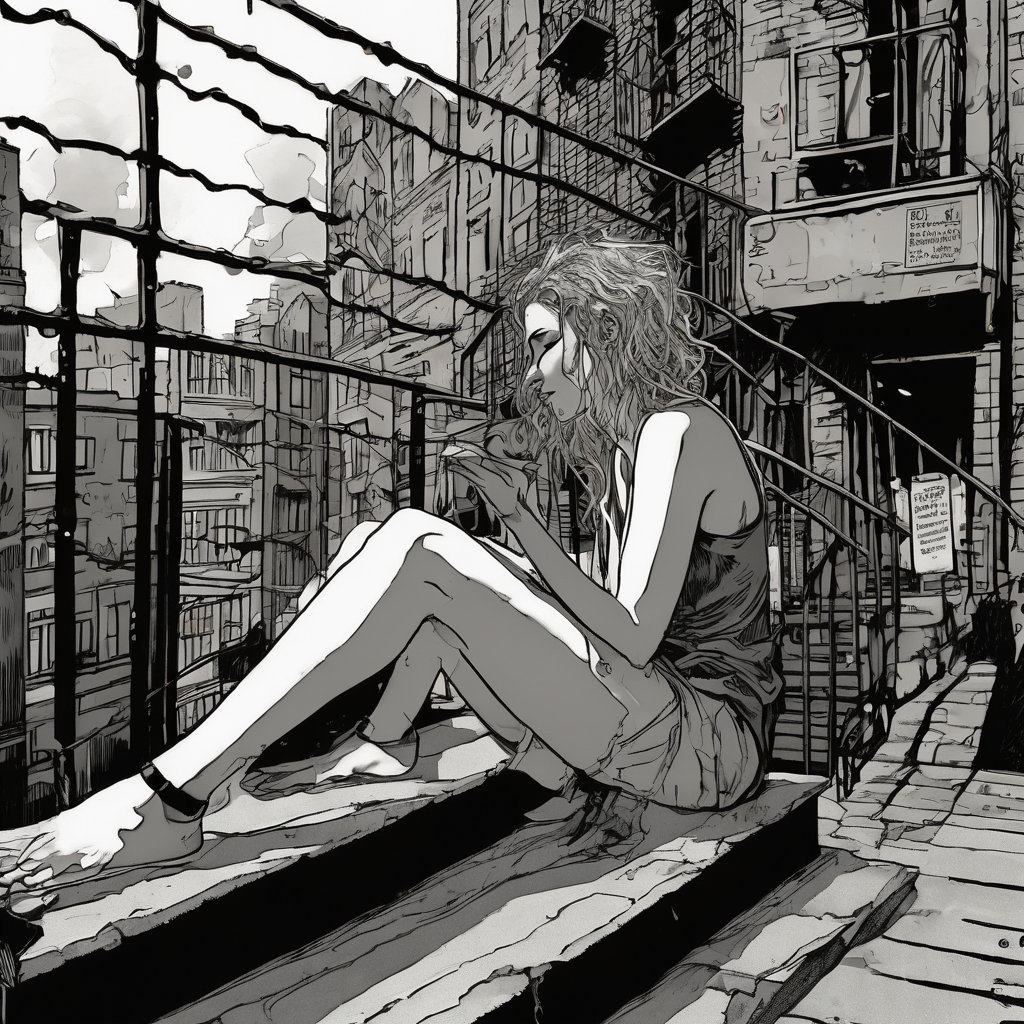
The city had been under the heat dome for three weeks. The air wasn’t just hot; it was thick, gelatinous, and tasted of melted asphalt and ozone. Time itself seemed to have slowed to a crawl, oozing like honey from a spoon. Elara sat on her fire escape, watching the shimmer-ghosts rise from the pavement below.
This was the season of strange phenomena. The bronze statues in the park had begun what the local paper cheekily called a ‘quiet quitting’; the General on his horse had slumped in his saddle, his sword arm now dangling limp at his side. The muse of poetry, once poised with her quill, now leaned against her plinth as if waiting for a bus that would never come. They hadn’t fallen, just… given up the pretense of their heroic poses.
It was in this syrupy, suspended city that she’d met him. Kael. He possessed a strange current, what the graffiti on the overpass called ‘rizz’—a low hum that made stray cats follow him and wilting window-box flowers turn their heads as he passed. He wasn’t handsome in the classical sense, but he moved with a languid certainty that made you believe the world rearranged itself for his convenience.
They existed in the hazy space between friendship and something more, a territory with no map and no name. A situationship, her roommate had called it, shaking her head. A collection of shared coffees and late-night walks, a sentence with no punctuation. With Kael, every moment felt both urgent and eternal.
One evening, he’d shown up at her door with a foraged bounty: slightly bruised figs from a forgotten tree in the cemetery, a handful of bitter greens from a crack in the sidewalk, and a single, perfect, cool-to-the-touch river stone. “Dinner,” he’d announced. It was the quintessential girl dinner, if a girl was a magpie or a forest witch. They ate on the floor of her apartment, the figs bursting with sticky sweetness, the drone of a thousand cicadas their only music. That night, he’d told her secrets that didn’t sound like secrets—how he could tell the time by the slant of dust motes in a sunbeam, how he once saw the sky crack open for a second, revealing not stars but gears.
Elara ran a thumb over the glossy-faced postcard in her lap. It was a picture of the sea, a furious, impossible blue she could hardly remember. On the back, in her neatest script, was a single sentence: *I think the heat is making me see you everywhere.* It was addressed to him, but she didn’t have his address. He was as locatable as a specific cloud.
Was she just inventing the depth between them? The tabloids at the checkout lane screamed about the new mental state of the youth: delulu was the solulu—the delusion was the solution. Maybe that’s all this was. A beautiful, shimmering delusion to get through the oppressive heat, to make the silent, slumping statues seem poetic instead of just sad.
She remembered a Tuesday, early on, before the heat had truly clamped down. They’d stood on the bridge, and he’d pointed to a flock of pigeons. He’d whispered something she couldn’t hear, and the entire flock had suddenly swirled into the shape of a perfect, fleeting heart before scattering again. He had just smiled, a private, satisfied little curve of his lips, and her own heart had echoed the shape, painful and full. That was the moment she had bought the postcard. The moment before the undefined quiet set in, before the hope became a weight.
The air shifted, a breath of something cooler, something that smelled of distant rain. A single, fat drop of water hit the postcard, smudging the ink of his name into a blurry, indecipherable watercolor. Elara watched it bleed. It felt like a decision being made for her. She didn’t try to save it. She let the single drop do its work, then slowly, deliberately, she tore the postcard into four clean pieces and let them drift from her fingers, tiny white birds falling into the shimmering, weary city below.

Leave a Reply