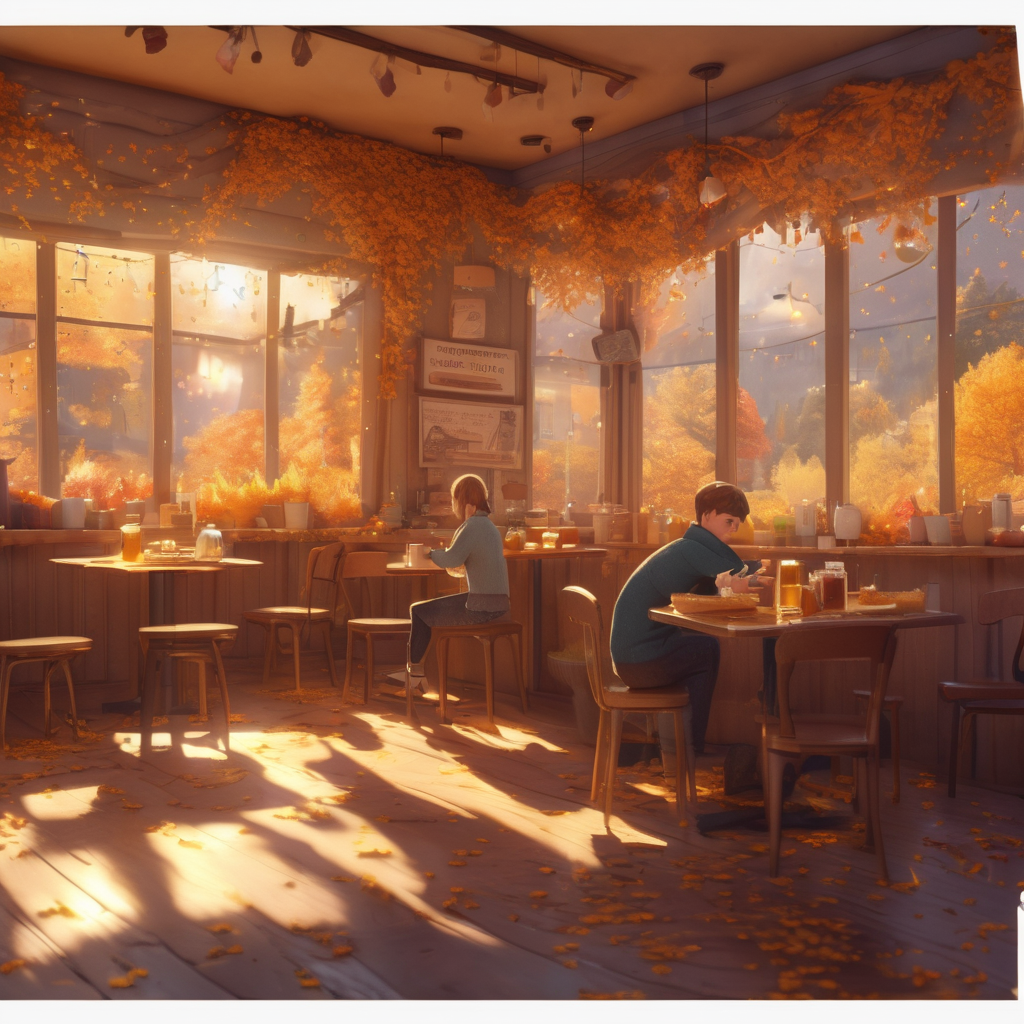
Every autumn at precisely 3:17 PM, the town of Millhaven loses an hour. Not in the way of daylight saving time, where clocks spring forward or fall back in neat, predictable increments. This is different. This is the Vanishing Hour, when time itself seems to fold inward like origami made of moments, and sixty minutes simply cease to exist.
Elena discovered this phenomenon three years ago when she first moved to Millhaven to escape her crumbling marriage in the city. She had been sitting in Rosemary’s Café, stirring honey into her chamomile tea while watching leaves spiral past the window in shades of amber and crimson. The wall clock read 3:17 PM when the world seemed to shimmer, like heat waves rising from summer asphalt. When the shimmer faded, the clock showed 4:17 PM, her tea had gone cold, and the barista was sweeping up leaves that had somehow blown inside despite all the windows being closed.
At first, Elena thought it was stress-induced dissociation, a side effect of her recent divorce and the anxiety medication she’d been prescribed. But as autumn deepened and the Vanishing Hour continued its daily occurrence, she began to notice that everyone in town seemed to accept it as naturally as they did the changing seasons.
Mrs. Patterson, who ran the antique shop next door, would set her grandmother’s pocket watch aside every afternoon at 3:15 PM. “No sense in letting it get confused,” she’d say with a knowing wink. The school dismissed children ten minutes early during autumn months without explanation. Even the church bells remained silent during that mysterious gap in time.
Elena became obsessed with documenting what happened during the lost hour. She tried setting multiple alarms, keeping detailed journals, even installing a security camera in her apartment. But every attempt yielded the same result: a blank space where memories should be, like trying to recall a dream after waking.
It wasn’t until she met Oliver that she began to understand the true nature of Millhaven’s temporal anomaly.
Oliver was new to town too, a photographer who had come to capture the famous fall foliage that drew tourists from across the country. He was tall and slightly awkward, with paint-stained fingers from his side hobby of restoring vintage cameras, and eyes the color of October sky. They met when he accidentally ordered her usual drink at Rosemary’s—chamomile tea with honey, extra strong.
“I’m sorry,” he said, sliding the cup across to her. “I’m still adjusting to small-town rhythms. In Chicago, everything moves so fast you barely have time to breathe, let alone notice what other people are drinking.”
Elena smiled. “Here, you’ll find we have plenty of time. Sometimes more than we know what to do with.”
They began meeting daily at the café, sharing stories about their former lives and their reasons for seeking refuge in Millhaven. Oliver had left Chicago after his photography studio burned down in a kitchen fire, taking with it years of work and all his savings. Elena told him about her divorce, about the way her ex-husband had gradually erased her from their shared life until she felt like she was disappearing even while standing right in front of him.
As the leaves reached their peak brilliance, Elena found herself looking forward to more than just their conversations. Oliver had a way of seeing beauty in forgotten things—abandoned barns, rusted weather vanes, the way afternoon light caught dust motes dancing in the air. When he looked at her, she felt seen in a way she hadn’t experienced in years.
One Tuesday afternoon, as they sat sharing a piece of apple pie while Oliver showed her contact sheets from his latest shoot, Elena decided to tell him about the Vanishing Hour.
“You think I’m going to believe that?” Oliver laughed, but not unkindly. “Time doesn’t just disappear.”
“Stay with me today at 3:17,” Elena said. “See for yourself.”
Oliver’s expression grew more serious as he studied her face. “You really believe this.”
“I’ve been here three years. It happens every day from the first leaves changing until the last ones fall. An hour just… vanishes.”
At 3:15 PM, they positioned themselves at Elena’s favorite corner table, Oliver’s camera ready, Elena’s notebook open. The café buzzed with its usual afternoon energy—Mrs. Patterson browsing the day-old pastries, teenagers sharing earbuds and giggling over some social media post, the barista humming while wiping down the espresso machine.
3:16 PM. Oliver reached across the table and took Elena’s hand. His palm was warm, calloused from years of gripping camera equipment.
3:17 PM.
The world didn’t shimmer this time. Instead, it crystallized, like Elena was seeing everything through the lens of Oliver’s vintage cameras. The café filled with golden light that seemed to emanate from nowhere and everywhere at once. The other patrons continued their activities, but their movements became dreamlike, underwater slow.
And then Elena saw them—translucent figures moving through the space like double exposures on old film. They wore clothes from different eras: Victorian mourning dress, 1920s drop-waisted dresses, 1950s circle skirts, and styles Elena couldn’t identify. They drifted between the tables, some sitting in chairs that overlapped with the living customers, others standing by windows that showed different seasons, different years.
“My god,” Oliver whispered. “Do you see them too?”
Elena nodded, her throat tight with wonder. An elderly man in a Union Army uniform sat at the counter, drinking coffee that produced no steam. A young woman in a flapper dress danced alone to music only she could hear. Children in old-fashioned knickers played with toys that cast no shadows.
“They’re all here,” Elena breathed. “Everyone who ever lived in Millhaven. Every autumn, they come back for an hour that belongs to them.”
As Elena watched, she realized the translucent figures weren’t just randomly occupying space—they were reliving moments. The soldier was meeting his wife after returning from war. The flapper was celebrating her engagement. The children were playing games their great-grandchildren had forgotten the names of.
“It’s not a vanishing hour,” Oliver said softly, his photographer’s eye taking in details Elena had missed. “It’s a returning hour.”
A woman in 1960s attire walked past their table, and Elena gasped as she recognized her—it was her own grandmother, young and vibrant, carrying a suitcase and looking around the café with the wide-eyed wonder of someone seeing a new place for the first time. Elena’s grandmother had mentioned once that she’d passed through a small town on her way to meet Elena’s grandfather, had stopped for tea at a little café and felt like she could have stayed forever.
“Grandma Rose,” Elena whispered, but the figure didn’t respond. She was living in her own moment, in her own time.
More figures appeared—some Elena recognized from old photographs in the town historical society, others were complete strangers who had simply passed through Millhaven and left some echo of themselves behind. They overlapped and intersected with the present-day patrons, creating a palimpsest of human experience layered like sedimentary rock.
Oliver raised his camera instinctively, then stopped. “Should I?”
“I don’t think it would capture anything,” Elena said. “This isn’t about documenting. It’s about witnessing.”
They sat in awed silence, hands still intertwined, as decades of autumns played out around them. Elena began to understand why the townspeople accepted the Vanishing Hour so readily. It wasn’t lost time—it was found time, moments that had been treasured so deeply they refused to fade completely.
A couple at a table near the window caught Elena’s attention. The woman wore a 1980s wedding dress, pearl buttons gleaming, while the man was in a simple brown suit. They were holding hands across the table just as Elena and Oliver were, their faces glowing with new love. Elena watched as the ghostly groom pulled out a small wrapped box and placed it between them.
“Our first anniversary,” the translucent bride mouthed silently. “Already.”
Elena felt Oliver’s thumb stroke across her knuckles and realized that someday, perhaps, they too might become part of this autumn return. Future visitors to Rosemary’s Café might see their own translucent forms, sitting at this corner table, falling in love during a mysterious hour when all of Millhaven’s past chose to visit its present.
The golden light began to fade, and the ghostly figures grew dimmer. Elena’s grandmother picked up her suitcase one last time, smiled at something Elena couldn’t see, and walked toward the door, fading with each step. The soldier finished his coffee and stood to embrace a woman who appeared just long enough to hold him. The children gathered their phantom toys and skipped away into whatever realm holds cherished memories.
As the last of the translucent visitors faded, the normal sounds of the café returned—the hiss of the espresso machine, the clink of dishes, teenage laughter. Mrs. Patterson was paying for a scone, the same scone she’d been contemplating an hour ago.
Elena looked at the clock: 4:17 PM.
“Did we just lose an hour,” Oliver asked, “or find one?”
“Both,” Elena said. “I think that’s the point.”
Oliver lifted their joined hands and kissed her fingers gently. “I think I understand now why you came here. Why we both did.”
Elena nodded, watching the ordinary Tuesday afternoon unfold around them. “Sometimes you have to disappear from your old life to discover what’s worth keeping.”
Outside, the autumn wind sent leaves spiraling past the windows in shades of gold and crimson, each one a small reminder that some things are more beautiful for being temporary, and some moments are too precious to truly vanish, even when time itself seems to fold them away.
Tomorrow at 3:17 PM, it would happen again. And Elena knew that now, instead of trying to document or understand the Vanishing Hour, she would simply experience it. She would sit with Oliver and witness the layers of love and loss and ordinary magic that made up the true history of any place where people had chosen to pause, to rest, to fall in love over chamomile tea with honey.
After all, the most important moments weren’t the ones you could capture—they were the ones that captured you.

Leave a Reply