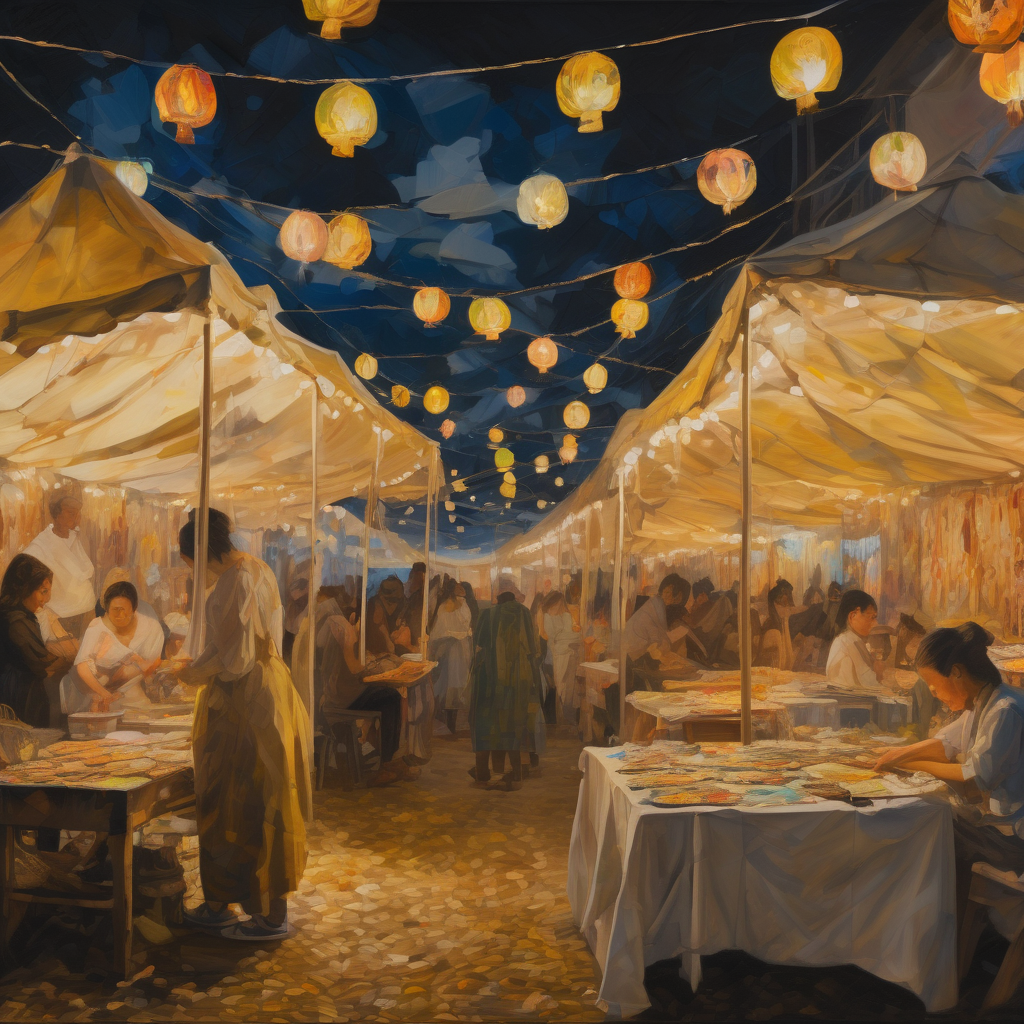
The canvas arrived at my door wrapped in butcher paper and twine, smelling of lavender and turpentine. Mother had been gone three months, but her lawyer said she’d left specific instructions: this painting was to come to me only after the autumn equinox, when the light turned golden and thin.
I unwrapped it in my kitchen, where Mother had taught me to grind pigments from beetles and berries, back when I still believed in her particular brand of magic. The painting showed a night market I’d never seen—paper lanterns strung between buildings that seemed to breathe, vendors selling impossible things. In the foreground, a woman in a fox mask held out her hand, offering something wrapped in silver paper.
That night, I dreamed of Mother’s studio, but the walls had dissolved into mist. She stood at her easel, painting with brushes made from comet tails. “Every artist leaves one door open,” she said without turning around. “You just have to find the right hour to walk through.”
I woke at three in the morning to find the painting glowing softly in the moonlight. The fox-masked woman had moved—her hand was now extended further, as if reaching through the canvas itself. The silver package in her palm caught the light like a beacon.
My grandmother had warned me about Mother’s paintings. She’d been a sensation in Prague before the war, creating portraits that supposedly captured more than just appearances. Collectors whispered that her subjects would age while their painted selves remained young. The sustainability of such magic was questionable, Grandmother said, but Mother never listened to warnings about the cost of borrowed time.
I touched the painted hand, and my fingers passed through the canvas as if it were water.
The night market materialized around me in scents first—star anise, burnt sugar, something metallic and old. The fox-masked woman lowered her hand and gestured for me to follow. We walked past stalls selling bottled moonlight and memories pressed between glass plates like flowers. A vendor called out, advertising “solutions to problems you haven’t had yet,” while another offered to trade three minutes of tomorrow for five minutes of yesterday.
At the market’s edge stood a tent made of paintings—hundreds of Mother’s canvases stitched together with golden thread. Inside, she sat at a low table, playing cards with three other women, all wearing different animal masks.
“You’re late,” Mother said, not looking up from her hand. “But then, you always were cautious. Unlike your sister.”
“I don’t have a sister.”
“Not anymore.” She laid down her cards—all queens, painted in her distinctive style. “She came through a different painting, years ago. Chose to stay. The market needs painters, you see. Artists who understand that reality is just another medium to work with.”
The fox-masked woman removed her mask, and I saw my own face, aged by decades, scarred by experiences I’d never had.
“That’s one possible you,” Mother explained. “The one who came through during the spring equinox of 1987. She’s been helping me run the market ever since.”
“You’re dead,” I said. “The cancer—”
“Death is surprisingly negotiable here. Everything has a price, but not always the price you’d expect.” She stood, finally meeting my eyes. “I painted this door for you, daughter. The world is changing faster than it can sustain itself. Soon, there will be crises you can’t imagine—wars over water, air that costs money to breathe, memories that can be stolen and sold. But here, in the spaces between painted things, we’re building something different. A refuge. A resistance.”
She held out a brush, its handle carved from what looked like crystallized smoke.
“Stay,” she said. “Learn to paint doors for others who’ll need to escape. Or go back, and forget this was ever possible.”
I thought of my empty apartment, my data entry job, the dating apps I scrolled through without ever messaging anyone. Then I looked at my older self, the fox-woman, who had clearly lived a larger life than I could imagine.
“What happened to the others who came through?” I asked.
Mother smiled, the first genuine smile I’d seen from her since before her diagnosis. “They became the market. Every vendor, every impossible thing sold here—they’re all artists who understood that creation doesn’t stop at the canvas edge.”
I took the brush. It weighed nothing and everything.
“Teach me,” I said.
Mother led me to a blank canvas taller than a door. “Paint what the world needs,” she said. “Even if it doesn’t know it needs it yet.”
I dipped the brush in colors that had no names, and began to paint a door for the next person who would need to choose between the world that is and the world that could be. Somewhere in the distance, I heard the market’s bells ringing, calling customers to browse tomorrow’s possibilities today.
The last thing Mother painted wasn’t just a door—it was an invitation to continue her work, creating exits for those who needed them, one impossible brushstroke at a time.


Leave a Reply