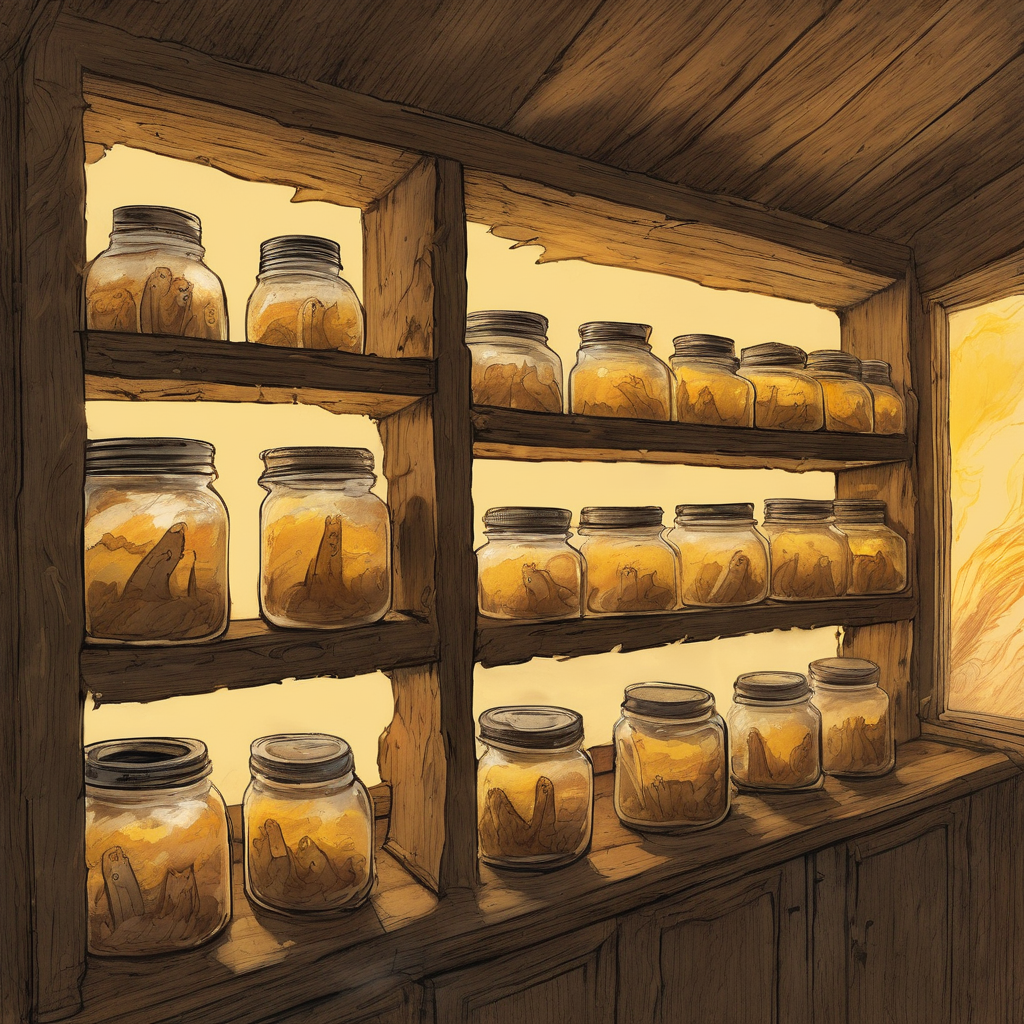
Marlowe discovered the first jar while renovating her grandmother’s attic, tucked behind a beam where decades of dust had settled like powdered sugar. Inside floated dozens of teeth—not the pristine baby teeth she expected, but molars yellowed with age, canines sharp as needles, and incisors that seemed to gleam with their own inner light.
The handwritten label read: “Liars, 1952-1967.”
Her hands trembled as she set the jar down and reached for another. “Cheaters, 1968-1983.” Then another: “Those Who Break Hearts, 1984-1999.” The collection filled an entire cabinet she hadn’t noticed before, organized with the precision of a museum curator.
Marlowe had always known her grandmother was eccentric. The old woman claimed to work “night shifts” well into her eighties, disappearing after dark with a leather satchel and returning before dawn smelling of mint and something metallic. When pressed about her job, she’d only wink and say she was “in collections.”
At the back of the cabinet, Marlowe found a leather-bound journal filled with her grandmother’s spidery handwriting:
*The child’s sin determines the toll. A small lie costs a premature molar. Cruelty demands the wisdom teeth, taken decades early. The worst offenders pay with teeth that haven’t grown yet—ghost teeth, pulled from future mouths through borrowed pain.*
The entries grew more elaborate, describing a vast network of collectors, each assigned different territories and types of transgressions. Her grandmother’s specialty had been “moral decay”—the slow erosion of conscience that left children susceptible to larger sins.
*The money under the pillow is just theater,* read one entry. *What matters is the exchange. Their innocence for our intervention. Better to lose a tooth than lose one’s soul.*
Marlowe turned the page and found pressed flowers alongside sketches of root structures that looked disturbingly like tiny hands reaching downward. Maps marked houses throughout the city, connected by red thread to newspaper clippings about missing children, about adults who’d committed terrible crimes, about families torn apart by secrets.
A note in the margin caught her eye: *Marlowe, age 7, lost all four wisdom teeth to protect the Morrison boy. She’ll understand someday.*
She remembered that week vividly—the inexplicable jaw pain, the dentist’s confusion at her premature tooth loss, and how her childhood crush Tommy Morrison had suddenly stopped bullying the smaller kids at school. She’d assumed it was coincidence.
The final journal entry was dated just three months ago: *Collection routes need new management. Marlowe has the gift—I can see it in how teeth respond to her presence. The satchel is in the hall closet. First assignment in the front pocket.*
Marlowe’s mouth ached as she read, her tongue probing the spaces where wisdom teeth should have been. In the distance, she could hear the whispered pleas of children calling for the tooth fairy, their small voices carried on wind that shouldn’t exist in a closed attic.
The satchel waited exactly where the journal promised, worn smooth by decades of handling. Inside, she found silver pliers that hummed with warmth, mason jars labeled with tomorrow’s date, and a folded paper with an address across town.
Below the address, her grandmother had written: *The Patterson girl, age 8. Spreading rumors that will destroy her teacher’s marriage. Intervention required before permanent damage sets in. Take the left lateral incisor—it’s already loose from guilt.*
Marlowe closed the journal and shouldered the satchel. The work would be difficult, but necessary. Someone had to tend the balance between innocence and consequence, between the teeth children willingly placed under their pillows and the ones that needed collecting for the greater good.
As she climbed down from the attic, her footsteps echoed with the weight of inherited purpose. Outside, the sun was setting, and soon the real collection would begin.


Leave a Reply