The floorboards above Margot’s bed had been creaking for three weeks now, always at the same ungodly hour. She’d inherited the Victorian row house from her great-aunt Delphine, who’d warned her about the peculiarities but never mentioned anything about nocturnal serenades filtering through hundred-year-old wood.
At first, Margot thought it was the pipes. Then mice. Then her neighbor’s tendency to binge true crime podcasts at inappropriate hours. But when the humming started—a low, mournful tune that seemed to bubble up from the earth itself—she knew something else was happening.
The melody was always the same: seven notes that repeated like a broken music box, accompanied by what sounded like fingers drumming against wood. Sometimes there were words, though Margot could never quite catch them. They seemed to slip away like mercury whenever she strained to listen.
On this particular night, armed with sage she’d bought from a wellness influencer’s popup shop and a flashlight that kept flickering despite fresh batteries, Margot decided to investigate. The crawlspace entrance was hidden behind a false panel in the pantry, another of Aunt Delphine’s secrets revealed only in her posthumous letter.
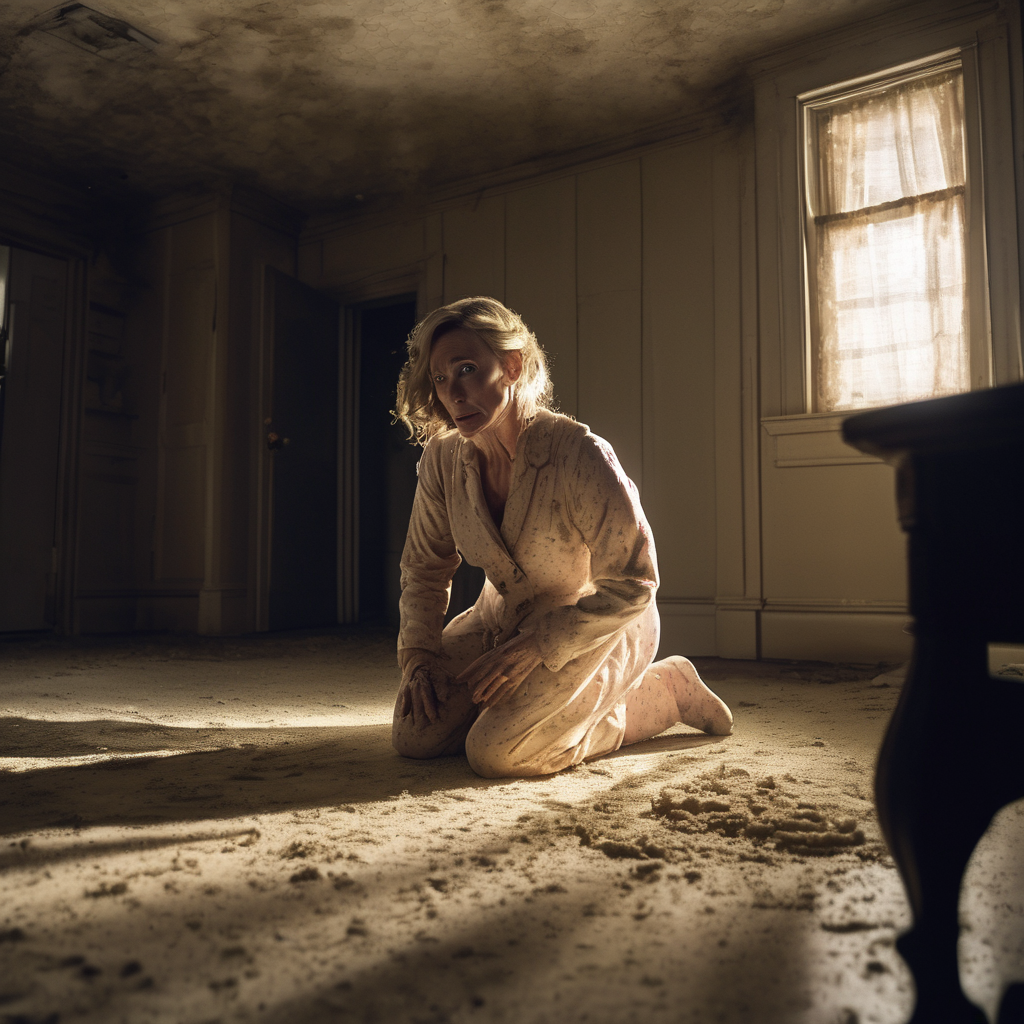
The door was smaller than expected, painted the same buttercream as the walls. Margot had to drop to her knees and shuffle forward, the beam of her light cutting through decades of dust that rose like tiny ghosts. The space opened up after a few feet, tall enough to crouch but not stand. Spider silk brushed her face like phantom fingers.
That’s when she saw her.
The woman sat in the corner where two foundation walls met, her back perfectly straight despite the cramped quarters. She wore a dress that might have been blue once but had faded to the color of old bones. Her hair fell in long, dark ribbons that seemed to move independently of any draft. She was knitting something shapeless with needles that caught no light.
“You’re early,” the woman said without looking up. “It’s only 2:43.”
Margot’s throat went dry. “Who are you?”
“I was Sarah Whitmore. I lived here in 1897. I had three children and a husband who worked at the textile mill.” The needles never stopped moving. “I died in childbirth with the fourth. They buried the baby with me, but I stayed here. Mothers don’t leave.”
“That’s impossible.”
Sarah finally looked up. Her eyes were the color of tarnished silver, reflecting nothing. “Is it? You still check your phone when you hear crying at the grocery store, even though your daughter is thirty-two and lives in Portland. Your body remembers what your mind tries to forget.”
Margot’s hand instinctively went to her stomach, to the scar from her emergency c-section decades ago. “How do you know about Emma?”
“Mothers know mothers. We recognize the particular way our bodies have been reorganized by love.” Sarah’s needles clicked faster. “I sing to my children every night at 3:17. That’s when the youngest would wake, hungry. Time means nothing here, but habits are eternal.”
“Your children… they’re not here anymore.”
“No. They lived their lives. Became teachers and sailors and one died in the Spanish flu. But I sing anyway. The house remembers them. These walls absorbed their laughter, their tears, their first words. I’m keeping those echoes alive.”
Margot found herself sitting down, the concrete cold through her pajamas. “What are you knitting?”
“Potential futures. Things that might have been. My fourth child would have been a daughter. She would have invented something important—I can feel it in the stitches. So I knit her possibilities into existence, even if they can’t leave this space.”
The flashlight flickered again, throwing wild shadows that looked like children playing. Margot could almost hear them—the ghost of footsteps running overhead, a ball bouncing, someone calling for mother.
“Aunt Delphine knew about you.”
Sarah smiled, and it was surprisingly warm. “Delphine brought me tea sometimes. Earl Grey with honey. She understood that some hauntings are acts of love.”
“Why 3:17 exactly?”
“That’s when I died. But also when I became eternal. The midwife marked the time. Said I fought for seventeen minutes after three, trying to stay for them.” The knitting grew longer, an impossible scarf of years unlived. “Would you like to learn the song?”
Margot knew she should leave, should call someone, should be terrified. Instead, she found herself nodding.
Sarah began to hum those seven notes, and Margot understood they weren’t mournful at all. They were a lullaby, worn smooth by repetition like river stones. The words came naturally, as if she’d always known them, as if every mother throughout time had known them—a promise to return, to comfort, to never truly leave.
When Margot finally emerged from the crawlspace, dawn was breaking through the kitchen windows. She made two cups of Earl Grey with honey and brought one back down. Sarah was gone, but the knitting remained, just a few rows of something that might have been the beginning of a blanket.
That night, at 3:17, Margot heard the singing again. This time, she sang along from her bed, adding her voice to the chorus of mothers who refuse to leave, who transform their grief into guardian songs, who understand that love doesn’t end just because breathing does.
The house settled around her, content, keeping its secrets and its promises. In the walls, children who had long since grown old and passed on stirred in their spectral sleep, soothed by lullabies that transcended death, sung by mothers who couldn’t let go and perhaps never should.
Emma called the next morning, unprompted, just to say hello. She’d had the strangest dream, she said, about being rocked to sleep by someone who smelled like Earl Grey and dusty roses.
Margot smiled, looking at the pantry door. “Must run in the family,” she said, and meant it.


Leave a Reply